A menu is every restaurant’s invaluable selling document, as I argue and illustrate in my book On The Menu published by Unbound in 2016 at £30.
But in an industry where there are so many moving parts, the menu fulfils another important feature: it is the lynchpin, a fixed point that allows the restaurateur, as well as the chef, to impose a certain amount of control. Write a short menu; limit the amount of options that are available to even the most adventurous of customers; and you can impose some form of control over what and when your customers can and will order.
Indian restaurants, and their restaurateurs, have long ignored this maxim of the business. Their menus are invariably long and often complex, which is not a source of concern in the hands of the less scrupulous but a constant source of anxiety to those restaurateurs who aim high and have a strong sense of moral responsibility.
Shamil Thakrar is one such committed restaurateur. Born to Indian parents in Uganda, he was promptly kicked out of the country with his family by Idi Amin and as a baby he spent some time with his mother in India before being summoned by his father to a then more tolerant and welcoming United Kingdom. Having settled his family in Leicester, his father went on to establish – with his brother, Shamil's uncle – Tilda Rice, a company that they sold in 2014 for a reputed £250 million.
By this time Shamil and his cousin Kavi were on the verge of opening their third Dishoom restaurant in London.
The first, in Covent Garden, had proved extremely successful; their second in Shoreditch, even more so; and they were just about to open in King's Cross. They have since gone on to open in Kingly Street and in the old Biba building off Kensington High Street as well as in Edinburgh. Dishoom Manchester will open in a former Masonic hall on 6 December with a site earmarked for the Argent (their landlords in King's Cross) redevelopment in Birmingham in 2019.
This has led to Dishoom becoming a restaurant and business success that has far exceeded their founders’ expectations, success that owes its origins to a variety of different factors.
The first, and probably most important, has been that this success was just waiting to happen. The authentic nature of Dishoom's Indian food plus the relaxed service style met a wave of young and enthusiastic customers whose taste buds were ready for excitement and who were ready to move on to the next stage on the spice dial. Instead of being confronted by older Indian waiters in white shirts and bow ties, today’s customers are looked after in Dishoom by young men and women who can only be differentiated from the customers by an earpiece or an apron – and certainly not by their tattoos.
The success of Dishoom has coincided with another change in our eating habits – the fact that choosing an Indian restaurant, in which unquestionably spicy food will be enjoyed, is no longer a ‘no go area’ for business lunches. I can still recall the era when this was the case, when suggesting meeting for a spicy lunch was something that was to be done only between the closest of friends. But the increasing popularity of restaurants such as Brigadiers in the Bloomberg Arcade, Gymkhana in Albermarle Street, Chutney Mary in St James’s Street, Kricket and the multiple branches of Masala Zone has changed all that.
But Dishoom has also had one effect above all others – it has made an Indian breakfast an event. This idea, which Shamil modestly attributed to the creative genius of Manchester-born Robbie Bargh of The Gorgeous Group, who has been a consultant and friend to Dishoom since its inception, has been a phenomenon.
At 9.30 am last Saturday at Dishoom in King’s Cross, to which most customers will have had to make a reasonably long walk from either of the two closest tube stations, the restaurant was packed. By 12.20 pm later that day there was the usual queue of customers outside waiting for a table for lunch.
The two pages of the Dishoom breakfast menu, which correctly uses boxes to guide the eyes but could be improved by the use of colour, is a clever mixture of the tried and tested and the unexpected. Date and banana porridge, yoghurts and house granola fall into the former category, a bacon and egg naan roll, kerjiwal, fried eggs on chilli cheese toast into the latter. Suppliers are credited. And the language harks back to Indian English: 'no poppycock' under the fresh juice heading; 'keep regular' alongside the delicious breakfast lassi; and the phrase ‘all who have tried it are swearing by it’ by their extremely popular house chai.
As a result, Dishoom has achieved restaurant nirvana, the state of being extremely busy for breakfast, lunch and dinner seven days a week. In fact, during October 2018, the six branches of Dishoom served a total of 221,923 meals to their customers, an extraordinary total which equates to around 1,200 customers per branch per day! And this in a business where the average bill is around £10 for breakfast; £20 for lunch and possibly reaches a high of £30 per head in the evening.
I know this precise total because it is up on the screens at Dishoom HQ in Shoreditch. This is a figure that Shamil and Kavi are proud to broadcast because it means that this is the number of meals Dishoom will donate to one of two charities, Magic Breakfast in the UK and Akshaya Patra in India, both of which are organisations providing nourishing free meals to schools in their respective countries.
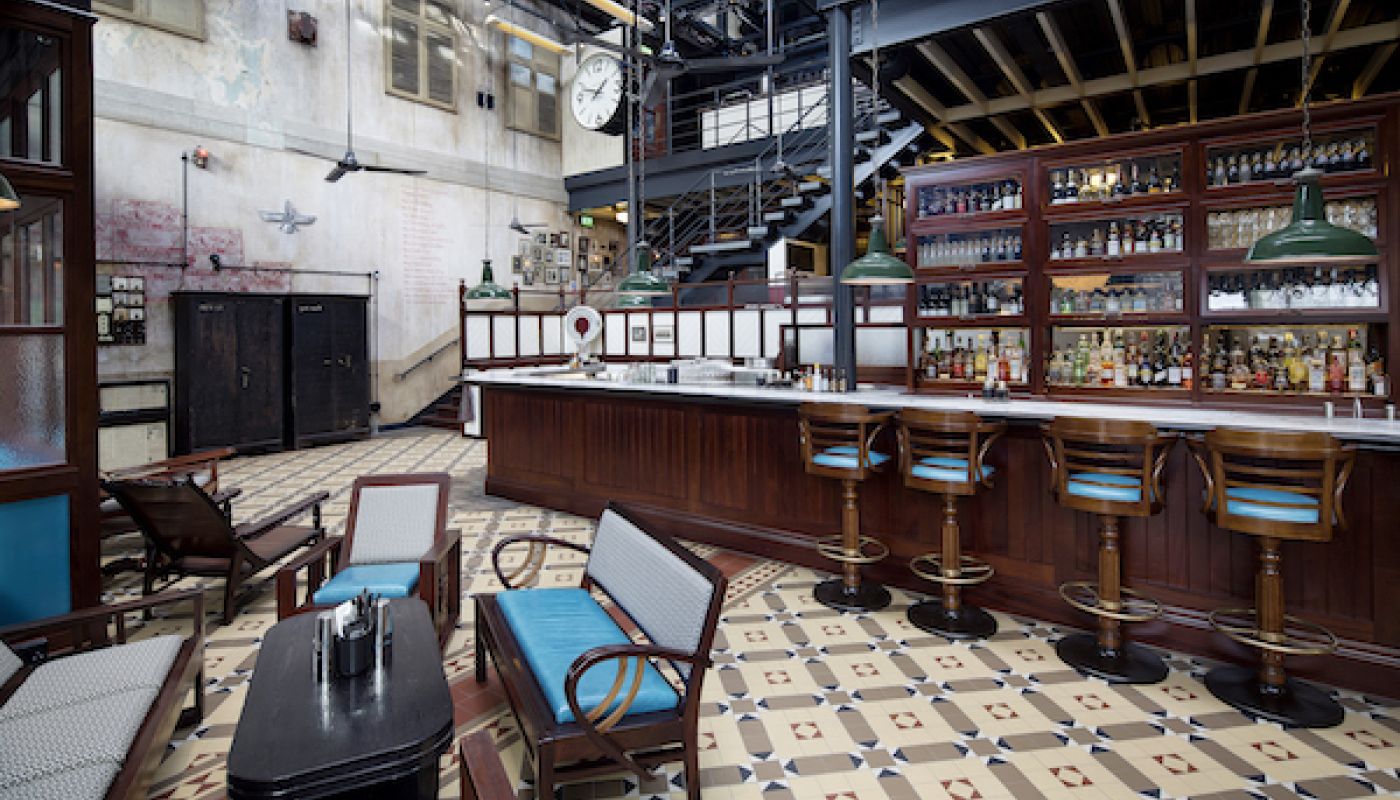
This is just one aspect of what drives these two cousins in their unusual management of what has become an unusually successful restaurant company, a company inspired by the faded elegance of the old Irani cafés that they remember visiting when they grew up in Bombay. Faded family sepia portraits on the walls; ceiling-mounted fans; bentwood chairs; and a slogan ‘From Bombay With Love’ that is so effective and memorable that no advertising agency could ever dream it up. (There were over 400 Irani cafés in Bombay in the 1960s but today fewer than 30 remain.) Above is the entrance to the King's Cross Dishoom; below is the Shoreditch branch.)

But Shamil, a worrier, is never satisfied and he quite rightly believes that it is incumbent upon him, while leaving the organisational detail to his cousin, to ensure that the almost 1,000 staff are motivated, looked after and cared for in the best possible manner. This is an approach that manifests itself in several different ways.
The first is in the management slogan ‘Deepen, don’t dilute’, referring to inter-staff relationships, which exemplifies how Shamil and his senior management look on their working relationship with their staff. Only if they do this, Shamil believes, can the staff do their job properly and the customer be treated appropriately. And only if they do this, can he, the man who created this brand, be reassured that every customer receives the food, drinks and wine – the moving parts of any menu – in the correct order at the appropriate time.
The second is a single piece of typewritten paper headed ‘At Dishoom, We Have a Core Belief about Humanity’, a principle enshrined in Sikhism of performing service without any notion of a subsequent reward. This is explained on the reverse by a list of six key behaviours that distinguish the excellent practitioners of Seva:
- Make eye contact and greet everyone before they greet you. Start every interaction with warmth.
- Be generous in everything you do. Keep asking, how can I help?
- Show gratitude and appreciation before every interaction.
- Start with exceptional groundwork and preparation. Anticipate the challenges and get ahead of them.
- With a beginner’s mind, find the issues. Fix them and figure out how to keep them fixed.
- Never compromise on quality. Seek tough feedback and raise your game every day.
As I said goodbye to Shamil, he stopped by a desk and pointed to an award that he said he was most proud of, his company’s high-ranking recognition in last year’s Sunday Times list of the 100 Best Companies to Work for in 2017.
And as Danny Meyer, the highly successful New York restaurateur, once told me, 'My job is not so much to look after my customers as my staff. If I ensure that they are happy and smiling, they will ensure that my customers leave my restaurants feeling exactly the same.' Being a perfectionist is another prerequisite to being a successful restaurateur.
Dishoom www.dishoom.com