Initially, it appeared like a very one-sided contest.
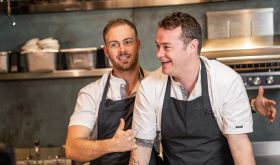
On one side of the swing door was Yan Tak, the highly talented chef of Lung King Heen (View of the Dragon) in charge of a brigade of 28 chefs at the dim sum restaurant in the Four Seasons Hotel in Hong Kong to which Michelin awarded three stars last year.
On the other side and around my table were two women, one Hong Kong Chinese, the other Korean, whose elegant attire and thin waists masked voracious appetites, and an equally well-dressed Hong Kong businessman, simply described to me as ‘one of the very best private Cantonese chefs living here’.
But before describing the course-by-course outcome of this contest, let me get a few preliminaries out of the way.
Firstly, we were to prove to be, albeit unintentionally, ‘the table from hell’. The reservation had been made for eight of us at 12.30 in the restaurant’s private room and the table had been set up precisely to accommodate this number. But this was Saturday lunch and so several phone calls were made and received before eventually only five of us sat down at 13.15, which was the signal to the kitchen for lunch to begin. A sixth guest arrived at 13.30 and a seventh at 13.45. Finally at 13.50 two more arrived to make a total of nine. While the restaurant staff coped with all this admirably, this was just another example of why I am glad not to be a restaurateur any longer.
But I managed to put the intervening period to good use by listening to Bobby, the restaurant’s experienced sommelier, on how he tries to overcome the particular challenges of matching Chinese food with wine.
Small and with a gentle, expressive face, he spoke softly as he explained that unlike Western food (and he worked in Caprice, the hotel’s highly regarded French restaurant for several years) where the flavours progress from light to heavy, in Chinese cuisine there is no such linear progression and the weight of the flavours varies far more from course to course. Rather than just going from white to red his solution is to open both the red and the white wines at the beginning of the meal to allow the interested guests to follow the opportunity to follow their own preferences
This promptly leads to a collision course with everything else that is on the table. Chinese food requires far more on the table than a typical Western meal: condiments, crockery, chopstick rests and spoons, not to mention the Lazy Susan that may take up most of the table so the table is crowded even before both wine glasses, and of course a water glass, are deployed. And, finally he added, with a sigh, “Chinese food is also served much more quickly than Western food so I have to have staff who can move around the tables swiftly, watching to see which wines may need topping up and doing so very, very carefully.”
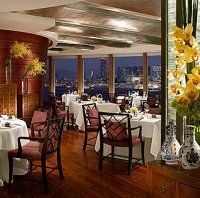
While I was jotting down these pearls of wisdom, my mouth kept falling open. This was less to do with the menu on the table, however appetizing it looked, and all to do with the view out of the window. The Four Seasons has been built on reclaimed land looking out across the water towards Kowloon and up towards the stretch of water that takes ferries, container boats, tugs and numerous kinds of vessels up the coast to China. Even at Saturday lunchtime this stretch of water was incredibly busy and I had trouble reconciling this bustling view with what I had read on the front page of the South China Morning Post that morning that due to the current slump in demand for containers there is talk of turning Hong Kong’s former airport into a container park.
From all this, I hope it is obvious that Lung King Heen is not a typical dim sum restaurant as we in the West think of them. The views are sensational; there is plenty of room between the tables; the waiting staff are smart, knowledgeable and friendly. But, what of the food?
What lay out in front of us was a seven course menu for which the price was £65 per person. While I was obviously excited, my enthusiasm was as nothing compared to the woman on my left. Although she lives in Hong Kong this was her first visit too and she was raring to go.
Our first course was described as their dim sum combination and consisted of two servings, initially of steamed lobster and scallop dumplings alongside Shanghainese pork dumplings with crab then a duo of baked whole abalone puffs with diced chicken and crisp sesame balls with roasted goose in a spicy plum sauce. This last dish elicited the adjectives ‘yummy’, and ‘very creative’ from the Chinese food expert on my left.
But it was the abalone, an ingredient highly prized by the Chinese, which caused the biggest consternation and discussion as to how it had been prepared. Questions were asked of the waiter who immediately disappeared into the kitchen and came back with the answer that the key was to use canned rather than fresh abalone to attain the consistency that had so impressed this critical audience.
Then came three more dim sum on one plate: a crisp frog’s leg flavoured with spicy salt; a square of barbecued suckling pig topped with caviar and a scallop topped with fresh pear. While the flavour of the latter impressed everyone it was the presentation of the frog’s leg with a ring of deep-fried aubergine at the join of the small leg that most impressed me.
Tak’s practice of combining inexpensive and ultra-expensive ingredients, evident in the combination of caviar and suckling pig, then became even more obvious with the next dish of shark’s fin soup with tofu and fresh crab meat. While I felt incredibly guilty about eating an ingredient that effectively brings an untimely end to the sharks which are caught, shorn of their fins and then thrown back into the sea, the more enthusiastic Chinese’s opinion was that it was simply too salty.
Two courses followed that showed just how good Tak’s brigade is and also revealed the only disappointing course.
The first was a bamboo basket lined with a large green leaf that contained a perfectly steamed, small fillet of garoupa nestling in the most delicious, clear fish stock. It was absolutely first class. Unfortunately, it was followed by a simple dish of bok choi with garlic but this had been over-steamed so that by the time it reached us was rather dry. And covered in too much garlic.
Finally, there appeared a bowl of fried rice with diced roast goose and taro; a delicious bowl of chilled mango, sago and pomelo; and petits fours that included a pink coconut rabbit. I was full.
This was the cue for Yak to come back into the room with a nervous smile on his face, keen to know first of all whether we had had enough to eat or as he put it, “Would we perhaps now like some noodles?” The response was unanimously negative although this was followed by equally enthusiastic comments on all that we had eaten.
As soon as I mentioned to anyone interested in food in Hong Kong that I had been fortunate enough to eat here, the immediate question was always, “Well, is it three star or not?” To which the answer has to be, both yes and no.
Certainly, in both terms of creativity and presentation the answer is definitely yes. The three Chinese food experts round the table were very, very impressed and all expressed their admiration for the vast majority of the dishes they ate. However, one dish and it has to be said the simplest and therefore one would have thought the one that they should have got absolutely right, was overcooked and topped with too much garlic (someone said that with so much garlic this must be a Korean dish!)
But, this aside, Lung King Heen is definitely the most exciting dim sum restaurant I have ever eaten in.
Lung King Heen, Four Seasons Hotel, Hong Kong. www.fourseasons.com
Open for breakfast, lunch and dinner 7 days.