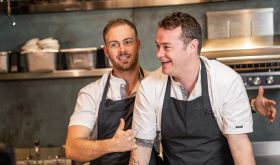
The scene at 6 pm on a Monday evening outside the gates of Pujol, chef Enrique Olvera’s fine restaurant in the wealthy Polanco suburb of Mexico City, brought back memories of the almost stupefied gastronomic enthusiasm I had last seen at El Bulli in Spain 25 years ago.
A crowd of young Americans milled around with their phones, unwilling to say a final farewell. They had just finished lunch, described by one woman as the best and longest meal she had ever eaten, before offering to take our photo, too.
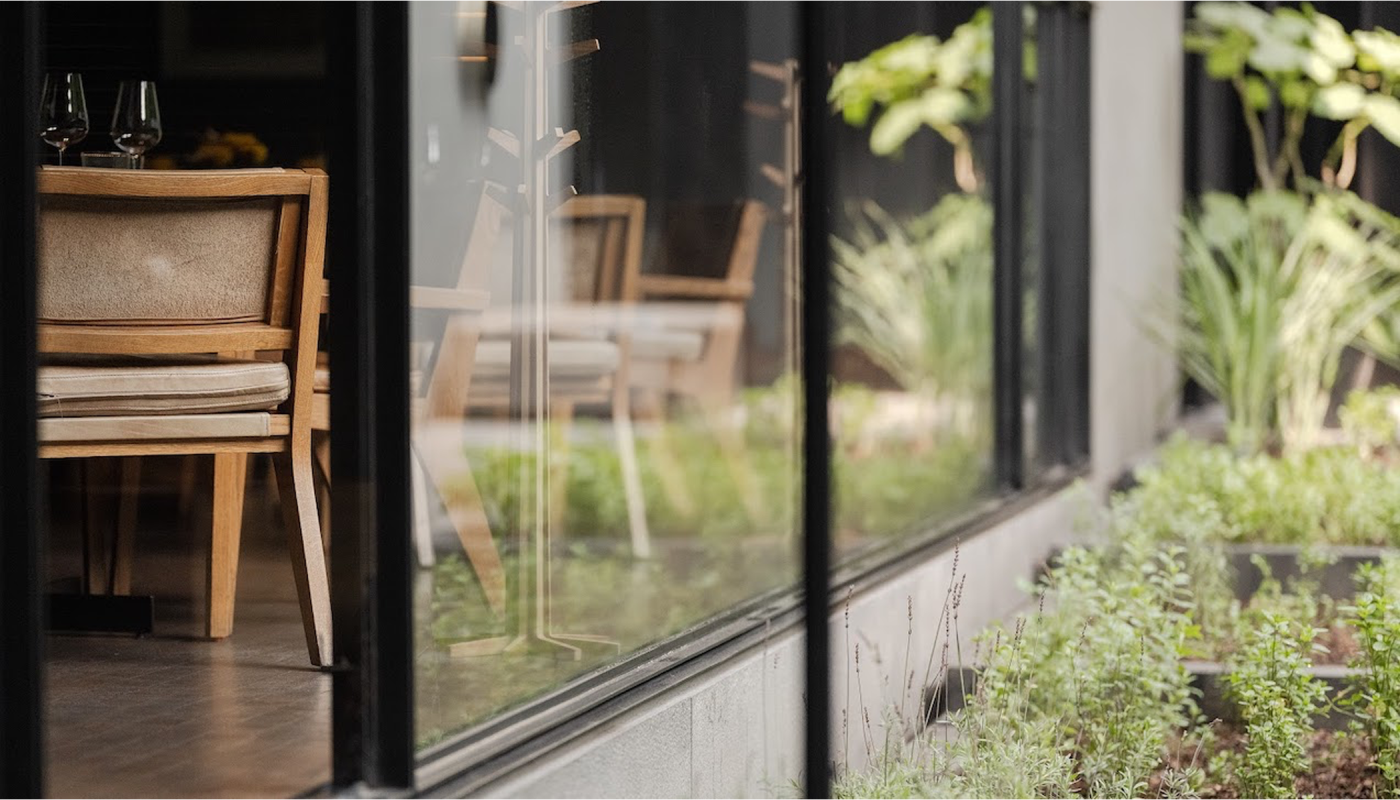
As we walked in, we seemed to change continents. We were suddenly in Japan, with a combination of sleek modern furniture and a carefully designed urban garden (see above). At a series of low tables flanking the way in, guests were just finishing their lunch over tea and coffee.
Once inside, however, we could only have been in Mexico. The sound system was playing – not too loud – catchy Mexican music. The lighting was dim (influenced by the US no doubt). The restaurant was considerably larger than any restaurant of this calibre anywhere in Europe: it must seat close to 70, with 12 seats at the bar.
And there seemed to me at least to be just as many staff. All smiling. All smartly but not uncomfortably dressed, their rank clearly delineated. We were looked after by a perspicacious trio of Roberto, Lucero and Daniel, a thoughtful and knowledgeable manager.
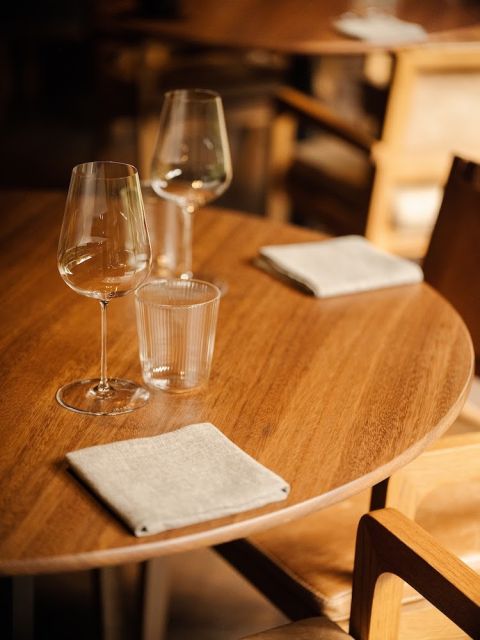
Jancis was surprised and thrilled to see one of her specially-designed wine glasses at every place, thanks to Mexican importers Vinos Enteros.
We were both hungry and thirsty, having eaten a breakfast of coffee and a smoked salmon bagel at 6 that morning in the San Francisco airport, supplemented only by a miniature brownie in our hotel room that afternoon. This meagre intake turned out to be the ideal preparation.
We were seated at a table for four with handbags hung on a wooden stand with ‘arms’ that seems the norm in every smart restaurant in this city (a far more practical solution than footstools). Roberto introduced himself and promptly handed out a copy of that evening’s menu so that all of us were made aware of just what lay ahead. What an intelligent approach, I thought to myself. As we ordered mineral water and our first margaritas, I considered Mexico’s place in the world of restaurants and just where Pujol fits in.
Mexican cooking, despite the writings of Diana Kennedy, has been considered one of the world’s most distinctive only for the past decade or so – long after the renaissance of Spanish, American and British cooking, later than the renaissance of Peruvian, Greek and even Australian cuisine. But this delay seems to have stood it in good stead as so many Mexican chefs seem to have learned from the mistakes and the excesses of their international predecessors. Mexico has a long and glorious tradition of farming, a sunny climate and a unique way with so many indigenous and exceptional ingredients. Pujol, which many identify as firing the starting gun, has been open since 2000 and since 2017 in this location.
The menu, a single piece of paper wax-sealed with a P, revealed a seven-course tasting menu and a price of 2,985 Mexican pesos (£132.20) per person. It was date-stamped and written in English. We read it while enjoying our margaritas, taking in the surrounding tables (many of them occupied by non-Mexicans) and watching waiting staff escorting customers through the garden to the lavatories under umbrellas as the rain intensified. (The garden walk turned out to be optional; the baños can be reached from inside.)
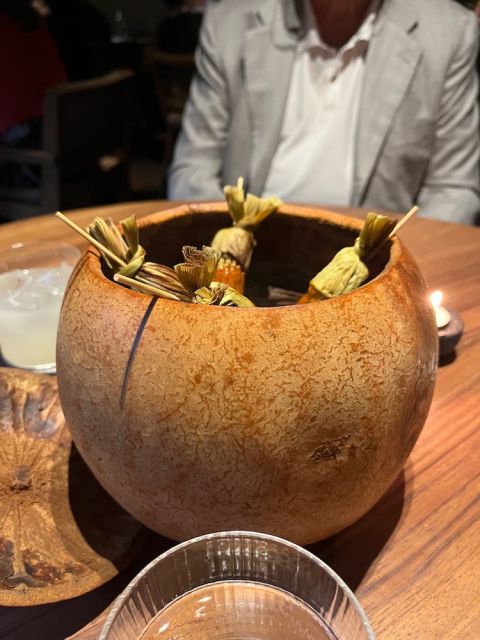
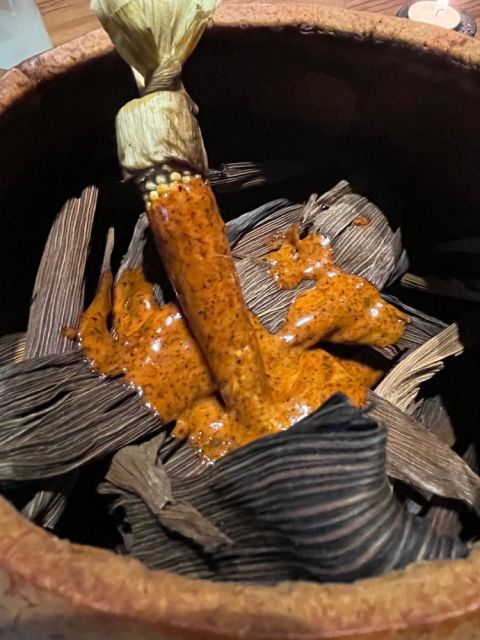
The first course, described as snacks, consisted of two very different dishes and ingredients. The first on our plate was a roll wrapped in nori containing slivers of amberjack and cucumber. Far more stunning was the highly polished gourd that was placed in the middle of the table which contained four thin, young corn cobs that had been coated with a mixture of chocolate, spice and ants (a common Mexican ingredient). These were soon polished off, the corn tasting sweet, but not too sweet; spicy but not too spicy; and with an extra crunch and a final kick at the end.
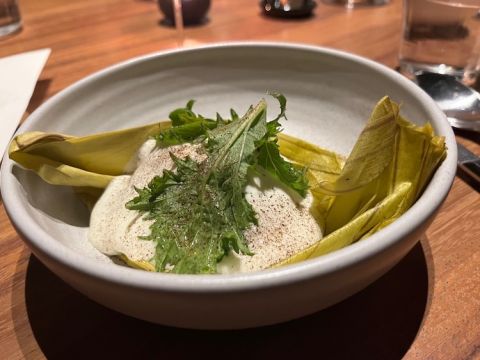
Then came a dish described as a ‘ceviche of conch snail, peas, heart of palm juice’ but what appeared looked more like a small bowl of soup (hurrah!). The key ingredients here were the juice from the hearts of palm which provided acidity; the taste of the sea; and the extremely fresh peas which provided the necessary texture.
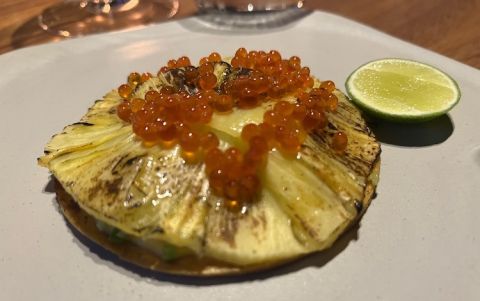
This course was followed by four dishes that served to embody modern Mexican cuisine while drawing on its long history. First came a ‘tostada’, a flat creation of mussels topped with the thinnest slices of grilled pineapple interleaved with avocado, plus the ubiquitous slice of lime. The kitchen had cleverly used a sensational pineapple purée to bind it all together. Then came a dish of bluefin tuna, from the belly of a fish caught off Ensenada where the Pacific waters are at their coldest (as Daniel explained). It had been lightly grilled and served with a sauce of cherry tomatoes and extra-strong capers. The cooking of this dish, and its presentation, cleverly showed off the kitchen's skills.
In the two subsequent dishes were two very Mexican ingredients. Firstly we were served a tamal, the dish made from traditionally nixtamalized corn, in this case stuffed with pumpkin and topped with a salsa macha, a thick and utterly delicious sauce made from peanuts, toasted chili peppers, garlic and sesame seeds. Then came the ‘mole madre’ and the ‘mole nuevo', two circles of the most traditional of all Mexican sauces, usually made from a combination of chilli peppers, spices and nuts. But this is a sauce that can mature and the outer one of our two moles was one begun 3,070 days before (the number had been left blank on our menu and recently filled in). It was a taste that proved too strong for certain members of my party but mixed with the inner younger mole and scooped up with the blue corn tortillas, it proved a fascinating and exciting introduction to traditional Mexican cooking.
We finished with a dish that combined tamarind, guava ice cream and perfect and cleansing slices of fresh guava. The bill was a robust £930 for four without coffee. Jancis chose an Austrian Grüner Veltliner from the first page of one of the best wine lists in Mexico. Our sommelier, without a clear explanation, substituted a more expensive Knoll Federspiel that went extremely well with the first half of the meal but was perhaps a bit too lean for the second half.
Despite this we thoroughly enjoyed the food and the service at Pujol. The meal served as an excellent introduction to the flavours of this new and exciting cuisine. But I have at least two reservations.
The first is that securing a table here is extremely difficult – we had to book weeks in advance. Secondly, while the food is modern Mexican and the waiting staff seem predominantly Mexican, the restaurant draws an international clientele. To see Mexican society at the table, head to the San Angel Inn.
This enormous restaurant, a former monastery built in the 17th century with its own orchard, is well south of the centre of this sprawling city and is opposite the studio built for Diego Rivera and Frida Kahlo. From the outside it appears to be quite normal, with perhaps even more attendants outside than usual for the regular arrival of the armoured cars favoured by the Mexico City elite.
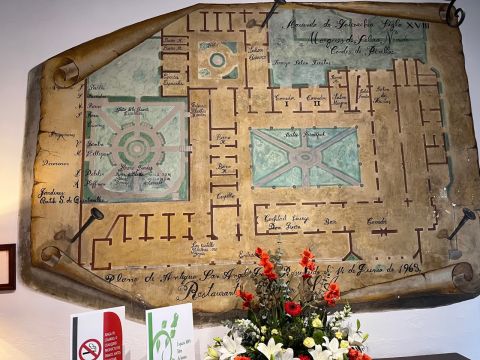
Inside, this building is literally jaw dropping. By the reception area this map gives some idea of the layout. Just inside there is a little chapel on the left and a baroque cocktail lounge on the right – nice juxtaposition.
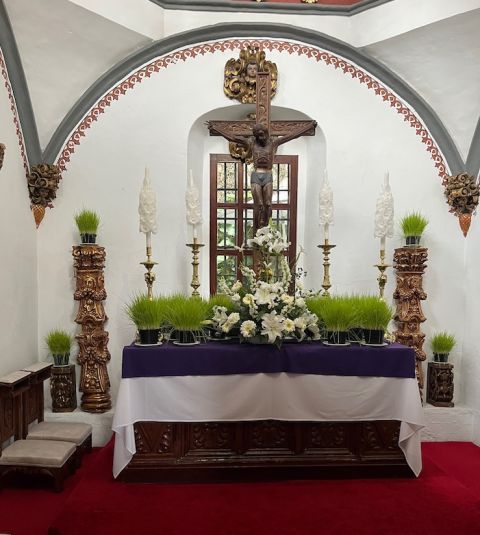
Then what was once presumably a cloister has been transformed into an extensive and inviting patio with smartly tableclothed tables throughout, umbrellas for those in the middle, surrounded by numerous smaller dining rooms, each with its own personality. Then there is a large room with more seating than most restaurants offer, leading out to a vast garden with even more tables round a fountain – and a security man in the distance. We gathered that this restaurant can seat 540!
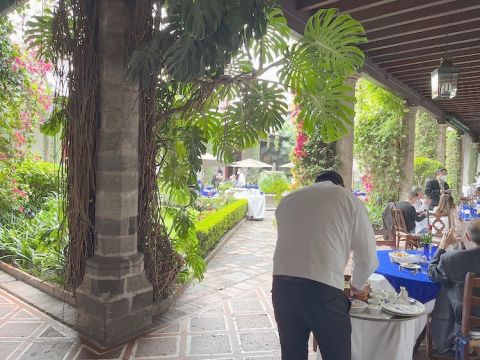
Most of these seats were occupied by the time we left at 2.30 pm. There were tables of families, businessmen and a number of tables occupied by ladies who lunch. The three-piece band playing in the main patio moved later on to serenade us.
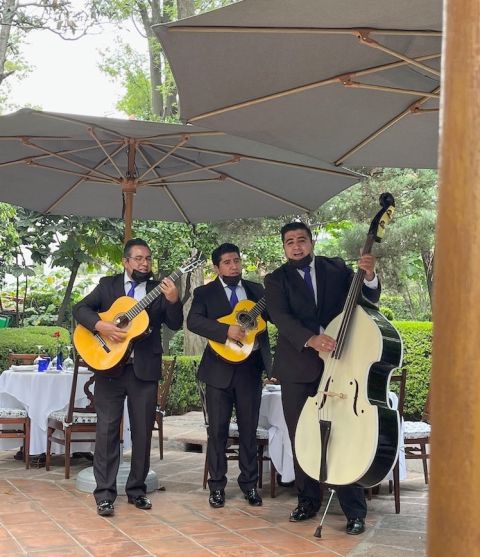
The whole scene was very Mexican (we seemed to be the only non-Mexicans at lunch) and great fun, as everybody seemed to be having a wonderful time.
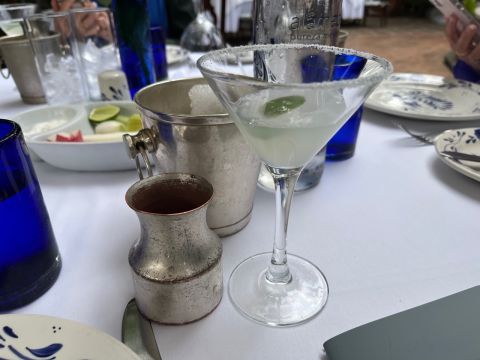
San Angel Inn is famous for its margaritas, elegantly served individually in a small metal flasks kept cool in our own miniature ice buckets and poured as we went. Heaven forfend that one’s margarita is not ice-cold. These saw us through the entire meal. We struggled with the menu on a QR code (still popular in Mexico City) until a printed one finally appeared. We’d been recommended to try ‘escamoles’, another ant-inspired dish so minute that we mistook it for one of the salsas. This came with a decent-enough cod dish and a slightly too salty schnitzel. We relished the atmosphere more than the food here.
The style of cooking was encapsulated by the waiter who came to take our dessert order and rattled them off, beginning with ‘floating islands’. This classic French dessert, a personal favourite, is one that I have not seen on a menu for far too long – our American friends had never heard of it – but this seemed the ideal place to eat one again. The dish was slightly too sweet but nonetheless we managed to finish a helping shared between four. Service was formal, waiters impeccably dressed, and rather charmingly old-fashioned.
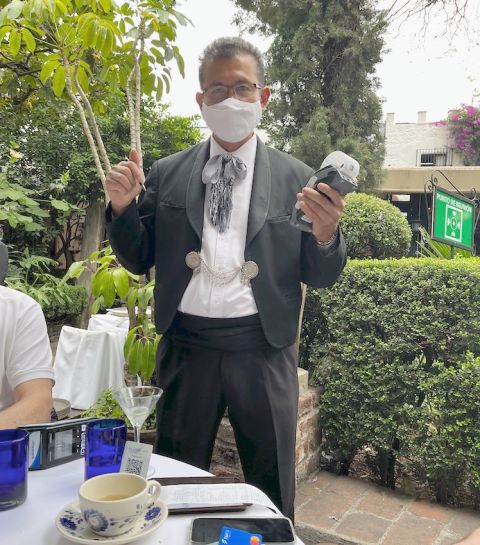
We left San Angel with considerable regret. We all felt that we had left a period piece. I will long retain the memory of a waiter asking a customer precisely how he wanted his steak tartare seasoned; of looking at a table where a young mother was showing off her newborn to her table of friends; and of tables of several generations of Mexican families obviously enjoying themselves in familiar surroundings.
So you have a choice: Pujol for the essence of modern Mexican cooking or San Angel Inn to observe a Mexico City that does not appear to have changed.
Pujol Tennyson 133, Polanco, Polanco IV Secc, Miguel Hidalgo, 11550 Ciudad de México; tel: +52 55 5545 4111
San Angel Inn Calle Diego Rivera 50, 01060 Ciudad de México; tel: +52 55 5616 1402
Top photo and wine glass photo by Araceli Paz, courtesy Pujol