James Flewellen is no stranger to JancisRobinson.com. See, for example, this review of a book on wine tasting he co-wrote. Here’s how he describes himself:
James Flewellen, 32, is a biophysicist based at the newly established Francis Crick Institute for biomedical research in central London, where he researches the mechanical interactions between human immune cells and HIV. James was bitten by the wine bug when he moved to the UK from New Zealand to undertake doctoral studies at Oxford University. He got involved in the university’s blind tasting society, winning several competitions and awards as the team captain.
James combines his scientific training, his educational experience illuminating abstract concepts such as quantum mechanics and holographic imaging, and his love of all things wine to bring a considered, demystifying (and, yes, sometimes geeky) approach to wine tasting and wine education.
He has completed the WSET Level 4 Diploma; runs the Taste Unlocked food and wine tasting workshops in Chartres, France; and is the co-author of The Concise Guide to Wine and Blind Tasting, which was awarded Best Drinks Education Book at the Gourmand Awards in 2015.
Much ado about smelling
'our power of smell is less discriminating and in general inferior to that of many species of animal' – Aristotle, De Anima II.9.
Words of wisdom from a towering intellect of the ancient world – none other than Aristotle himself, writing in De Anima some 23 centuries ago. Aristotle’s considered opinion in this text reveals the lowly human sense of smell has been written off since time immemorial. Still today, our nose is popularly considered to house the weakest of our five traditional senses and as a species we are regularly compared unfavourably to dogs, rats and even elephants. Even in the scientifically illuminated times of the late twentieth and early twenty-first centuries, research into our sense of smell – or olfaction as the jargon would have it – has been sorely neglected, with smell considered the least important and least interesting of our five senses from an evolutionary and medical perspective.
It has only been relatively recently that science has begun to shed light onto something we wine tasters have known ever since the first time we stuck our noses into the enticing bouquet of a mature red burgundy – that our sense of smell is nowhere near as bad as we’ve been led to believe over the past couple of millennia. For, in fact, we smell in a physiologically rather different way to most other mammals, for reasons that may have been important in the evolution of our species, and which today allow us to enjoy the richness of flavour and aroma in a glass of wine in a way that no other animal can.
When we first approach a wine, after peering through the glass to observe the hue, the gradient, a hint of sediment or perhaps some wine diamonds, we lift the glass to our nose. We inhale, gently at first perhaps, then give the wine a swirl, inhale again – this time more deeply – and exhale. All going well, this exhalation is accompanied by a sigh of pleasant anticipation of the taste experience to come. As we breathe in through the nose, olfactory molecules arising from the surface of the wine are carried along on the stream of inhaled air; they enter our nasal cavity and reach the smell receptor organ – the olfactory bulb. This organ is a cluster of cells sitting beneath our brain. They are designed to receive the molecules of aroma by binding to them – a little bit like making a series of molecule-sized handshakes. This act of binding sends an electrical signal along the nervous system directly into our brain, perhaps triggering a memory of a past experience of a similar wine, thus leading to our feeling of anticipation. This preparatory inhalation is what we commonly think of as smelling, and indeed, if that was all there was to examining the bouquet of a wine, perhaps we’d be better off leaving it to the dogs.
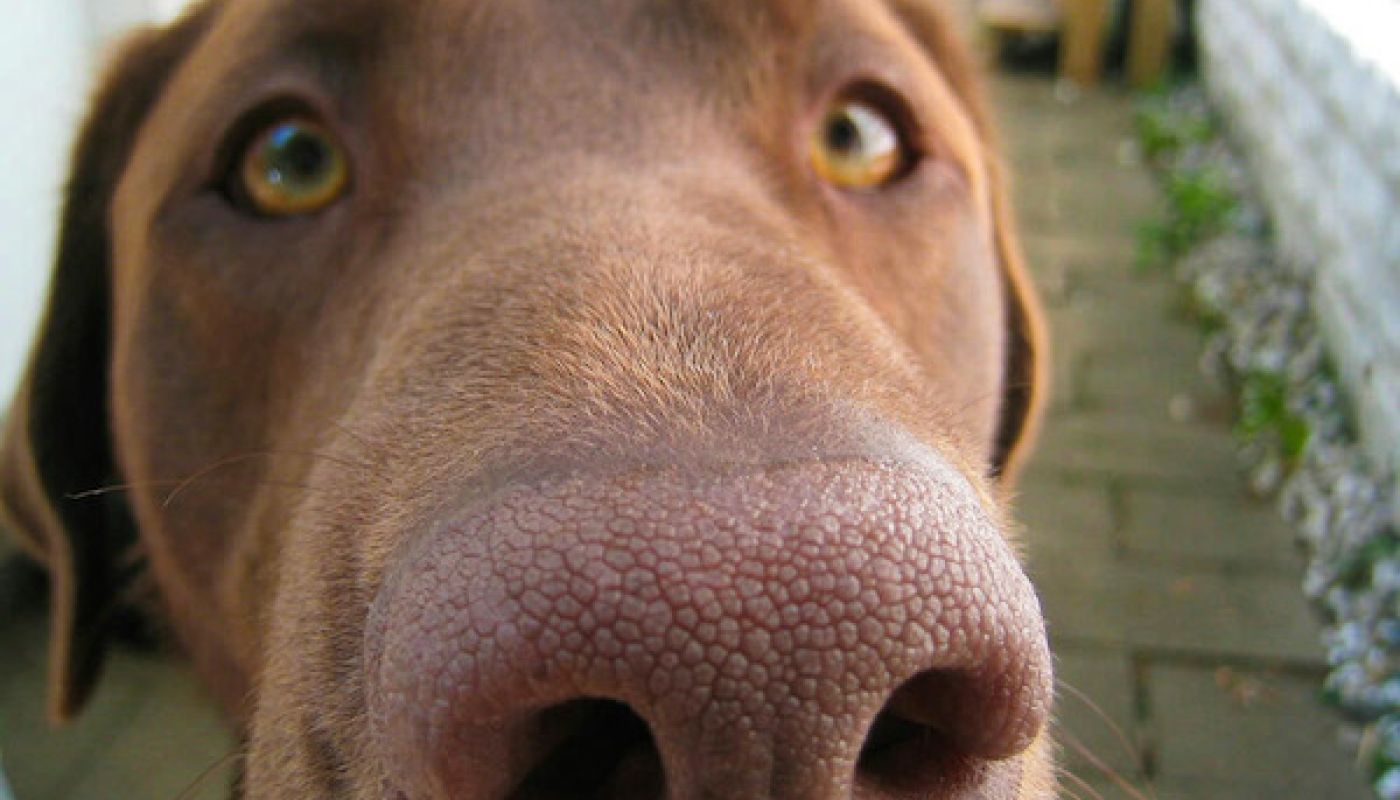
However, it is humans, not dogs, who savour the scents of wine, and to see why, let’s have a look at man’s best friend for comparison. Have you ever stopped to notice the shape of a dog’s nostrils and compare that to your own? Have a look some time and you’ll notice canine nostrils are shaped a little like quotation marks that have lain down on their sides. This brilliant piece of evolution allows these expert truffle-snufflers to smell the outside environment – particularly that environment close to the ground – in the most exquisite manner. As the dog breathes out, air is directed through the narrow slit part of the nostril (the ‘flick’ of the quotation mark) slightly to the side; inhalations are drawn centrally through the large, round opening. This has several advantages in smelling: on the next breath, our canine companion is not breathing in the air it has just exhaled. In fact, the exhaled air can even form a directed jet of air designed to stir up new aroma molecules for the next intake of breath (technically called ‘jet-assisted olfaction’; as you can begin to imagine, there is a whole field of study into the fluid dynamics of breathing awaiting more research investment!). By contrast, our own nostril design does not allow for directed exhalations and thus we are stuck with re-breathing our own expired breath rather than something new. (This is one of the reasons that as wine tasters we need to make the most of our first few inhalations on a new wine and then need to swirl the glass to generate new micro-air flows inside it to ‘stir up’ the aromas.)
After the air enters a dog’s nostrils it is channelled along a long nasal cavity inside the snout on its way to the olfactory bulb. The long canine snout focuses the inhaled aroma molecules beautifully onto the olfactory bulb, thus maximising the activation of the nervous system. It is these physiological adaptations, evolved in creatures that lived with their heads close to the ground and needing to use their sense of smell to find food and evade predators, that make dogs and other mammals such champions at smelling while breathing in. (Indeed, look at the relative snout length of most mammals – primates and poor pugs excepted – and you will notice they have elongated noses.) To examine our own sense of super-smelling, we need to look at things the other way round.
After being enticed by the bouquet of the wine in our glass, we take a mouthful, swirl the liquid around in our mouth, savouring the flavour, before swallowing and absorbing the after-effect of the finish. Critically, as we do all of this, we are still breathing through our nose (try enjoying wine holding your breath, or with a blocked nose) and as the wine sits in our mouth, those same aroma molecules we enjoyed when smelling the bouquet from the glass are being stirred up from inside the liquid, vaporising into the little pocket of air in our mouth. This molecule-laden air then moves above our soft palate, into the nasal cavity, giving our olfactory sensor cells a few handshakes on its way out through our nostrils. In fact, even more aroma molecules are being released here inside our mouth compared to in the glass. Our internal body temperature warms the wine, agitating more molecules out of solution – heavier ones, different ones – and the act of swirling the wine around with our tongue and muscles in our cheeks is doing the same.
In contrast to our canine friend, we short-snouted humans have a relatively large mouth cavity: it is spacious and resonant and conveniently close to our olfactory bulb, which is housed in its own commodious cavity. The same features of our facial structure that mean the aromas we experience during inhalation are somewhat diffuse actually serve to accentuate the aromas we experience upon exhalation – or during ‘retronasal olfaction’. This method of smelling is responsible for our greatly sophisticated sense of taste: with retronasal olfaction, not only do we beat our canine companions, but we may even come top of the animal kingdom. After all, we know too well the dogs around us can spend an eternity fixated on snuffling away at the ground (or at another canine’s posterior…), yet when was the last time you noticed him savouring his doggie biscuits?
The evolutionary reasons for our fantastic sense of retronasal olfaction are still unclear. Primates’ snouts presumably became shorter compared with those of their ancestors as they moved to live in trees and no longer needed to have noses so close to the ground for snuffling out food. Was it, therefore, a happy evolutionary coincidence that we ended up with such a great sense of smell, when we smell from the inside out? Or is there another advantage conferred upon being able to smell food well as we chew to release flavour, but critically before we swallow and ingest potentially harmful agents? The research continues.
To give Aristotle his due, it has only been recently that we have come to understand that most of what we experience as flavour from inside the mouth is in fact due to our sense of retro-smell. Aristotle did not have access to functional MRI scanners to peer at brain activity, nor high-speed video cameras that can trace the motion of air passing in and out of our nostrils as we breathe. For millennia we have conflated the distinct senses of smell and taste when we eat and drink – quite understandably, as eating and drinking are located psychologically for us in the mouth. As the research picture becomes clearer, we are learning more and more how important our sense of smell really is in engaging with the world around us – and in the glass in front of us – and just how sensitive our noses can be.
Of course, the real instrument of smell is the brain. The human brain is the most sophisticated on the planet and the olfactory bulb is plugged in to one of the most evolutionarily ancient parts of it. Important research goes on to understand our evolutionary origins and to explore the very strong link between memory and smell. As wine tasters, we may well ask what is going on in our brains when those vinous aroma molecules wine start making handshakes with our olfactory bulb and trigger electrical signals? What sorts of memories are triggered? Why those memories with that wine? And then how do we respond to them and use our sense of smell to inform our decisions, our enjoyment and our formation of new memories for future recall? But these are all stories for another day.
Orange, NSW: the hottest spot in cool-climate Australia

I like a technical winery visit as much as the next wine geek, but this was something else. Peter Hedberg was up to his chest in an excavated pit in the ground of his own vineyard, Hedberg Hill, gesticulating enthusiastically at the layers of vermillion soil. The bases of vine trunks and net-ensconced autumnal foliage framed his head, while the lateral roots of these vines poked through the quarried earth. He emerged from the earth and led us over to the tasting shed, then presented us all with an 18-page, full-colour booklet detailing the history, geography, geology and climate of viticulture in the region, complete with topographical maps and rainfall charts. Before the tasting began in earnest, we were shown to a table arrayed with newly clipped bunches of grapes, labelled by variety, and invited to taste and compare the fruit of this year’s harvest sourced from different sites around the volcano.
Welcome to Orange, New South Wales: the hottest place for cool-climate wine in Australia.
The producers in Orange clearly take their wine Very Seriously. On my visit, as part of a Wine Australia tour of Australian wine regions, the typical Aussie banter was muted in favour of even more technical specs than usual: yields, harvest dates, sugar densities, soil drainage rates, wind speeds, mean temperatures, planting aspect and orientation, and rootstock identification numbers. There is an element of the new kid on the block in the approach of the Orange vignerons – the ambitious yet unproven overachiever eager to show off not only what the region can do right now but also what its enormous potential is. Everything with our visit was laid out with a precision and attention to detail that you can tell is also executed in the vineyards and you can taste it coming through in the wines.
The winemakers in Orange form a relatively small but close-knit community – evidenced not only by the clubbing together to form the Orange Region Vignerons' Association, but also by the delight that they all clearly took in each other’s company during our tastings and visits. But if you’re in an isolated town of 40,000 people, nearly four hours’ drive from Sydney, and trying to prove yourself on a global stage, you need all the support you can get. There’s no room for big egos and certainly no way to go it alone. While the wines of Orange are yet to make it large on the world stage, the winemakers are certainly proving themselves – and the region – in spades.
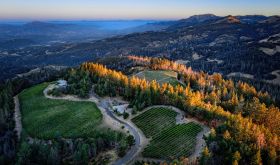
The wine region of Orange is organised around Mount Canobolas, an extinct volcano rising 1,396 m (4,580 ft) above sea level to dominate the landscape 120 km (75 m) inland of the Blue Mountains. Visiting the region in autumn, you would be forgiven for thinking its name comes from the spectacular autumn foliage afforded by a long, dry lead up to winter, or from the ancient, mineral-deprived, volcanic soils, rather than the more prosaic reason of being named for yet another royal from half a world away (in this case, Prince William of Orange). Well over a century ago, the region was recognised as having an outstanding climate for fruit trees – apples, pears, stone fruit (too cold for oranges, ironically), although the modern wine industry dates from the 1980s. In 1997 Orange was recognised with a Geographical Indication (GI) – Australia’s version of the Appellation d’Origine Contrôlée. Unique in Australia, and unusual throughout the world, the region’s GIs are determined by elevation as well as location: for vineyards above 600 m you can have ‘Orange’ on your wine label; below this, you’re in the Central Ranges GI. This makes sense for two reasons: firstly, the climate is noticeably different the higher up the mountain you go; and secondly, the soil structure also changes as you ascend the volcano, with the results of more recent eruptions to be found closer to the summit.
For the Orange GI, plantings range from 600 m to 1,000 m above sea level, making Orange the highest wine region in Australia. The mean temperature during Australia’s hottest month, January, is just under 22 ºC (72 ºF) at 600 m and drops to 18.5 ºC (65 ºF) at 950 m. At this elevation the mean temperature is cooler than that of Burgundy’s hottest month – to say nothing of other Australian regions – leading to much excitement over whether Orange can be Australia’s answer to genuine cool-climate viticulture. The climate of the lower reaches of the appellation lends itself to comparisons with the Rhône and – slightly higher up – Bordeaux. Altitude comes with its challenges, however. Orange is a sunny spot (over 1,800 sunlight hours between October and April) and the ozone layer above New South Wales isn’t what it used to be. Slopes for planting are typically selected to face away from the harsher setting sun. To further mitigate damage from ultraviolet light, canopy management techniques are employed, with east-facing foliage trimmed and west-facing foliage allowed to grow freely for use as personal parasols by the grapes.
Throughout the tastings, I found wines from the region to be pretty, floral and well structured. There were no blockbusters or alcoholic fruit bombs. Whites and reds alike had a taut leanness from punchy acidity offset by a depth of fruit flavours that could be rich without being overbearing. The technical enthusiasm that is clearly shown in mapping out the vineyard sites in the region has gone through into the winemaking itself. Traditional winemaking techniques (wild ferments, punching down, gravity-fed systems) are in vogue, accompanied by a sharp eye on technical measurements in the winery throughout the vinification process. And there is hardly an American oak barrel in sight. A fascinating feature of the tasting for a wine geek like me was being able to taste varietal wines made in the same way from vineyards planted across the full 400 m elevation range. Shiraz, for instance, went from a generous fruit-jam-and-baking-spice expression at the lower climes, through a Rhône-like cured meat and black pepperiness midway up the appellation, into a taut, herbal, linear wine reminiscent of New Zealand Syrah towards the top of the mountain.
Unsurprisingly for Australia, Shiraz is the most planted variety in the region, with Cabernet Sauvignon a close second. The real star red wine of Orange’s future may be Merlot, with plantings racing ahead to catch up with Cabernet. Australia is yet to find a really successful spot for Merlot and there is quiet excitement in the Orange community that the plentiful sites on the side of Mt Canobolas with sandy soils and a kind climate may be the best thing to hit Merlot since Pomerol.
White varieties are about half as popular as reds as far as plantings go, but as the word gets out about the region’s success with cool-climate varieties, this is changing quickly. With autumns as reliably long, warm and gorgeous as they are, Riesling promises to be a future star too, especially on the upper slopes. These top elevations are also home to an interesting expression of Sauvignon Blanc – light, floral, delicate and a far cry from anything made ‘across the ditch’ in Marlborough, New Zealand. However, in the meantime, Chardonnay reigns supreme among the whites. It comes in a variety of styles throughout the elevation range – round with tropical fruit hints at lower elevations through to lean and lemony at the top. One Orange winemaker told me, ‘to make a good Chardonnay in Orange, you hardly need to try'. Although even a cursory flick through the Orange Region Vignerons' Association’s impressive guide book to the region will tell you that plenty of trying is going on in crafting wines of elegance and poise. And it’s good news for the rest of us that it is!