At the end of 2019, I saw an ad asking for a winemaker for a project in Bolivia.
The ad read:
“Winemaker needed for small family owned winery in Bolivia
We will make: Limited batches of sparkling, red and white from ancient vines of Vischoqueña, Negra Criolla and Muscat of Alexandria”
I had always wanted to visit Bolivia; and I have had a passion for old vines since a winemaking gig at Sevenhill Cellars in the Clare Valley, South Australia, where I worked with a block of Shiraz that was planted in 1854. I still vividly remember the depth of colour and soaring aromatics of those grapes
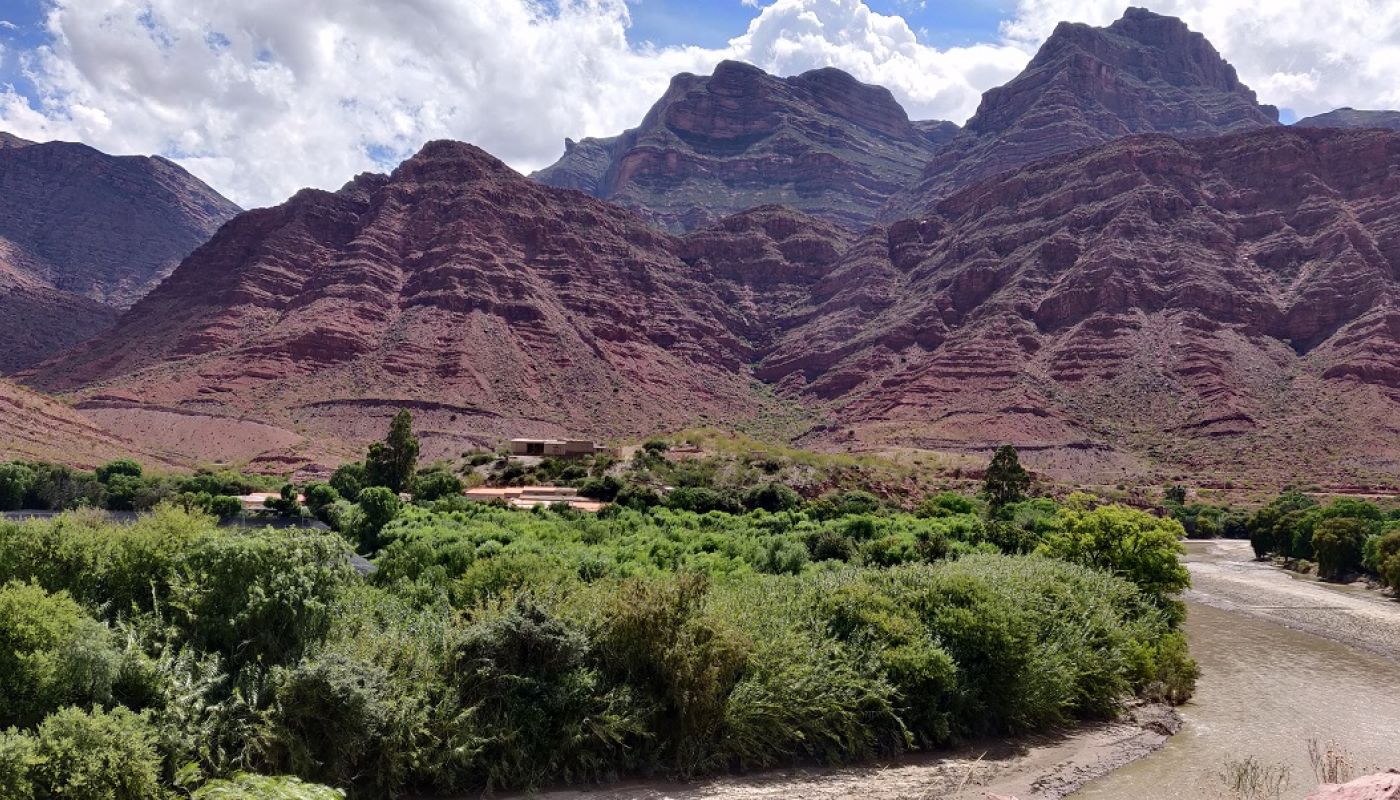
The vineyard that we worked with in 2020, San Roque, is in the south of Bolivia in a region called the Cinti Valley (Chuquisaca). The latitude there is -20 degrees, 46 minutes. If you think that the traditional ranges for viticulture lie between +/-28 and 50 degrees, you will have an idea as to how far removed this is; and how much closer to the equator it is. To give you a rough idea, that is about the same latitude as Madagascar, or Townsville, Australia. (The photo above is overlooking the San Roque vineyard.)
The factor that allows viticulture, for winemaking, to be viable in the Cinti Valley is its altitude; around 2,300 metres (7,300 feet) above sea level. With every metre of elevation, the average temperature drops. The Cinti Valley is also very far from any large body of water, giving it a continental climate; and it does get cold at night, even in the height of summer.
As with much of South America, Vitis vinifera was introduced following the Spanish conquest, by the Franciscans and Jesuits.
The first vines were planted in Los Cintis (Cinti Valley) around the mid-1500s. The grapes were either made into Sacramental wine or distilled to make Singani, the national spirit of Boliva. The Singani fuelled the workers at the mines in Potosí, to the north. Potosí had the largest deposits of silver in the world and, at the time, had a population greater than London. (Singani and Potosí are fascinating subjects, but I know that Jancis would rather I stuck to wine.)
Everything that surrounds the Cinti Valley is arid; little grows apart from scrub and cacti. There is a river that runs through the valley, the Rio Grande, which is literally the life blood for the region. Agriculture and viticulture, specifically, only survive on the banks and in the bends of the river.
While we are not sure exactly when the San Roque vineyard was first planted, we are certain the oldest current plantings are over 200 years. Many of those vines still survive and are producing to this day.
There are a number of different varieties, some of which we have not yet been able to identify.
The main ones are;
- Moscatel de Alejandria, which is the most ancient of the Muscat family, and is one of the most widely geographically distributed varieties; this has traditionally been distilled to make Singani.
- Negra Criolla (a red grape), which started life in Spain, where it no longer seems to exist, but was carried to South America via Tenerife (where it is called Listan Prieto) and was planted throughout Central America. It goes by the synonym Pais in Chile, and Criolla Chica in Argentina. In California it is called the Mission grape.
- Vischoqueña (also a red grape) that is only found in a small area of Bolivia, and nowhere else in the world. We still have no idea about the heritage of Vischoqueña.
So, we have an off the radar country, at a latitude not usually associated with winemaking, at high altitude, with three non-mainstream varieties that were planted over 200 years ago.
But, what makes this vineyard so special, you may ask. And rightly so...
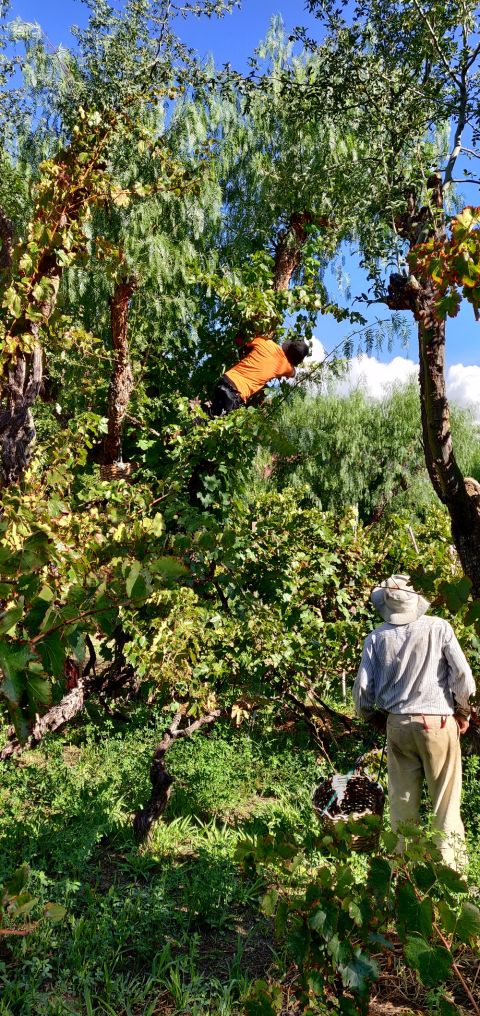
Well, back when these vines were planted, the owners chose to plant them using trees for support. None of those feeble end posts or weak strands of wire for these vines. No! Instead they chose sturdy, native trees that grew as the vines grew.
The trees are still thriving and still support the vines which, in some cases, reach to a height of six metres. Of course, this kind of vine training is not without its challenges; both harvesting and pruning become exercises in acrobatics.
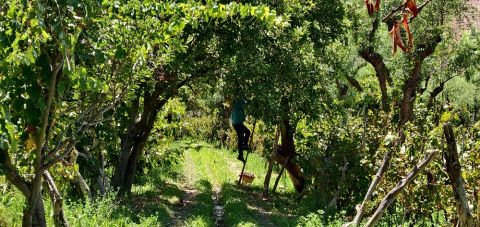
For both pruning and harvesting, we need ladders; and people who are not afraid of heights. It is slow work, but the quality of the fruit makes the effort worthwhile.
We have often pontificated as to why these ancient vines still exist. Viticulture is an unsentimental business. If a vine does not pull its weight, it will get replaced with something that does. The vineyards in the Cinti Valley are also planted with apples, quince, corn, citrus and figs; any one of these could take the place of an underperforming vine. They could also be replaced with a variety in more commercial demand.
Most vines have a lifetime of less than 100 years, and often less than 50.
In the case of the Cinti Valley, one of the key factors for longevity is that the region is free from Phylloxera, so there has never been a necessity to replant on resistant rootstocks. These vines also continue to produce copious bunches of grapes (we often pull 40kg+ from a single vine), so they are definitely earning their keep.
In its heyday, the Cinti Valley had 1,700 hectares (ha) of vines, these would have all been bush vines or arboreally trained vines like the ones we work with at San Roque. The last survey, about 10 years ago, indicated that there were 300ha; I would say the figure, now, would be significantly lower.

Our project, Jardín Oculto [hidden garden], was created to help preserve and celebrate the vine heritage of Bolivia. We began with San Roque and this year have started working with another two vineyards, Mollepampa and Los Membrillos.
Our aim is to work with the growers to improve their vineyard practices, as well as trying to make wines that showcase these heritage varieties; and prove that this history is worth saving. By extension, we also help the communities in the region by bringing money and value into the area.
It is imperative that these vines are preserved. Once they are gone, they are gone for ever. Their loss would be a cultural tragedy, not just for Bolivia, but for the world.
The photos are provided by Nayan Gowda.
















