Marisa Finetti writes I write about wine, travel, and culture—often with a splash of my illustrations. My goal? To make wine approachable, engaging, and fun. You might’ve seen my stories in Decanter, Wine Enthusiast, and Full Pour, or spotted my “doodles” on wine lists, menu boards, and aprons. I hold certifications from WSET and the Wine Scholar Guild, but the most valuable lessons still come from walking the vineyards and having great conversations over shared bottles. Currently, I’m brushing up on my Italian for my second book, Marisa’s Italian Wine Doodles. Find me at @marisafinetti and @marisaswinedoodles.
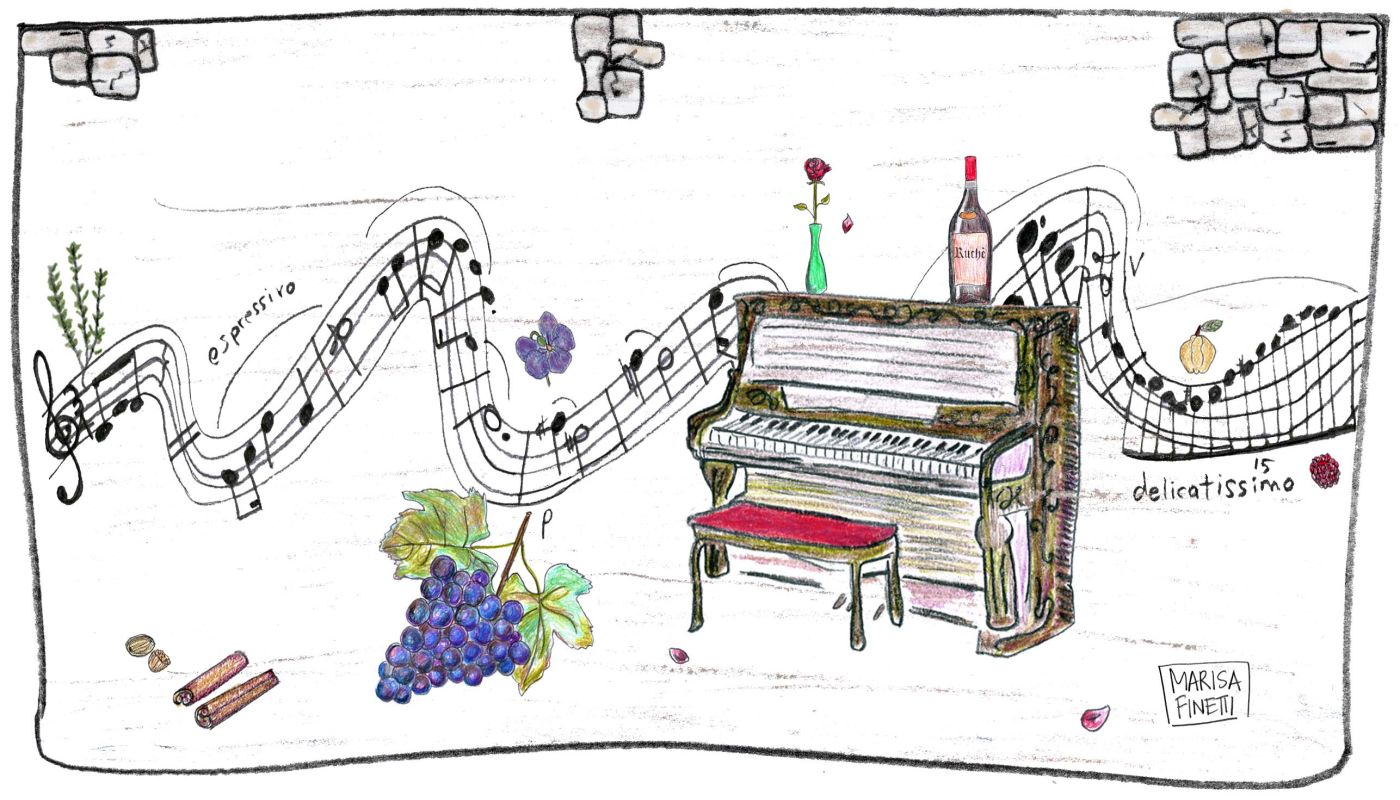
The girl who played Ruchè
It was never supposed to be Ruchè. Not in a world where grapes like Nebbiolo and Pinot Noir are so deeply loved. And let’s be honest—when it comes to Champagne and Chablis, who doesn’t surrender to Chardonnay? But Ruchè was waiting for me.
I didn’t go searching. Ruchè arrived in a wine glass from Italy’s Piedmont region.
And for me, wine often appears as a fleeting apparition—revealing a flicker of human personality taking stage through a curtain of juice. It’s a kind of personal synesthesia, not with colors, but with people. The grape reveals its characteristics only partially, waiting for me to finish their story.
I’ve spoken of this in my scribbled wine reflections through Marisa’s Wine Doodles. Some wines are obvious (to me): Sauvignon Blanc is forever single. But when mingled with Sémillon and Muscadelle, Sauternes lounges in silk pajamas. Verdicchio drives with the top down. Nebbiolo, a storyteller. And its lesser-known neighbor, Ruchè? A melody emerging from silence.
She is a young woman seated at an upright piano in a dark basement apartment somewhere in Romania. Her family lives modestly. Thick walls of plaster and stone and thick soups made mostly of beans and bread. She is brilliant. But nobody knows. Not even her.
I had her for the first time at my house when my dear friend brought a bottle of La Miraja by Eugenio Gatti. She wore the fragrance of crushed rose petals, faded letters, and a bowl of raspberries - yesterday’s pick. Beneath that softness was a bit tension and spice—cinnamon, cardamom, roasting herbs, an oak farm table holding an overgrown pot of violets. This wasn’t a wine that begged for attention.
Here was this rare aromatic red grape from Piedmont, thousands of miles from my image of her in Eastern Europe. I began to seek her out, hunting for her bottles around Castagnole Monferrato, where her vines cling to seven charming villages.
Cue up Chopin’s Mazurka in A Minor, Op. 17, No. 4, and walk with me. The rhythmic shifts evoke a sense of nostalgia, recalling memories that are both beautiful and bittersweet.
On this day, it’s breezy and gray, with bursts of welcoming intermittent sunshine. In Castagnole Monferrato, behind the parish church treasures hide within the fortification walls: a theater, farmhouses, and villas from centuries past. Around each turn, glimpses of Ruchè’s vines emerge in the distance. Strolling these old walls reminds us that Ruchè, too, nearly vanished—lost to time and neglect. But the ruby-red heart of the village is alive again, like the mazurka’s shift from melancholy to quiet hope.
Only a few families kept her vines going at first, often growing them alongside local varieties - Barbera and Grignolino - in backyard plots. Ruchè was mostly made into sweet wine for special occasions and remained in the shadows as Barbera and Nebbiolo rose to prominence. But she endured. Her French-sounding name, Rouchet, may trace back to roncet—a viral degeneration—hinting at her resistance.
Then came the parish priest, Don Giacomo Cauda, who saw her potential. He revived the grape and began vinifying it dry, giving Ruchè a new voice. Today, Luca Ferraris cultivates her from that original vineyard, remembering how he once watched the priest make wine. Now, he carries the legacy forward. And he’s not alone—producers like Cantine Sant’Agata, Bersano, Montalbera, and Crivelli are helping Ruchè shine in her own right.
Yet Ruchè di Castagnole Monferrato remains overlooked, often mispronounced, and always a mystery. And that only makes me adore her more. Because Ruchè is not a crowd-pleaser by design. Her vines are a bit unruly. Her clusters ripen early, and her tannins can surprise you—requiring careful coaxing in the cellar. Her lineage, likely a crossing of Malvasia Aromatica di Parma and Croatina, is still debated, contradicting earlier suggestions of Burgundian origin. Ruchè plays in minor keys when the rest of the region plays in C major.
But if just to smell something beautiful, Ruchè, when made into wine, shares herself gloriously. And when she finds someone willing to listen, she opens up. Florals, berries, and spice give way to fine-grained tannins—firmer than expected but never forceful.
I’ve poured her for friends—some wrinkle their noses trying to place her. Old World? Yes, very Old World. Floral? Spicy? Light? Bold? Stop.
She doesn’t fit into categories, nor does she want to.
She's just Ruchè from Castagnole Monferrato.
In a wine world leaning on precision and pedigree, Ruchè reminds me why I fell in love with wine in the first place: sometimes, it’s serendipity—discovering something no one told you to love, and suddenly, it becomes yours. Not by marketing. Not by rating. Not by prestige.
But most definitely by resonance.
And every time I raise a glass of Ruchè di Castagnole Monferrato, I see her again—playing introspective and dreamlike for no one.
The illustration, captioned “The Girl who played Ruchè”, is the author's own.