Melanie Webber writes based in Los Angeles, Melanie Webber (DipWSET) is a professor of Wine Studies at College of the Canyon’s Institute of Culinary Education and Director of MWWine School, which offers WSET, and other wine courses, in Paso Robles, California and Asheville, North Carolina. Melanie has helped nearly 1000 industry professionals and wine lovers achieve their wine certifications, writes about wine under the BottlePoet handle, and is part of the founding team of the world-renowned Garagiste Wine Festival.
A horse of another color: Palomino, from Ordinaria to Gloriosa
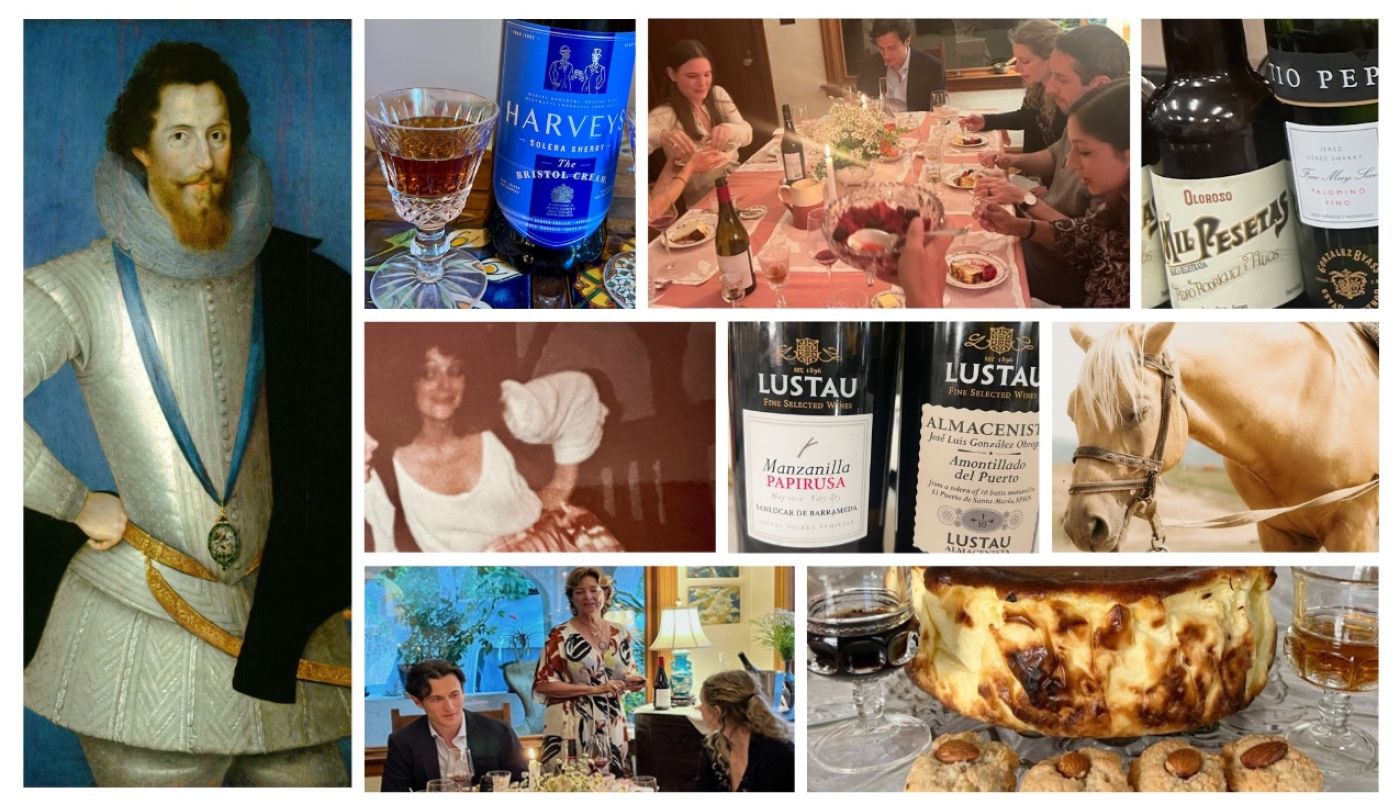
As a typical English girl, I always wanted a horse. Not just any horse: a Palomino, all cream and gold, a graceful beast. But a horse was never in the cards for me, especially after we moved to the US. Back then, I had no idea that the source of the luminous liquid my parents elegantly drank from cut-crystal glasses shared a name with the horse I dreamed of.
Although the name is Spanish in origin -- the horse from the Spanish word for dove ‘Paloma,’ and the grape, less poetically, but more dramatically, after the Reconquista Spanish knight, Fernán Yáñez Palomino -- both stories are more exotic and interesting than the grape itself in its natural state. But it is a grape I love; not for what it is, but for what it can become, a foal on spindly legs maturing into galloping glory in shades of cream and gold and amber.
I was struck by this recently as I curated, with theater friends of many decades, a Spanish wine and food pairing dinner to celebrate the marriage of our goddaughter. Sherry was well represented at the dinner, where, bound by our histories and journeys into maturity, old friends were at one table while, at the other, the youngsters, if not quite foals, but cantering into their prime and bound by their own youthful friendships, were surprised and delighted by their first tastes of a Manzanilla Sherry.
In my youth, Sherry was as much a part of family and social rituals among my parents’ set as cups of tea, measured out through celebrations and sorrows. It was the sweet ooze (from its PX boost) of Harvey’s Bristol Cream that made me fall in love; but, thanks to my mother’s affection for its more refined sibling, Tio Pepe, I developed a taste for the briny, doughy astringency of Sherry’s more austere incarnation that was pure Palomino.
At university, my dormitory ‘bar’ was: Southern roommate - Southern Comfort; Midwest roommate - Chivas Regal; Me? Harvey’s Bristol Cream. Sherry followed me through my acting career as Shakespeare was no stranger to “sack’ (the old English name for Sherry). When I played Maria in Twelfth Night, at the theater I helped start with those dinner friends, it was my character’s task to quiet down the aptly-named Sir Toby Belch, who was well into his cups from burning ‘some sack’.
And, I suppose, I have a birthright of sorts, if I take as gospel the family lore that we are direct descendants of Robert Devereux, Earl of Essex who, thanks to his affair with Queen Elizabeth I, held the monopoly on all sweet wines imported into England, including Sherry…until he became mixed up with an Irish rebellion, losing the Queen’s favor, his sweet wine monopoly and his head.
But, it wasn’t until I started my wine studies that I considered the grape from which Sherry was made - an undistinguished, if dependably productive, grape to write an ode to – neutral in flavor, low in alcohol and acid, and lacking in complexity and perfume. But, my ode is as much to Palomino’s journey, as to the grape itself.
Birthed from roots spread through a crust of bleached fossils, it digs deep for the water that gives it life, as the light of centuries is reflected back to coax its buds into pendulous orbs. From here, Palomino’s journey into its identity, like the one we each take, comprises multiple definitions, judgments and classifications, from vineyard to winery to the pyramid of barrels of the solera, where it receives wisdom from its elders as it ‘runs the scales’ of maturity, giving as much youthful energy as it takes. Just as we, in our life journeys, leave parts of ourselves behind at every stage, fractions of our histories.
And this begs the question: Is there any other grape that so defies a solo identity and skips across multiple personalities in its development to the extent that Palomino does? A more romantic thought in wine production than coming into one’s own from under a living veil of ‘flowers’ – velo de flor – a frothy mantilla, lacing over, protecting the wine from the corruptions of oxygen by a yeast evolved over centuries, just to grace us with precious sips of briny lemon, chamomile, blanched almonds, and a dust of sea salt? Or, a journey more adventurous than the one the more robust Palominos take, eschewing the ephemerality of flor, rippling with enough muscularity to meet a different destiny, transforming oxygen’s murderous intent into Oloroso’s sensual, dark nut brittle and burnished orange peels? And, are there any grapes whose wines are so beset with identity crises as those of the trapped-in-amber Palo Cortado and Amontillado…with brief lives under flor before opting for oxygen’s toasty death, then roaring to the surface all salt, nuts, dried fruits and caramel?
My answer is no, and it hurts my heart that, today, these beautiful wines are so under-appreciated. Another reason for this ode.
At the end of that dinner, those beautiful faces flushed with youth and the flow of wine, as fresh and as ripe as that Manzanilla with the potential of their futures, I served an Amontillado paired with Basque cheesecake and, oh! how they embraced that wine, while we older folk, as nutty and seasoned as the Sherry, reveled in the richness of our years of friendship and the bittersweet magic of the reverse mirror at the next table.
I may never have owned that Palomino horse, nor lost my head like my ancestor, but the lesson of Palomino resonates, just as it did during that dinner’s ‘running of the scales,’ as young and old melded, and paid tribute to the ties that bind. After all, our blank slates are as moveable and changeable as Palomino’s, and what ultimately comes from each step into maturity, as Palomino teaches us, can be pure divinity. Rather than to be feared, that journey should be embraced, through each precious sip until the very last drop.
The main photo, compiled by the author, is captioned: 'Robert Devereux, Earl of Essex, the author as Maria in Twelfth Night and curating a Spanish wine dinner, a Palomino horse, a Basque Cheesecake and lots of Sherry!'
















