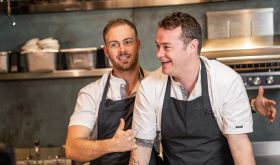
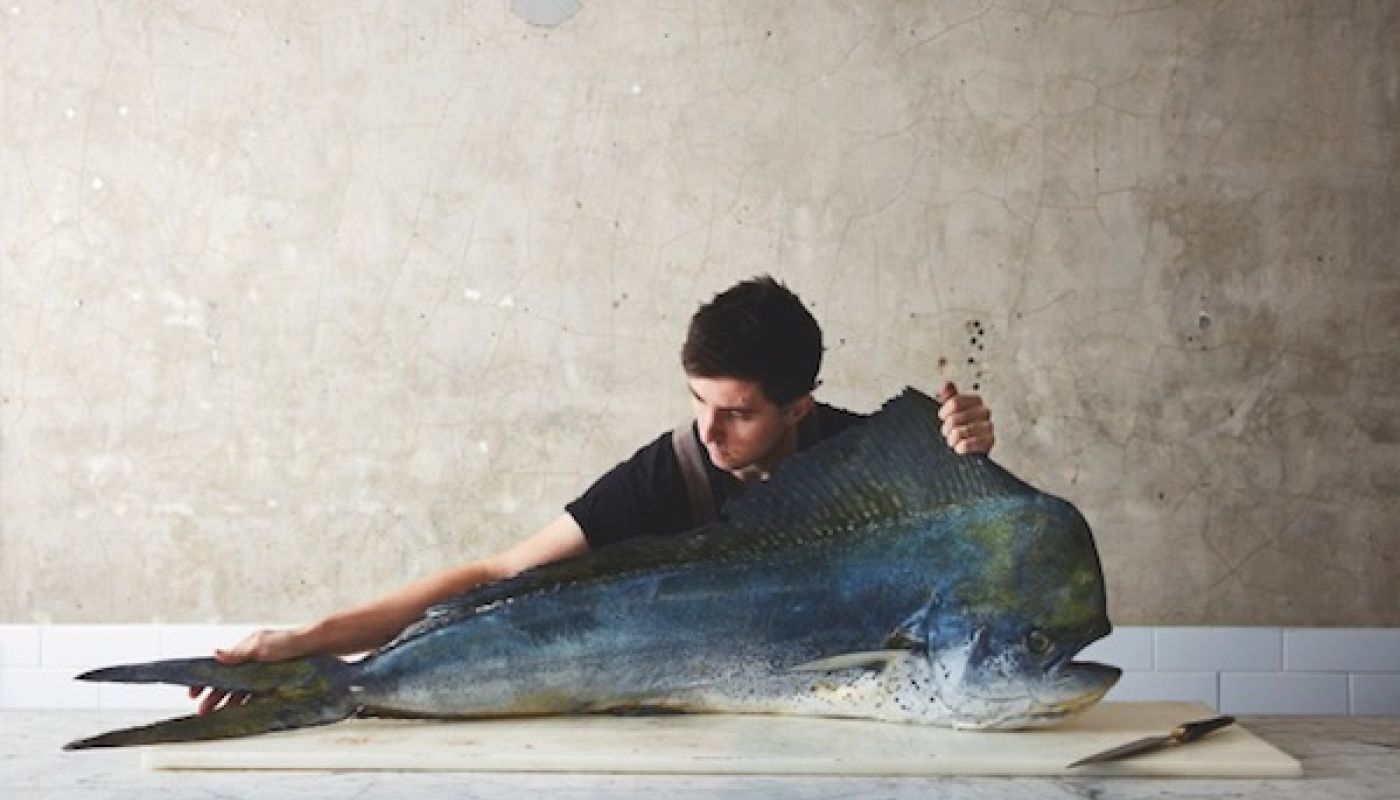
I first met the highly talented but modest Josh Niland in December 2017 after enjoying a fantastic meal at his fish restaurant, Saint Peter, in Paddington, Sydney. I ended my review by writing, ‘Niland has a lot to teach the world’s chefs about fish sourcing and fish cooking as well as the opportunity to provide his future customers with a great deal of pleasure.’
I recently re-met Niland in London on the first stop of his month-long trip as he is in the process of teaching chefs in the UK, the US and Canada about his unique approach to fish. Having written The Whole Fish Cookbook (Hardie Grant, 2019, £25), Niland was in London before giving a speaking performance at the Galway food festival Food on the Edge and then cooking in New York, in Chicago alongside Grant Achatz of Alinea, in Canada, where his book has already been warmly welcomed; and then on to California before heading home to his wife and three small children. His book has already sold 36,000 copies, apparently.
He had been in London for six days and had already appeared on the popular Saturday Kitchen TV show, where he was enthusiastically received. Jamie Oliver had held a party for him complete with a birthday cake as Niland turned all of 31. On the Sunday morning he had held a masterclass for a select number of chefs in the wine bar of Fortnum & Mason, chefs that included Tom Brown of Cornerstone and Jonny Lake, who will shortly open Trivet with Isa Bal near London Bridge.
Niland’s popularity is easy to understand. Fish is almost every chef’s favourite ingredient, the party piece that really allows them to strut their stuff. It is also one of the healthiest ingredients. Yet fish stocks are dwindling and prices are consequently rising all the time. This is forcing chefs to be more creative – the increasing presence of pollock on many restaurant menus is a case in point. But surely everybody should be able to afford a piece of more expensive fish now and again?
There are several key principles behind Niland’s novel approach.
The first is that we must, in view of dwindling fish stocks, begin to use all the fish. Here Niland unashamedly copies the ‘nose-to-tail eating’ approach of St John’s Fergus Henderson. We must adapt these same eating habits to fish in general, Niland insists.
So fish liver is an ingredient we will have to get used to enjoying. At his restaurant in late 2017 I enjoyed an absolutely delicious combination of John Dory with a piece of this fish’s very rich liver and some smoked eel. Over a recent dinner at our son’s Quality Chop House, where the chef Shaun Searley already adopts many of Niland’s principles, we enjoyed a lovely dish of Cornish monkfish liver in a consommé. (Searley pointed out that whereas five years ago he would have paid nothing for this ingredient, now it costs him £5 per kilo – although this is still considerably less than this prized ingredient will cost any chef in Japan.)
By using so much more of the fish, Niland can generate a much higher yield from each fish. For the uninitiated, this equates to how much of the fish can be used for human consumption. Most chefs work to a ratio of 47–50% per fish whereas Niland’s approach generates yields of over 95%. ‘Take a 4.2 kg sea bass. When I prepare it, we get a yield of 96% with just the 175 g of gall bladder (that tastes of battery acid before you ask) and 4 g of heart that have to be thrown away. But that is all and that is double what is generated by the usual approach', he told me. The double-page photos on pages 44–45 of his book show the 31 pieces of edible protein one particular bass grouper can be broken down into, from scales to skin.
Niland’s two main points of difference, other than claiming that there is far more edible matter on any fish than just the fillets, are in his chapters headed ‘Storage and Dry-Ageing’ and ‘Fish as Meat’. And before that comes one essential piece of advice – your fish must avoid water.
‘Ideally, the last time your fish touched water was when it left the ocean', Niland writes on page 29 of his book, and this is a heartfelt cry. The manner in which fish has been treated, smothered in unforgiving, harmful ice and inundated with water, is finally beginning to change as chefs buy more discerningly and increasingly directly from their increasingly aware suppliers, but this is not widely available to amateur chefs. For these chefs, Niland recommends scaling and gutting your own fish, with details of both these processes provided.
But it is in his next chapter that Niland’s vocabulary is revolutionary, and he has his words into practice in Sydney. Having opened Saint Peter on a very small budget, a year later Niland opened a Fish Butchery and on page 37 he explains the similarity between meat and fish. ‘Fish share with mammals the possession of a backbone (or vertical column) and have fundamentally the same basic system of bones and organs as mammals’, Niland writes. Yet over the years the way each is treated has diverged significantly. While meat butchery has transformed itself into something glamorous that brings a sense of luxury to this already expensive ingredient, fish shops by and large remain cold and smelly places that are not overly pleasant to interact with.
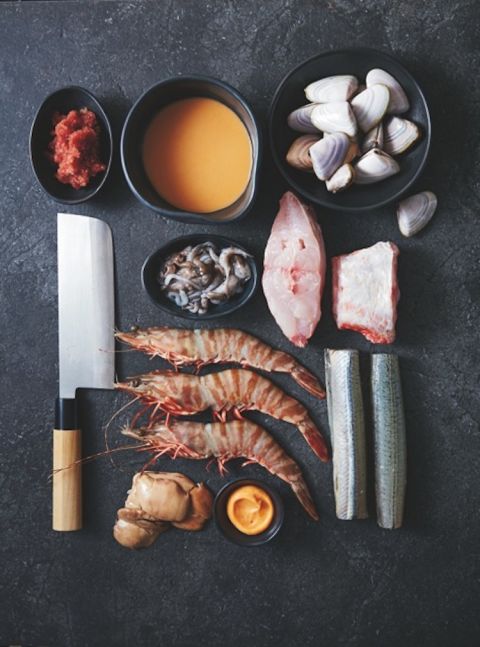
Once fish is thought of as more like meat, far more possibilities become available for preparing and serving it: there is curing, a process already widely followed; there is offal charcuterie; and there are methods of preparing fish that to the uninitiated seem at first slightly unusual but are ultimately successful. Hence Niland’s recipe on page 127 for a fish cassoulet using fish sausages made from cod, and fish bacon made from swordfish (recipe page 60, picture above). Even fish scales can be put to excellent use as his recipe on page 69 proposes.
I feel extremely pleased that I got to know Niland at the beginning of his career as a fish chef. He has a powerful story and one that touches us all. For fish enthusiasts the world over, not to mention my children as well as grandchildren, I do hope that his book will become essential reading for chefs both professional and amateur.
The Whole Fish Cookbook: New ways to cook, eat and think by Josh Niland (Hardie Grant, 2019, £25). Photography: Rob Palmer.