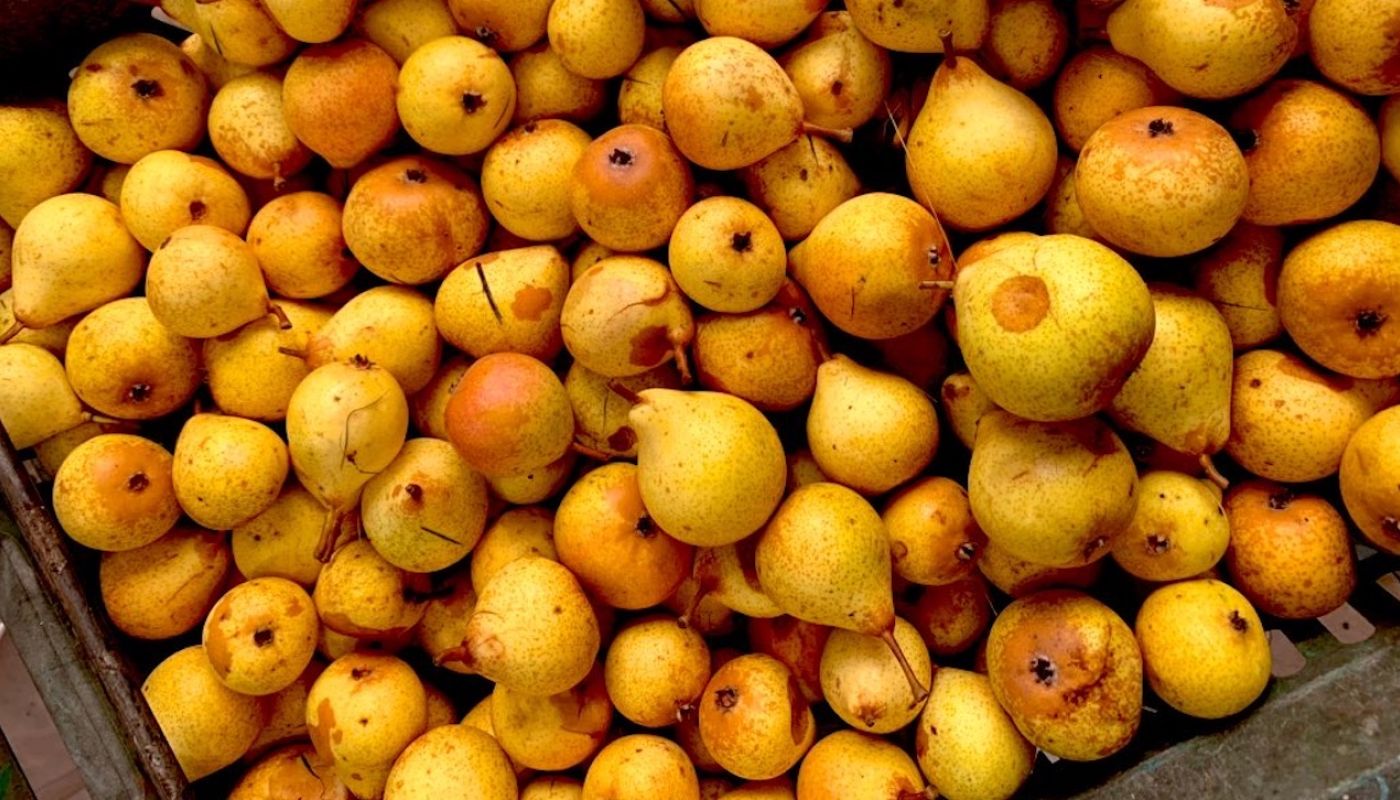
Flakey Bark is a marvel of a drink. Broad, bold, structural, it carries on its breath a muscular depth of pear skin, peach pit, earthy bacon rind and wet slate. Its tannins in youth are formidable – so much so that eating the fruit raw is said to skin the roof of your mouth. It is built for food-pairing, offers extraordinary versatility in that respect, and with age it unfurls into layers of riper, fleshier fruit. A treasure – a delicious one. And one bad storm could wipe it entirely from existence, because there are only six mature Flakey Bark trees left in the world.
If Flakey Bark were a wine grape, this would of course be unconscionable. Even if it were a cider apple, there would likely be more effort made to conserve it. But it is neither. It is a perry pear.
Perry is the overlooked jewel in the crown of drinks in general and British drinks in particular. It has been made in the same way as wine or cider since at least Roman times – Pliny’s written fondness for Falernian perry mirrors his admiration of that region’s wine, and Palladius in the fourth century expressed a preference for fermented pear over fermented apple. It was popular in the Holy Roman Empire of Charlemagne, has likely been made to some extent or another in Britain for a millennium and enjoyed such admiration at the height of its popularity (usually when wine was harder to come by) that Napoleon apocryphally referred to it as ‘the champagne of the English’.
Today, if perry is known of at all, it is largely as a result of the popularity of Babycham in 1970s Britain or through being confused with so-labelled ‘pear cider’, which is often no more than a neo-alcopop made of apple concentrate, sugar, water and pear flavouring.
But, particularly in its British heartland of the Three Counties – Herefordshire, Gloucestershire and Worcestershire – perry is a drink with its own history, identity, varieties and extraordinary palette of flavours. It can also boast a conception more remarkable and convoluted perhaps than any other fruit-based drink.
It begins with the pears and with the trees. Perry pears – different from eating pears, just as wine grapes are to table grapes, although perry can be and is made from either – grow on trees that don’t tend to come into harvest-bearing maturity for 20, perhaps 30, years at their youngest. ‘Plant pears for your heirs’ is an antique truism in the Three Counties; indeed Normandy’s Eric Bordelet, one of the world’s foremost perry-makers, doesn’t consider trees to be truly ready until they are 60 years old. Their longevity is extraordinary – the ‘mother tree’ growing at the site of Gregg’s Pit cidery in Herefordshire has been harvested for perry every year since before the battle of Waterloo.

That longevity naturally cultivates the perry-maker’s first dilemma: as shown above in this picture from James Forbes, perry pear trees grow to enormous sizes and, as such, can be a devil to harvest. The task is made all the more troublesome by varieties such as Thorn, whose window of ripeness is minuscule, or Yellow Huffcap, which ripens unevenly and starts rotting on the branch from the inside out.
The headaches continue once the pears are off the tree. The physical make-up of perry pears means that they inevitably gum up presses. Tom Oliver, one of Britain’s elite perry-makers, cites Blakeney Red as a particular culprit in this respect, and refuses to use the Judge Amphlett variety, such is its tendency to clog. Albert Johnson of the respected Ross-on-Wye Cider & Perry Co echoes the opinion, describing perry as far harder to make than cider. It is also an exceedingly capricious liquid to ferment, one prone to such faults as acetic acid, ethyl acetate and mouse taint, and its particular protein structure makes it all too likely to throw a sediment. Many perries will, without provocation, turn milky to the point of opacity overnight. Others will conjure huge flakes of sediment even after having been disgorged.
Small wonder then that few producers put themselves through the heartache of perry-making, not least when, after enduring those teeth-grinding tribulations, they are left trying to sell a drink that barely anyone has heard of.
‘If it didn’t make that drink I’d stop making it tomorrow’, Tom Oliver told me. ‘But it’s that drink, honestly. Cider’s great, and I drink far more cider than perry, but if I want to show off to somebody it’s usually a perry I go for. What a drink. What a drink.’
Perry, at its best, from a producer such as Tom Oliver, Ross-on-Wye, Gregg’s Pit, Little Pomona or Cwm Maddoc, is breathtaking. Be it the rich lusciousness of a Blakeney Red or Betty Prosser; the herby, mineral delicacy of Gin Pear or Oldfield; the intense, vivacious zest of Brinarl or Thorn (perhaps made using the traditional method); or the deep robustness of Flakey Bark, Aylton Red or Butt. These are beautiful drinks that range from nearly bone dry to tooth-numbingly sweet and span a dazzling spectrum of flavours from thrilling citrus to opulent honeys and spellbinding tropical fruits.

They deserve to be known, drunk and appreciated more than they are, and they desperately need to be because the plight of perry pear trees is significant. As I mentioned, only six mature, fruit-bearing Flakey Bark trees remain on Gloucestershire’s May Hill as shown above, harvested by the Johnsons of Ross-on-Wye. The variety was thought to be extinct until Charles Martell noticed the trees with their distinctive, eponymous bark as he went up the hill in a horse and cart. All six are centenarians and, like many perry pear trees, are heavily biennial at best. The last available vintage is 2017.
Nor is Flakey Bark the only extreme rarity. Betty Prosser, fermented only by Cwm Maddoc, Monnow Valley and Palmer’s Upland cideries, counts its trees in the low dozens. Brinarl, made into perry for the first time only last year by Little Pomona, is spread across just two rows. Cwm Maddoc recently made a 2020 perry from old trees of a wholly unidentified variety which they've named Cefnydd Hyfryd ('lovely ridge') – again, only three trees of the variety are thought to exist. Rarest of all, when there's an on-year, Tom Oliver makes a perry from the single mature Coppy tree left in existence. I could go on.
Thankfully, the seeds of interest in perry are beginning to sprout. It is being written about in magazines such as Full Juice and Graftwood (for both of which I write) as well as by an increasing digital chorus of writers. Sales are gradually increasing again and tentative conversations are beginning to take place among drinkers. Scions of Coppy, Flakey Bark and Betty Prosser are being taken for grafting and the names of great varieties such as Thorn, Oldfield and Gin Pear are being cited by increasingly dedicated enthusiasts.
Great perry deserves to be on the radar of serious wine lovers, and I make that assertion confidently because I am one myself, with the WSET Diploma and eight years in the trade behind me. I came to perry expecting nothing and discovered a drink that seized my love of Rieslings, Viogniers, Austrian whites, Sauvignon Blancs and particularly the Chenins of the Loire and showed me something that could reach out and touch those wonderful wines while exhibiting flavour profiles of which I had never dreamt. Something made from perhaps the oldest, largest, rarest and most remarkable fruit-bearing plants in the world of drinks; precious, ancient treasures that deserve to be nurtured and championed.
There has never been a better time to discover the joys of perry. Across the west of England, the Domfront region of Normandy and Austria’s Mostviertel, producers are comparing notes, upping their game and making better drinks than ever before. So if you try just one new drink this month, let it be a Blakeney Red from Oliver’s or a Betty Prosser from Cwm Maddoc. A pétillant naturel from Little Pomona or a traditional-method Thorn from Gregg’s Pit. Or let it be a 2017 Flakey Bark from Ross-on-Wye. And when you drink this last one, think about those six trees clinging to existence on the side of a Gloucestershire hill. They have stood there for a century against everything time, trouble and public insouciance can muster, and they may, with your help, stand there for another hundred years yet.
Adam Wells is the creator and co-editor of Cider Review, the UK’s leading source of long-form, independent articles on cider and perry. He is also the lead writer of cider education content for Burum Collective.