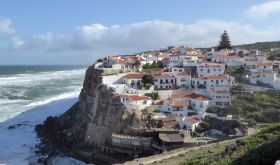
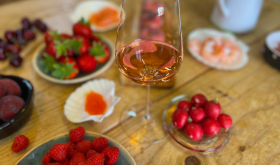
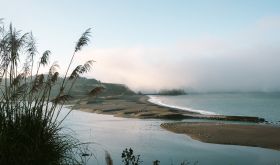
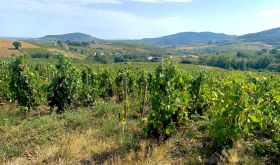
If like me you love melted cheese, great views, not too many people and reliably good wine, Sardinia is for you. This picture was taken just before dinner at one of Cagliari's favourite seaside restos just before sunset.
I made my first trip there this summer and loved it. This was supposed to be a holiday so I visited no wineries and talked to no wine professionals. Like any tourist, I simply chose wines from restaurant menus, looking for names less famous than Argiolas, Santadi and Agricola Punica.
I did a little preparation, asking Walter Speller, our Italian specialist, to recommend a few producers. Recent emails and his esteemed contributions to the latest Oxford Companion to Wine resulted in this list: Colombu, Nuraghe Crabioni, Alessandro Dettori, Gianfranco Manca, Giovanni Montisci, Panevino and Salto di Coloras. Alas I encountered a wine from only one of these on my travels around the south and east coast of the island and that as part of a gratuitous tutorial on the merits of natural wine.
We were strolling around the narrow streets of the old quarter of the capital Cagliari looking for an aperitif and came across Sapori di Sardegna, one of those enoteche that the Italians are so good at, designed to serve wine by the glass and local snacks. The man in charge of this one is a fervid naturalista and was determined to convert not just us but the couple at the next door table outside.
Accordingly he served us two glasses of 2015 Vermentino, Sardinia’s signature white wine grape – one conventionally made by Vigne Surrau in Porto Cervo on the Costa Smeralda in the heavily-yachted north east of the island and the other from committed natural wine producer Alessandro Dettori, based on the north west coast. The glasses could not have looked more different.
The light from the setting sun shone brightly through the pale straw-gold of the Vigne Surrau wine that had Vermentino’s lemony fruit, refreshing digestibility and light saltiness. It had more of a struggle penetrating the dark gold of the Dettori wine that smelt just like the skin of a russet apple and tasted extremely potent. The back label suggested it was 15.5% alcohol but our host told us proudly that in fact it was closer to 16%. There was certainly a tell-tale smoulder on the back of my palate. The text on the back label ended with this, to me slightly ominous, message from the producer: ‘We produce wines we like. They are what they are, not what you want them to be.’ This was a monument of a wine, to be admired for its daring but not necessarily enjoyed.

The shared characteristic of virtually every wine we tried on the island, especially the Vermentinos, was enjoyment. Varietal Vermentino seems to have so much going for it. It has no shortage of fruit but, generally thanks to fairly early picking, tends to have quite enough acidity to make it a pleasure to drink with or without food. Vermentino grown in the north east of the island, Vermentino di Gallura, was awarded its very own DOCG, Italy’s official top wine ranking, back in 1996 – still Sardinia’s only one. Some producers such as Capichera deliberately keep the grapes on the vine much longer and make a richer (but not sweet) version of Vermentino – evidence that the Sardinian Vermentino is not homogenous mouthwash.
For many years Vermentino was most closely associated with Sardinia but recent DNA analysis has shown that in fact it is genetically identical to the Pigato grapes grown alongside Vermentino in Liguria, to the Favorita grape that is a speciality of Roero in Piemonte, as well as to the grape variety known as Rolle in southern France and some of those called Malvoisie on Corsica.
But the name Vermentino is more fashionable and better known than any of these, so the V-word is increasingly used no matter where it is grown. It was long thought that, because Sardinia was ruled from Spain for about 400 years, Vermentino’s roots were Spanish, but there is no evidence for this – in fact it looks more likely that it originated in north west Italy.
But Sardinia’s two signal red wine grapes are almost certainly Spanish in origin. Cannonau is to red wine what Vermentino is to white, and is identical to the Garnacha of Spain and the Grenache of the southern Rhône in France. I was delighted to find that some Sardinian producers are already on trend and making lively, fresh examples of this grape, a bit like the marvels to be found in the Gredos mountains west of Madrid – although rich, spicy, concentrated ones more in the mould of Châteauneuf-du-Pape are also easy to find (at much lower prices than the Rhône archetype).
The other Spanish red wine grape is that known as Carignano in Sardinia, Carignan throughout southern France and Cariñena in northern Spain. I find many lesser French Carignans rather tart and acrid but was long ago won over by Carignano del Sulcis, a speciality of southern Sardinia. Is it the extra heat here (Sardinian summers are very hot) that works its magic on this late-ripening variety?
But the best wine I enjoyed on my serendipitous dip into the Sardinian wine offering was unlike any other. We stopped for lunch in Araxi e Mari di G Guidetti, a Costa Rei roadside trattoria, sympathising with the chef deputed to man the wood fire in temperatures in the high thirties. The wine list had obviously been put together by a wine enthusiast and I was particularly intrigued by the 2004 Vernaccia di Oristano from Contini, whose dry blended table wine made from Vermentino and the Vernaccia grape I had enjoyed earlier in the week.
When I asked for a glass of it with my grilled fresh giant prawns the waitress warned me off it, assuring me it was sweet. But I wasn’t going to be fobbed off the chance to try such an outré wine from the west of the island. And anyway, since flor, the protective yeast that plays a crucial part in dry sherry production, was mentioned on the wine list, I had a hunch the wine was dry. It was bone dry but wonderfully satisfying, like a lighter version of a nutty dry oloroso with rich orange peel flavours. For a 12 year-old wine, this is a bargain bottle, selling from €13 in Italy and Germany and $25 in the US.
All over the island, exciting and generally uniquely Sardinian wines are now being made. I wish more of them escaped.
Stockists from winesearcher.com. For tasting notes see Rest of Italy assemblage.
STAR SARDINIANS
WHITES
Contini, Componidori 2004 Vernaccia di Oristano 2004
Cantina di Mogoro, Puistèris 2012 Semidano di Mogoro
Cantina Gallura, Canayli 2015 Vermentino di Gallura
Ragnedda, Capichera VT 2014 Isola dei Nuraghi
REDS
Chessa Cagnulari (Graciano) 2013 Isola dei Nuraghi
Cantina Oliena, Nepente di Oliena 2013 Cannonau di Sardegna