
Why do so many restaurateurs today seem to ignore the principal reason customers come to enjoy their establishments?
With the exception of those lone diners checking out a restaurant for the Michelin guide or the like, the principal reason for visiting a restaurant has to be to meet people; to converse; to talk, to listen to and to be heard by friends and colleagues. What we choose to eat and drink is important but it has to be secondary. The first function of any restaurant must be to provide an enjoyable and comfortable social environment.
And yet, noise levels in restaurants seem to continue to rise – at least judging by two very recent experiences.
The first was a return visit to akub in Notting Hill Gate in London with an old friend whose family are Lebanese and who retains a lifelong interest in this troubled region. We were shown to a table by the window on the top floor and the three of us sat facing each other for the subsequent 90 minutes. During which we heard very little of each other’s conversation.
The small room had two other tables of principally young women, one of them a table of seven. They were loud, having a good time and the happy noise they generated reminded me of an occasion once in a restaurant in Florence (dining with four senior Masters of Wine) when a woman at the next table gave us a dirty look and got the management to ask us to pipe down. I would never dream of resorting to such a response. The noise level was the consequence of what the restaurateur had created. It was, and remains, up to the restaurateur to solve this issue.
Looking around the room at akub I saw that there was much to be done and little that had been done. There was virtually nothing to absorb the noise: no tablecloths, no curtains or blinds, the walls were bare, there was nothing on the floor, and, of course, there were no acoustic panels on the ceilings. The restaurateur had done little to cope with the consequences of the success that he had aimed for and that his staff were working so hard to achieve. We left before ordering dessert or coffee.
Then last night Jancis came home from a dinner at Gauthier in Soho, organised by Claire and Gonzague Lurton of Chx Haut-Bages Libéral, Ferrière and Durfort-Vivens, who are especially concerned about the rapidly deteriorating world environment and so had chosen this vegan restaurant. One of the principal reasons, she told me, for accepting the invitation was to glean some gossip before her visit to Bordeaux at the end of April to taste the latest vintage en primeur.
In this she was markedly unsuccessful. The small private dining room was crowded and once again the restaurateur had done little to mitigate the consequences of their success. She came home having much enjoyed discussing regenerative viticulture with her next-door neighbour Claire Lurton but largely unable to hear what the man across the table from her had to say.
I have to admit that both of us are over 70 and – as was highlighted in my 2006 article when I took acoustics expert Alan Saunders to lunch at Kensington Place, then London’s noisiest restaurant – hearing is a physical function that sadly declines with age. ‘We spend a lot of money on the designer eyewear that we choose to be seen in but we seem reluctant to spend anywhere near that amount on our hearing’, I recall him explaining to me.
To discover what have been the improvements in restaurant acoustics over the past 17 years I decided to try and contact Saunders again, only to discover that he has retired and was currently uncontactable in New Zealand. Fortunately, his business partner in Clarke Saunders Acoustics, Winchester-based Ed Clarke, was just as professional and helpful.
To my initial question as to whether today restaurateurs care enough about noise levels, Clarke was ambivalent. ‘The noise levels generated by and escaping from restaurants and bars have to be taken seriously by their operators, because when neighbours complain local authorities can see them fined and eventually shut down. But acoustic conditions internally are an aspect less of an existential threat to the restaurateur. And even when customers complain about excess ambient noise, these conditions are often viewed as another aspect of an atmospheric offering. But TripAdvisor reviews do drive restaurateurs to action much more today and we have periodic enquiries from restaurateurs looking for advice on controlling their internal acoustics, even if these still tend to be seen as “nice to have” projects rather than essential improvements’, Clarke added somewhat regretfully.
I followed this up by questioning Clarke on the most obvious acoustic improvement any restaurateur can make to their premises: installing acoustic panels which are widely available on the internet, are inexpensive and can be extremely effective. I quizzed our son Will about the costs involved in installing these in two of his restaurants, Portland and Clipstone, to be told that the installation cost £5,000 at each restaurant and the difference in noise levels has been ‘significant’.
Clarke was extremely enthusiastic about the ‘massive difference that sensitive acoustic absorption can make, especially in the very reverberant environments of the type of architecture often favoured today for vibrant high-end dining’, before adding that the science has made significant progress. ‘At CSA we’ve started using Pinterest to engage with architects’ visual communication needs to generate acoustic treatments that can also look interesting and be part of the overall design rather than something that has to be bolted on afterwards.’
To my final question, as to whether there could be some form of legal recourse – that for example the granting of an alcohol licence could be dependent on a maximum acoustic reading – Clarke was initially dismissive but finally encouraging. ‘My view is that a positive consumer demand for better acoustic conditions in restaurants would be required before restaurateurs really invested time, effort and money in taking this issue seriously. But today there is an app, SoundPrint, designed to help users discover quieter venues in their area.’ This international app appears to be extremely useful and comprehensive but is of course entirely dependent on users’ submissions.
And of course whatever music is being played, inevitably via Spotify, will only add to the noise level. I remember being told when I was a restaurateur that it had to be played, that nobody would sit happily in a quiet dining room. This was bad advice 40 years ago and remains bad advice today. Who can remember what was being played as they were being taken to their table? And yet music does contribute considerably to the overall noise level.
My own view is that unless and until the acoustics in any restaurant are taken as seriously as the quality of the food, the wine and the service, then many customers will continue to struggle to make themselves heard and to be clearly understood. But I suspect too many restaurant designers and architects will continue to focus on what looks good, exciting and modern – such as the increasing prevalence of open kitchens with their abundance of hard surfaces such as stainless steel and tiles – to the detriment of their customers’ conversations.
It seems symptomatic to me that the World’s 50 Best Restaurants, a competition founded 20 years ago in 2003, continues to ignore an attribute that is essential to every restaurant in the world.
Although, so as not to be too ageist, I should probably report what our daughters have to say about noisy restaurants. Julia, 40: ‘It can be slightly annoying but doesn’t really bother me or put me off going out. Though I would probably prefer that to somewhere very quiet! I don’t like feeling you have to watch what you say.’ Rose, 32: ‘I don’t mind them when it’s the noise of the restaurant – it’s often a side-effect of having an interesting restaurant location. But when it’s loud music I will leave. The only time I really can’t hear is when the restaurant is playing music too loudly.’
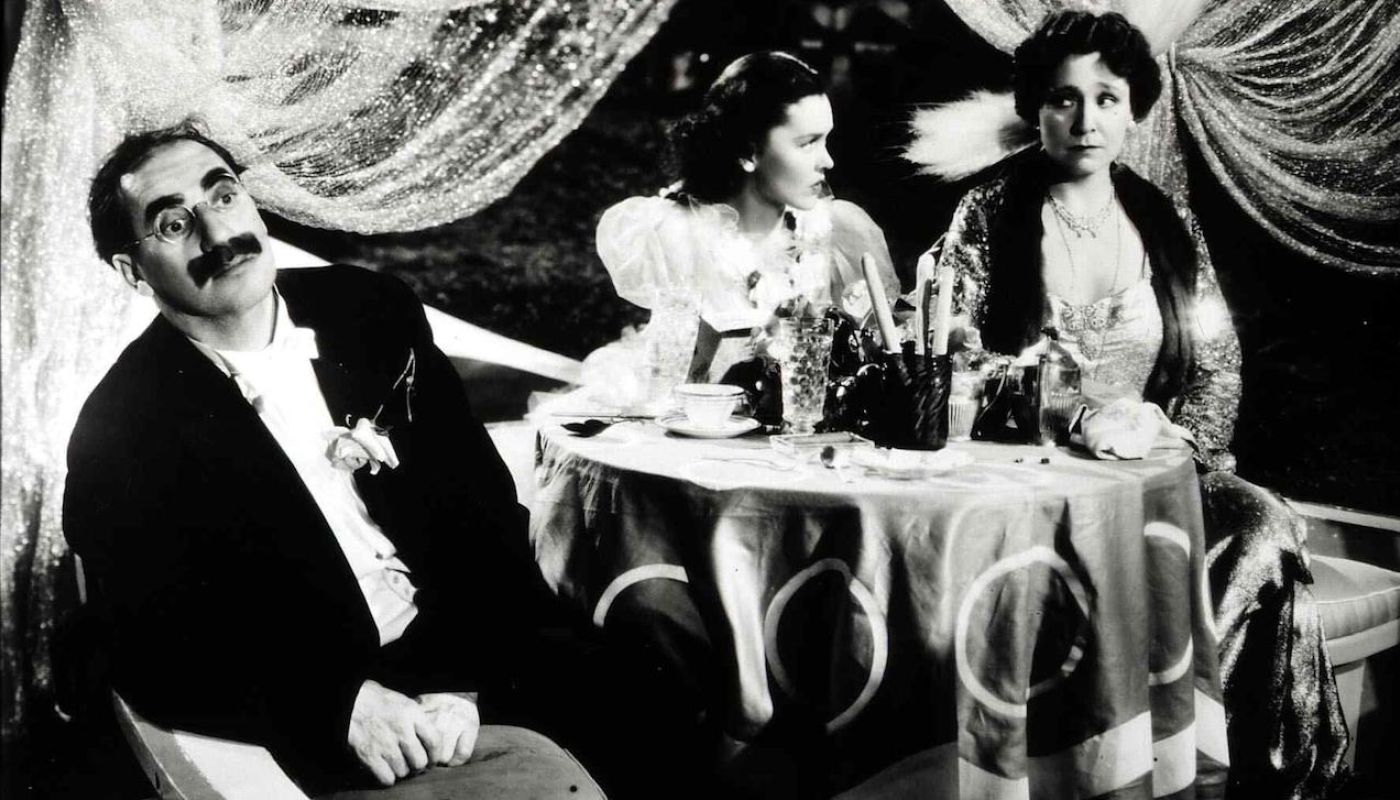
Still from the Marx Brothers' A Day at the Races from FilmPublicityArchive/United Archives via Getty Images.