
Planes to Madrid this weekend will be as full as those conveying world leaders, politicians and bankers to Switzerland for the World Economic Forum in Davos towards the end of the month.
In the expensive seats will be some of the world's most innovative chefs – Gaston Acurio from Peru, Martha Ortiz from Mexico, Matthew Bax from Singapore and Kristof Coppens from Belgium – while their teams of junior chefs will be somewhat less comfortable.
For three days this coming week, these and numerous Spanish chefs, including Ferran Adrià from El Bulli, Martín Berasategui and Juan Mari Arzak from San Sebastian, will perform culinary demonstrations on stage at the ninth Madrid Fusion, this year devoted to the theme of 'dynamism'. This annual gathering of chefs has proved so successful that many other cities have subsequently followed its example.
The most recent newcomer is Seoul Gourmet, which, shortly before South Korea hosted the G20 summit of world leaders in November 2010, also hosted an array of top chefs.
Carlo Cracco from Milan demonstrated his egg-yolk-only spaghetti with smoked garlic and chili for an appreciative audience.
The benefits of sous vide cooking, whereby the essential flavours of many ingredients are ensured by prolonged cooking in a vacuum, up to 24 hours at relatively low temperatures, around 60 °C, were demonstrated by Dr Bruno Goussault, the man who pioneered this technique in France.
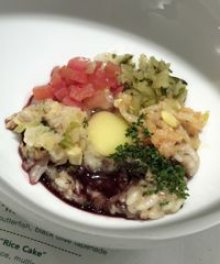
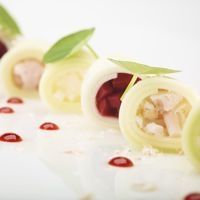
And while the pâtisserie skills of Jordi Roca, of the three-star Michelin restaurant El Celler de Can Roca in Girona, Spain, and of Luigi Biasetto from Padua, Italy, were enthusiastically admired, there was no doubt that the hero of the Seoul event was Sang-Hoon Degeimbre. (His 'kimchi revisité' is shown above left; both photos courtesy of Jean Pierre Gabrielle.)
Degeimbre was born in Korea but was adopted at the age of five when he went to live in Belgium, where he now runs the two-star Michelin restaurant L'Air du Temps in the small village of Noville-sur-Mehaigne. The South Koreans really warmed to the return of this prodigal son.
The most raucous cheers were, however, reserved for Michel Troisgros, from the world-renowned restaurant in Roanne, France, who led all the chefs that had cooked for the Gala Dinner in a rousing Burgundian drinking song while standing on a table in J J Mahoney's, the bar under the Hyatt hotel, in the early hours of the morning.
As well as demonstrations of European and Korean cooking, this gastronomic convention also involved numerous lunches and dinners for the public. Food writers from Sweden, France, Italy, Germany, the US and the UK were introduced to Korean ingredients, the wares of a Seoul supermarket (not the place I expected to see several tanks of live eels) and, of course, to the particular charms of kimchi, the national condiment of fermented cabbage to which liberal amounts of chili are added. The humble preparation of this by a Buddhist monk was a highlight. And, of course, the chefs gave endless interviews that are certain to attract a steady stream of Korean visitors to their restaurants in the future.
This event, now in its second year, joins a growing list of such gastronomic conventions. Madrid Fusion is followed by Omnivore in Deauville, France. This is followed by Tokyo Taste; Identità Golose in Milan and London; the Star Chefs gathering in New York; and finally in November, Gastronomika in San Sebastian, Spain.
While these gatherings are underpinned by a highly charged political alliance of tourism bodies and city councils, as well as sponsors such as the major hotels and airlines, there is no doubt that the main goal of all these events is educational.
 The aspiring young chefs in the audience – and they can number up to a 1,000 at one time in Madrid or Tokyo – are reverentially silent as Heston Blumenthal from The Fat Duck in England, Ferran Adrià, or Grant Achatz from Alinea in Chicago, walk on to the stage ahead of their small brigade of assistants.
Silent that is but for the whirr of their cameras. While a state-of-the-art kitchen is set up in the middle of the stage, all the chefs' movements are scrutinised by cameras to the right and left of where they stand while few in the audience, particularly in Asia, are without the very latest piece of photographic equipment. The chefs perform for around an hour, handing round their finished dishes to those lucky enough to be sitting in the front row and then answering questions from the floor. Once they leave the stage, the chefs are invariably whisked off for yet more interviews.
These gatherings bring enormous commercial benefits and not just to the chefs. The city's restaurants receive a huge boost from the presence of so many journalists in town. The organisers of Tokyo Taste put such effort into this aspect of showing off their city that they arranged for several of the city's top restaurants to stay open throughout the afternoon to cater for the journalists who certainly had their eating credentials put to the test. The city's bars may do even better business. But the real beneficiaries of these events are the host city and the reputation of their national cuisine.
The most high profile of these events and the one that all others seek to emulate is unquestionably Madrid Fusion, which was launched by José Carlos Capel in 2002 just as the world was beginning to appreciate the growing number of hugely talented Spanish chefs.
Madrid Fusion has certain inherent advantages. Its location makes it accessible to chefs from all over the world. It takes place in January, the quietest month of the year in any chef's working calendar and when journalists are desperately looking for new and interesting angles for food articles. And the name, Madrid Fusion, has managed to capture the aspirations and imagination of all those who attend and are involved – although Carlos admits that he had no idea that it would prove so memorable when it was first proposed.
Madrid Fusion's final distinction has been its close association with Ferran Adrià, who has appeared over the years not only as its top-of-the-bill performer but also as the spokesman for the extraordinary culinary progress within Spain. It was on the stage of Madrid Fusion in January last year that Adrià announced that he would be closing his El Bulli restaurant in July 2011 for ever, thereby generating even more headlines for himself and Madrid Fusion all over the world.
It is a tribute to the success of Madrid Fusion that many now believe that cooking in Spain is more exciting than anywhere else in Europe and that it has accomplished this transformation in less than a decade. The Koreans would like Seoul Gourmet to achieve the same.
Seoul Gourmet 2010 had several publicly aired goals. The first was to make food writers from around the world more aware of the distinctive charms of Korean cooking. The second was to promote Seoul as a gastronomic destination to rival Tokyo, Hong Kong and Singapore. There is also the desire to make the visiting overseas chefs appreciate Korean ingredients in the hope that they will incorporate them into their menus on their return (each visiting chef had been sent a large package of Korean ingredients before they arrived).
And, finally, there is the far more long-term and far more ambitious plan to make Korean restaurants better known and more popular globally. The aim is to see Korean restaurants in locations other than where expatriate Koreans are currently most heavily concentrated: in Koreatown, Los Angeles; between 31st and 36th Streets in New York; and around New Malden, Surrey, outside London.
In several respects, Korean cuisine is in a similar position to that occupied by Spanish food a decade ago.
There is no shortage of top-quality ingredients: the fish; shellfish; hanwoo, the high-quality marbled beef; as well as the long-established Buddhist influence which has perpetuated a strong reverence for healthy, and inexpensive, vegetarian cooking. There also seems to be a national obsession with food and a love of all things spicy.
And while the Spaniards used to believe that their cooking was inferior to that of the French and Italians, South Koreans undoubtedly believe that their style of cooking has been ignored while the rest of the world has fallen for the charms of all that Thai, Japanese, Chinese, Malay and Singapore chefs can offer. Having convinced the world to buy Korean, the mission is now to persuade the world to eat Korean.
This is eminently possible. The current vogue for tapas bars and Spanish restaurants certainly did not seem probable a decade ago. Korean food, spicy, quickly prepared, cooked and served does lend itself to the informal and highly successful style of casual restaurant that have seen wagamama, Busaba Eathai, Yo Sushi!, Ping Pong and Pho in London, as well as Momofoku in New York, achieve such wide popularity.
There is no reason why bibimpap, Korea's inexpensive one-pot dish of rice and vegetables topped with beef, fish or chili pepper paste should not be equally popular one day. It certainly brought smiles to the faces of all the chefs in Seoul who enjoyed it for the first time.
Where chefs get together
• 6 min read
This article was also published in the Financial Times.


选择方案
会员
$135
/year
适合葡萄酒爱好者
- 存取 296,559 条葡萄酒点评 & 16,125 篇文章
- 存取《牛津葡萄酒指南》及《世界葡萄酒地图集》
- Access askJancis, our AI wine assistant


核心会员
$249
/year
适合收藏家
Everything in “Member”, plus:
- Early access to the latest wine reviews, 48 hours in advance
- Early access to the latest articles, 48 hours in advance
专业版
$299
/year
供个人葡萄酒专业人士使用
- 存取 296,559 条葡萄酒点评 & 16,125 篇文章
- 存取《牛津葡萄酒指南》及《世界葡萄酒地图集》
- Access askJancis, our AI wine assistant
- 提前 48 小时获取最新葡萄酒点评与文章
- 可将最多 25 条葡萄酒点评与评分 用于市场宣传(商业用途)
商务版
$399
/year
供葡萄酒行业企业使用
Everything in “Professional”, plus:
- 可将最多 250 条葡萄酒点评与评分 用于市场宣传(商业用途)
- Access to submit wines for review
- Offer memberships to your employees and manage them from a single place
- API access available for an additional fee
More Nick on restaurants

Nick on restaurants
An international institution in the southern Irish countryside. In 2011 I travelled to Ballymaloe House, a 40-minute drive from Cork...

Nick on restaurants
伦敦东区餐厅界令人兴奋的新成员。上图,萨莉·阿贝 (Sally Abé)。 萨莉·阿贝 (Sally Abé) 的新餐厅蒂尔 (Teal)...
Nick on restaurants
丹吉尔的鱼之味餐厅 (Le Saveur de Poisson) 绝对值得(稍有挑战性的)一游。 在当今世界的各种餐厅中...
Nick on restaurants
开设第二家餐厅并不容易,无论第一家有多成功。尼克 (Nick) 从伦敦西区冒险进入伦敦码头区。上图为联合主厨杰克·克罗夫特 (Jack...
More from JancisRobinson.com

Tasting articles
Proof that South Africa remains one of the most rewarding countries for wine. Above, Chris Keets (left) of Weather Report...

Tasting articles
历史悠久的葡萄园、高海拔、火山土壤和有机种植的结合使这个鲜为人知的 AVA 脱颖而出。上图为 拉塞特酒庄 (Lasseter Winery)...

Tasting articles
来自热浪年份的诱人清新且易饮的葡萄酒。索蒂马诺 (Sottimano) 从科塔 (Cottà) 特级园(如上图所示...
Tasting articles
来自 2022 年份及更早年份的葡萄酒证明了巴巴莱斯科的陈年潜力。 巴巴莱斯科 2022 年份的晚期发布打破了两个误解—...

Free for all
路边餐馆的乐趣,作者:查理·吉奥根 (Charlie Geoghegan)。照片由杰森·洛 (Jason Lowe) 拍摄。...

Free for all
首个跨大西洋合资企业作品一号 (Opus One) 涉及20世纪葡萄酒界的标志性人物。本文的一个版本发表于《金融时报》(Financial...
Tasting articles
25种在炎热中保持清爽的方式。 上周欧洲经历了有记录以来最严重的6月热浪;本周,美国东海岸各城市将打破高温记录。在这种炎热中喝什么?水...
Wines of the week
一款由前化学家以精确态度和葡萄藤语者灵魂酿造的绿酒 (Vinho Verde) 白葡萄酒。售价 23 美元起,22 英镑起。上图为拉莫斯...