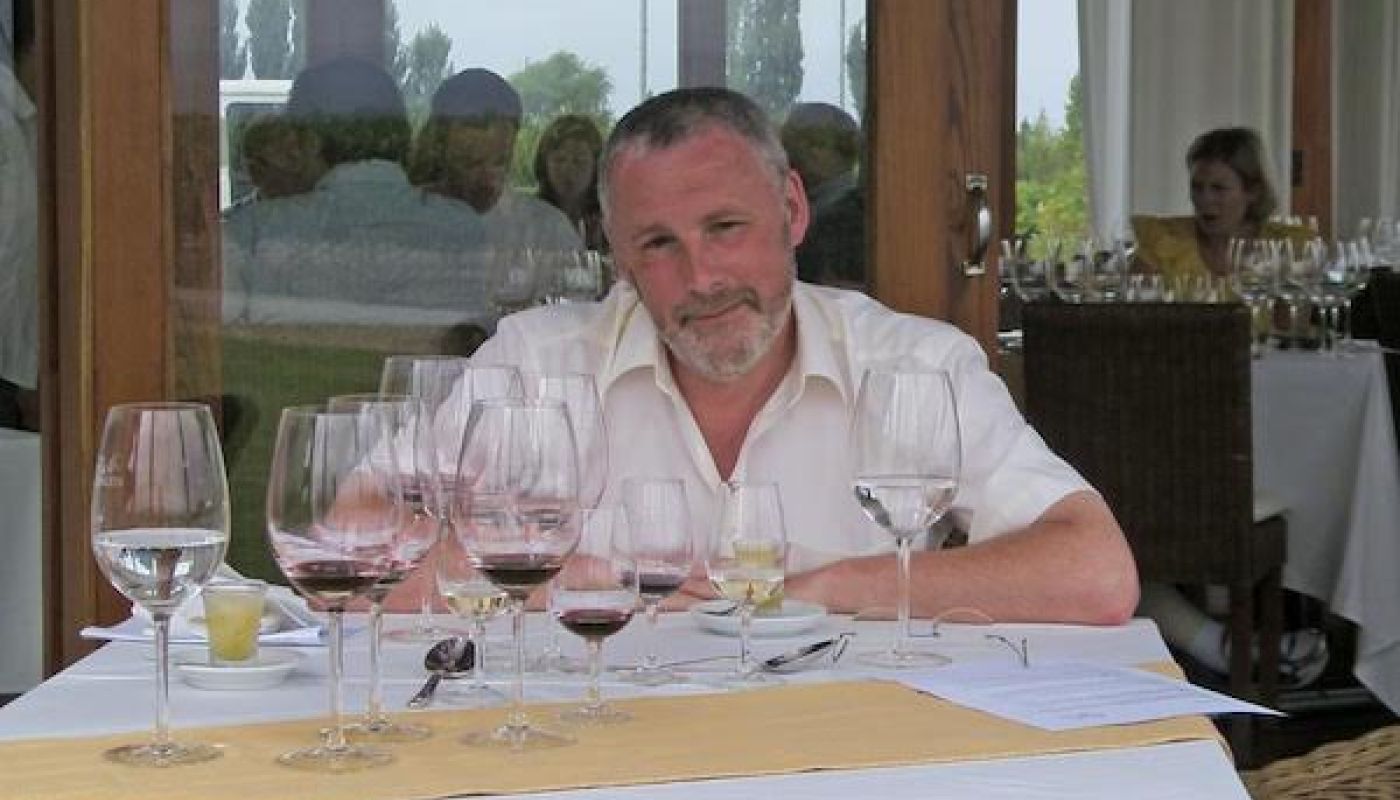
Number 20 in our series of entries from our wine writing competition comprises two entertaining entries from Jonathan Bates, who describes himself in the following terms:
Male, sixty-ish, recently retired (and thus, wonderfully, with time to write) after spending most of my life managing scientists and scientific research. Now based in Brixham, Devon, and enjoying learning about the fishing industry – which not only survives but thrives here. Enjoy travelling around Europe, but also increasingly in South America, where four trips to Argentina and Chile have opened my eyes to some great wines.
A warning for the young wine collector
My mother tells me that when I was very young I loved cheese. Then I went through a spell in my teens where I hated it so much I wouldn’t touch it. Now I consider myself something of a connoisseur. I rarely leave our (very good) local cheese shop without half a dozen examples for the weekend.
There isn’t anything too startling about that. People’s tastes change. I liked punk music once.
It’s the same with wine. Your tastes change.
It’s difficult for me to believe how much I once enjoyed the heavily aromatic, nettle-filled notes of a basic Sauvignon Blanc. I suspect many of us of a certain age will have started our wine voyage accompanied by endless bottles of cheap wines from Touraine. We bought Sancerre and Pouilly-Fumé when we could afford it, Menetou-Salon when we wanted to show off to friends. Then we discovered all those ultra-grassy New Zealand Sauvignons and we were off on a giddy exploration of the New World, desperately seeking the small allocation we were allowed of the latest Cloudy Bay vintage.
Now? I rarely touch Sauvignon, other than at tastings, when I tend to sniff at it suspiciously before letting it anywhere near my mouth. Or I wait until it’s blended with a great Sémillon to produce a fine, oaky Graves.
But there's not too much harm done there. It’s not as if I’ve laid down a lot of Sauvignon Blanc. However, if you had told me thirty years ago that one day I might not want to drink a mature Château Haut-Marbuzet or La Lagune or that a Léoville-Barton would be a wine I could take or leave, I wouldn’t have believed it. Even less likely would it have seemed that the opulence of a fine St-Émilion would not immediately excite me. Or that I would look twice at a well-reviewed bottle of Pomerol.
The trouble is, tastes change. I find claret too inky these days. There’s too much cedar, the freshly sharpened pencil notes don’t grab me, I don’t enjoy the oak. A lot of good claret is too dry in my mouth, particularly at the finish. And I’m not talking here of young, tannin-laden, mouth-puckeringly difficult bordeaux – I’m talking of mature wines, the wines from the late 1980s and 1990s with which I filled my cellar. My name is Jonathan and I was an en primeur addict. Hungerford Wines were my by-word. I justified the fact that I had no savings with the thought that one day I’d be drinking wines I wouldn’t be able to afford any longer.
I was right about one thing. I have a lot of wines in my cellar that I wouldn’t be able to afford to buy these days. The trouble is that I don’t drink them. Some of those wines of the 80s and 90s – mature now, lovely for those who still like fine Bordeaux – get passed on to friends or family. I’ve even used them to reward tradesmen for a job well done. Very occasionally I’ll try one, but it’s usually with a heavy heart.
I should like them, I know.
I could sell them, of course. To do that, though, I would need to have stored them professionally and I’m afraid that when I was younger and buying these wines was stretching my resources to the limits, I preferred an extra case to meeting the cost of storage charges. I piled my cases in outhouses, garages, even lock-ups. Oh, I ensured they weren’t south facing, I measured their temperature regularly – and for the most part the wines I’ve stored, some for thirty years plus, have aged well. Some are corked, but then so are some wines I have bought in the last year. However, I can’t give a buyer the reassurances they require.
It’s not just Bordeaux, that’s the trouble. Even Châteauneuf-du-Pape and Gigondas, those twin loves from a time just before Robert Parker discovered them, wines that I have filled my car with on endless trips to the south, wines that I relished tasting as I stumbled round vineyards on glorious, sun-filled days when the galets threw their heat back at me … well, even those rest longer on their racks and shelves than I ever expected. Even the mature 85s, 89s, 90s, with their lovely, ripe blackberry flavours, seem over-alcoholic. I just can’t manage more than a glass or two, and during spring and summer my eyes pass over them and then on to something else.
As I say, your tastes change. [See, for example, Jancis's recently re-published 2001 article How our taste in wine styles has evolved.]
The good news is that there are so many wines I still enjoy. Red burgundy, for example. The taste of red burgundy has just got better and better over the years. My mouth loves the myriad flavours of cleverly made burgundy. Whether that’s because my taste buds have evolved or because the winemaking is getting better is a moot point. A bit of both, I suspect.
And then there are wines that I’ve come to enjoy, because in the same way that my taste buds no longer love certain flavours, there are others that once were a mystery to me once that now offer endless delight. In the same way that I now love Époisses over a great cheddar, white burgundy was the great discovery of my 40s and 50s. At one time I honestly didn’t quite get them: now I have a cellar (well, a garage) full of Chassagne-Montrachet and Puligny-Montrachet. I’ve rediscovered Chablis. Argentinian Malbec, which I once thought almost vulgar in its richness and ripeness, has gripped me by the throat and wrestled my pension from me. There’s a whole gamut of flavours from Chile that I enjoy.
Champagne has just got better and better. Growers’ champagnes are the joy of my wine-drinking life: I can’t get enough of them.
So what’s the lesson? Well, if I could have my time again I would still buy the wines I enjoyed at the time I enjoyed them. Only maybe not so many, because I would bear in mind that what I enjoy now I might not enjoy tomorrow.
And I would gladly meet the storage charges that I once rejected. I would happily pay someone to look after my wines for me, because it’s like insurance – you might not need it, but it’s great to have it when something goes wrong. Or when your tastes change. And, to be fair, those charges actually seem pretty good value now, given the way that the cost and value of fine wine has appreciated over the years.
By the way, I do still like punk music.
I just don’t play it very often.
A day in a cold climate

Señora Marín has a problem.
The men will not go into the barrel store.
It is eight days after an earthquake measured at 8.8 struck Chile. Five hundred people died; the San Antonio area, where we are standing, suffered very strong to severe shaking. ‘The men are afraid', she says. It’s not surprising. We’ve already felt one after-shock; last night in Valparaiso all the lights went out for miles around as we sat on a restaurant terrace looking out across the city. It was disconcerting.
It is always a possibility, here in this long, thin country that lies along the Pacific Rim, directly on the Ring of Fire.
When we go in to the store, we can see at once the problem: the barrels have been shaken off their battens. They no longer rest evenly. It’s as if someone has swept their hand across a chessboard in annoyance at losing a game.
I have seen how vulnerable wine production is to the vagaries of the weather. I’ve felt the sharp sting of the hail that accompanies the sudden, violent storms that strip the vines in Chablis, Meursault or Pommard – hailstorms so violent that you can understand why the word ‘stone’ becomes attached to ‘hail’. But making wine in a country where the earth itself can rise up against you? Señora Marín shrugs. The gesture seems to suggest that you play the hand that is dealt you.
María Luz Marín is a woman easy to like. When she greeted us and began to walk us round Casa Marín (one of the other ladies that greets you at the estate is pictured above), we expressed our surprise and pleasure that she was giving us her personal attention. She corrected our assumption. ‘I have no one else', she explained. ‘All the men are busy. We have far more important things to do than show visitors round today.’ Her eyes twinkle as she says it, to mitigate any offence. But she means it. Even if the men will not venture into the barrel store, they are still busy dealing with the consequences of the earthquake. My guess is that she could occupy her own time better. And yet she is still showing us round and then presiding patiently over a lengthy tasting of the wines she produces.
She professes surprise at my lack of enthusiasm for Sauvignon Blanc. ‘Have you tasted this?’ I sniff, sip, my antipathy fairly obvious. Then grudgingly accept that the wine in my glass is more subtle than many. There are mineral notes to it. The wine is from a vineyard close to the Pacific and tastes, she claims, of the salt carried in by the breezes off the ocean. I’m instantly cynical, questioning the chemistry of this. But the wine does have a subtle saline sense that makes it instantly more interesting than most Sauvignon.
We sit there, sipping on the wine, taking in the differences. And yes, I have to admit that while I don’t drink Sauvignon Blanc, I might serve this to friends who like it. A Sauvignon Gris, offered to us next, is startlingly good. I’d last tasted one in the St-Bris region of France; this was similar to that in the same way that Crémant de Bourgogne is similar to fine champagne. Once again, there is that saline, mineral note to it that makes it distinctively different from other New World Sauvignon. It’s partly oak-aged and I suspect it makes a great food wine. Now this is one I’d buy and drink myself ...
Señora Marin tells us how, when she began to create her vision in 2000, she planted varieties here that no one else was planting in Chile, that no one believed would thrive here. But they did. Riesling and Gewürztraminer, for example. The Gewürztraminer is a triumph: everything you’d expect of the grape (lychees, etc) but multi-layered, long, less fat than many of its Alsace counterparts and all the better for it. I’d tasted this back in the UK and been surprised by it. Sadly, production recently has become very limited due to repeated frost damage in the vineyard. They have to fight the weather here, as well as earthquakes. The Riesling is good: fresh, very elegant, interesting.
She also planted the more usual Syrah and Pinot Noir – and they too are good, complex, subtle wines. Subtle is a word I find myself using a lot at Casa Marín. She charged higher prices, not just to reflect the costs of production (irrigation is a great deal more costly here than in the neighbouring Casablanca Valley, for a start) but to send a clear signal that this was fine wine.
And it is.
It was a risky strategy, though. Unlike many of the other producers we’ve visited in Chile, there is a distinct sense of the small scale here at Casa Marín. It’s more like a homestead than a factory. This is like the sort of winery you come upon in the backstreets of Châteauneuf-du-Pape, a total contrast to the acres of stainless-steel tanks we’ve seen elsewhere in Chile, wine farms that look like they’ve been dropped in here from California. The wines here are from named, single vineyards. That’s not something you see a lot of in this country.
As we walk around the rolling, hillside vineyards of this distinctly small-scale operation, something suddenly strikes me. Over the years I’ve noticed how I’ll nod at something I read, thinking I understand it – and then I’ll have an experience and suddenly really appreciate what was being described. So here we are at Casa Marín on the Chilean Pacific coast and it’s distinctly cool, whereas not that far inland, in Casablanca, towards Santiago, where we were a few days ago, it was seriously hot. Here, though, you can feel the chill in the air. It’s like Bakewell on a March morning. And I realise not only that Casa Marín makes cool-climate wines – but what that actually means.
Indeed, when Señora Marin created the winery in Lo Abarca, many were sceptical not just about her choice of varieties (and, as she frankly admits, about her gender): they thought it would be too cold here. Despite her background in the wine trade, she couldn’t get investors. And yes, it can be cold: we had just spent a few days walking the Pacific coast and felt that icy hand reaching up from the Antarctic. Our eyes had strained to see across the ocean towards the penguins inhabiting one of the nearby islands. The Humboldt Current causes banks of fog to form that cling to the littoral fringes of the San Antonio region, trapped by the mountains that dominate inland. Those fogs can hang over Lo Abarca for days at a time. Then there’s that frost I mentioned earlier, that so impacts the Gewürztraminer. Not to mention the cold winds that sweep the area.
‘That must have been some vision to have, back in 2000', I suggest.
If there are downsides to trying to make wines in a cool climate, though, there are also upsides. The long growing times, time for the grapes to really ripen. The struggle that the vines have to go through. Vines can be a bit like politicians, or chefs, or sportsmen. Those that have it easy can be less interesting – and in Chile, you have to fight against winemaking being just a bit too easy. The grapes do ripen in this country: if anything, they can ripen too much. Syrah can become jammy. Cabernet often is. Drinking Merlot can be like being punched in the jaw. Partly owing to climate and location, partly owing to the strict Chilean laws, disease is far less of an issue than it is elsewhere.
You couldn’t say that the subtle, interesting wines of Casa Marín have it easy. These wines have been challenged by their location, then coaxed, trained, and encouraged. They’ve had to work a bit. The results are clear: an unusual depth of flavours for Chile, balanced by good acidity. Subtlety.
But I am left with a question. How will they get those barrels back onto their rests?
















