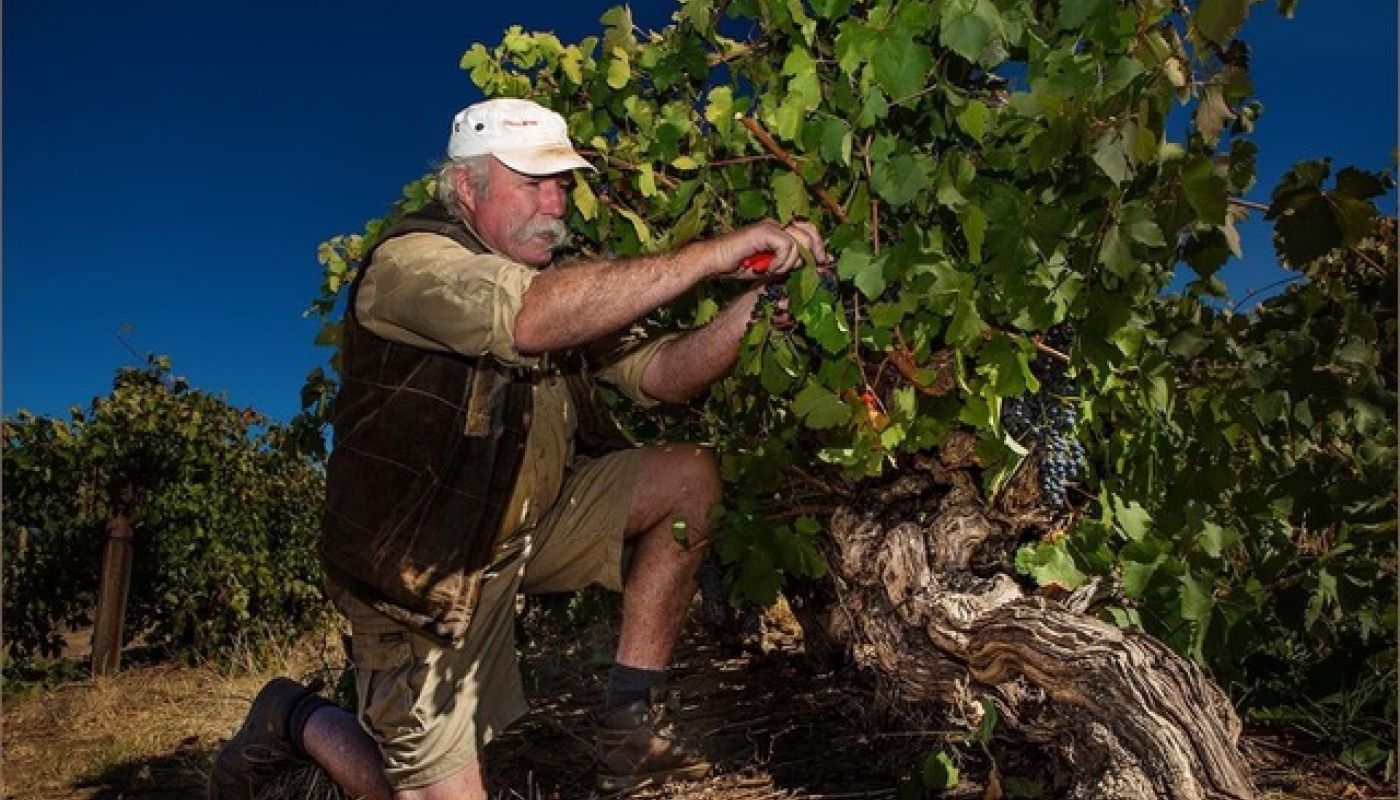
Gibson Wines, located in the heart of South Australia’s Barossa Valley, is anything but typical. Here one can find not only the world-famous Barossa Valley Shiraz, but also traditional European varietals such as an Italian Vermentio, Fiano, Nero D’Avola or Montepulciano. Fancy a little Tempranillo but don’t want your standard Rioja? They have you covered. I personally love their Mataro/Shiraz/Grenache blend, Wilfreda – a South Australian take on a southern Rhône classic. If you want to go for a local favorite, try The Dirtman shiraz. And the inspiration behind that name? Rob Gibson – better known as “Gibbo” to his friends. He is the dirtman; a name given to those who study viticulture at Roseworthy College, his alma mater. No matter how I try to characterize Rob I will fall short. The man simply cannot be put into a box. There’s no tidy category he fits into. His wines don’t fit into any tidy categories either. As Rob appeared on my screen for our zoom call in May, I was greeted by his impressively large mustache, relaxed personality, and the kind of smile that can only come from a life spent pursuing one’s passions. Rob arrived at a passion for wine making he says, by accident. He calls it “following his nose” and his nose led him to work for Penfold’s back in the 1970’s. Today, Rob’s passion is old vines; a passion he cultivates with the production of his Old Vine Collection.
There are two wines -both Shiraz – that currently make up this collection: one from the Barossa Valley and one from the slightly cooler and higher-elevated Eden Valley. If you’re lucky, you may yet find a bottle of a third wine, formerly a part of this collection: A McLaren Vale Grenache. Should you not be so lucky however, don’t fret. The two wines remaining in this collection leave you wanting for nothing. When Rob says that these vines are old, his definition and indeed the definition of the Barossa zone in general, is quite a lot different from mine. The oldest vines used in making his Barossa Valley Shiraz were planted in the early 1860’s. Just to put this into perspective: When the vines that produce this gorgeous wine were first planted, Queen Victoria was on the throne and Abraham Lincoln was the President of the United States! The so-called young vines used date back to around 1911. To taste this wine is really to take a sip of history and for Rob, history is the whole point. Rob produces only 6 barrels of his Old Vine Barossa Valley Shiraz each year. He could of course focus on younger, higher-yield vines that are more profitable in the long run. Many older vines were sacrificed to this way of thinking in Australia in the 1980’s, as many older vines were uprooted in favor of younger vines that could produce, well, more than 6 barrels a year. Thankfully, Rob didn’t follow the trend.
“It was more a passion of preserving antiquity and taking care about little things. In the hurly burly of doing all the mass things that you do to try and make a wine business work, it was more that. It was more preserving the heritage”, Rob told me. I must say this is the aspect of wine that fascinates me the most: how intertwined wine is with the story of who we are as human beings. History, geography, culture, and tradition – it all seems to come together in the moment that you lift the glass to your lips. People like Rob understand this and want to ensure that the story of Australian wine making isn’t lost in the pursuit of profit. This is why he and other winegrowers in the region formed the Barossa Old Vine Charter and established a classification system for these vines. The next step in their process is to establish an Old Vine Register and document vines like those Rob has collected or one might even say, “rescued”.
During our conversation, Rob was helpful enough to correct my use of the word “vineyard” as, in Australia, they are simply referred to as gardens. Traditionally, families in the Barossa would plant grape vines as one might the vegetables in a vegetable garden; everything sort of mixed together. The wines that resulted were for private consumption, just something tasty and simple to be enjoyed with a meal. But gardens aren’t always well-tended and unfortunately, these vines were no exception. They were often, according to Rob, simply forgotten. He describes the older vines as being somewhat small and insignificant, when not cared for. Like he said, caring for old vines is about taking care of the little things. Tending to the details that others overlook. Occasionally someone would prune these old vines simply for aesthetic purposes, but in extreme cases, vines were not tended for five or six years at a time. It is vines like these that Rob rescues. Perhaps the reason for this nonchalance regarding such vines has to do with another element of Australia’s wine-making history: The fortunate absence of Phylloxera. The “Great Wine Blight” of the mid-19th century completely missed [South] Australia. Unfortunately however, shiraz vines would have to contend with another agricultural blight. Due to the “garden-like” style of planting so common in the Barossa, vines were often planted among apricot orchards. Unluckily, the fungus Eutypa lata thrives in apricot orchards and subsequently wreaked havoc on the shiraz vines planted in the orchards. Shiraz vines lucky enough to have been planted elsewhere, survived. Such “close shaves” is yet another reason that Rob feels that old vines “are so damn precious”. It is however important to remember, as Rob said in a presentation to the International Shiraz Alliance that “whilst vine age may often be used as an indicator of potential quality, it is not a prerequisite for quality, just as variety, region or maker does not, by itself, create a superior wine”. But these wines are superior.
With age, the vines have been able to produce wines of immeasurable complexity and character. It is anything but a “standard” south Australian shiraz but at the same time, the finest examples. One would expect them to be heavy and a bit austere but that is simply not the case. They are surprisingly fresh and yet not lacking in power. As Rob put it, the Barossa Shiraz is “surprisingly light on its feet”. It has gorgeous minerality and somehow a sweetness, albeit a dry sweetness. Allow the wine to breathe and notes of toasted grain will manifest themselves. Its surprising, sometimes contradictory and anything but typical – and this is only the case with the Barossa Valley Shiraz. The Eden Valley Shiraz expresses itself completely differently. This is not difficult to imagine being that terroir in the Barossa zone in general is extremely varied. Even within the Barossa Valley itself, the same varietal can vary immensely from vineyard to vineyard (or garden to garden, if you like) as the soil is so varied. The soil, in the case of Rob’s old vines, consists of a sandy topsoil layer, but way beneath the surface, there is a layer of clay which collects the moisture of the rainy seasons. The roots of old vines can reach into reserves of moisture that younger vines couldn’t begin to access - yet another factor in the survival of these vines.
Through Rob Gibson’s Old Vine Collection, I have become convinced that old vines, when cared for properly and placed in the hands of a brilliant winemaker can reach places that younger vines couldn’t begin to do. Much like the deep reserves of water into which the vines reach, they reach into antiquity and carry with them the story of winemaking in the Barossa. The wines themselves are full of expressive character, elegance, and charm, developed, in some cases, over the course of 160 years. “Old vines develop their character with age. They are like the wrinkles in a wise old man’s brow” Rob told me as we wrapped up our final chat about these his old vine collection. Gibbo, like his wines, is full of character – developed over the course of nearly 50 years in the wine industry. Gibson wines is celebrating their 25th anniversary this year. Please find one of these splendid expressions of shiraz and celebrating with Gibbo and his team! During this time of pandemic in which we now find ourselves, wine is your passport to the places you have always wanted to go. Might I recommend a little trip to the Barossa Valley?
The photo above was provided by Tim Eichberger.
















