Before I get to the news, I have a correction: in last week’s newscast I stated that Trump tariffs are hurting US producers due to rising prices on corks, barrels, glass and winery equipment. While that is mostly true, corks are exempt from higher tariffs according to key term #2 under the statement released by the US and EU. Thank you to Nick Jackson MW for catching that.
Napa fire update
As of Friday morning, the Pickett Fire has burned 6,803 acres (2,753 ha) of northern Napa Valley and is 41% contained. The economic cost is estimated at $65 million – all in agricultural losses; no structures are reported to have been damaged. Investigations as to the cause of the fire are ongoing.
EU’s largest wildfire season on record
Meanwhile, fires in Spain’s Castilla y Leon, Galicia and Asturias regions continue to burn. Reuters reports that wildfires have consumed more than a million hectares of land so far this year, breaking all records since the EU began tracking wildfires in 2006.
Château Lafleur leaves Pomerol
On 24 August Château Lafleur, a top estate in Bordeaux’s Pomerol AOC, announced that, starting with the 2025 vintage, they will designate all their wines as Vin de France. Two days later they clarified the reasons behind the move, explaining in a press release that, faced with a 73% water deficit in March 2025, they altered their vineyard practices in line with actions they found to be helpful in experimental plots they have studied for over a decade. They reduced the canopy height to limit water loss through transpiration; left more foliage to protect their fruit; and in mid June began occasionally irrigating at a depth of 15 cm directly to the vines’ roots. Currently, irrigation is permitted in Pomerol AOC only after government authorisation – something that happened only on 22 August this year, much too late to help growers.
Lafleur proposed five changes to the current regulations that they believe AOC Pomerol should adopt: authorising planting at lower densities, soil-covering techniques such as mulching, the use of canopy shading, reductions in canopy height and irrigation that’s carefully controlled and uses only water from outside the public drinking-water network. Expect to hear more on this topic soon.
Canada lifts tariffs on US wine
On 22 August Canada’s Prime Minister, Mark Carney, announced that, as of 1 September, Canada will drop the 25% retaliatory tariffs imposed on items protected under the US–Mexico–Canada trade pact. This includes wine. However, as the California Wine Institute pointed out in its response, ‘Provincial sales bans are still blocking US wines from reaching Canadian shelves across most of Canada.’ Just this week, Quebec’s liquor board announced that they would be destroying $300,000 worth of US alcohol that had expired (products such as bag-in-box and RTD drinks) since the provincial government ordered that shelves be emptied of US alcohol back on 4 March. Quebec has $27 million worth of US product in storage that is non-perishable.
Champagne freed from foils
Two years ago, in August 2023, the EU ruled that foils on sparkling wine should be optional, not required. The Comité Interprofessionnel des Vins de Champagne (CIVC) responded by requesting that the National Committee for Wine Designations of Origin (INAO) include it in Champagne’s AOC regulations – arguing that the foil was vital to Champagne’s brand identity and should be retained. They then initiated an in-depth study on its role and on consumer perception of foil. As the results showed that eliminating foils did not pose a significant risk to overall sales, the CIVC dropped their request on 27 August.
This seems a small thing, but it is nice that producers are no longer obligated to use what eventually becomes just another piece of waste. While foils might help to protect corks from bacteria and fungi during long-term storage, only a small proportion of wines are aged. Maybe the ones meant for immediate consumption shouldn’t have a foil.
Unfortified sherry now official
On 29 July, the European Union officially approved unfortified sherry! The caveat is that in order to label an unfortified wine with the Jerez DO, the wine must naturally reach the 15% minimum alcohol requirement of the appellation either through ripeness or through drying the grapes – referred to as the asoleo method. This change applies to Fino, Amontillado, Oloroso and Palo Cortado. Due to the 15% alcohol requirement, this change does not affect the many producers making lower-alcohol unfortified wines – often referred to as Vinos de Pasto – under the Vino de la Tierra de Cádiz IGP.
2025 harvest starts around the world
On 18 August Anjou-Saumur began harvest for Crémant. Quality is expected to be good but yields are low.
On 21 harvest began in the Santa Lucia Highlands in California with the first grapes destined for sparkling wine.
On 22 August news listener Julia Runnacles emailed to let me know that Merlot was being harvested for Crémant in the commune of St-Michel-de-Fronsac. Thank you, Julia! As for reds, along with the declaration that they were leaving the Bordeaux appellation, Château Lafleur sent news that they began their red-wine harvest on 26 August … though since they’ve given up the appellation, perhaps Château Troplong Mondot, who began on the 28th, will be considered first to pick?
Also on 22 August, news listener Laurent Richet messaged with the news that in Burgundy, Domaine Leflaive had started their harvest with the Clavoillon vineyard and that Château du Moulin-à-Vent would begin picking this week.
On 27 August The Drinks Business reported that Symington Family Estates has begun harvest in Portugal with white grape varieties in the regions of Douro, Alentejo and Vinho Verde.
On 28 August Harper's reported that France's Rhône Valley has begun harvest – they’re expecting lower-than-average yields but high quality.
That’s all for this episode of the wine news. If you enjoy this newscast and would like to see it continue, please become a member of JancisRobinson.com. And if you have breaking news in your area, please email [email protected].
This is a transcript of our weekly five-minute news broadcast, which you can watch below. You can also listen to it on The Wine News in 5 Podcast. If you enjoy this content and would like to see more like it, please become a member of our site and subscribe to our weekly newsletter.
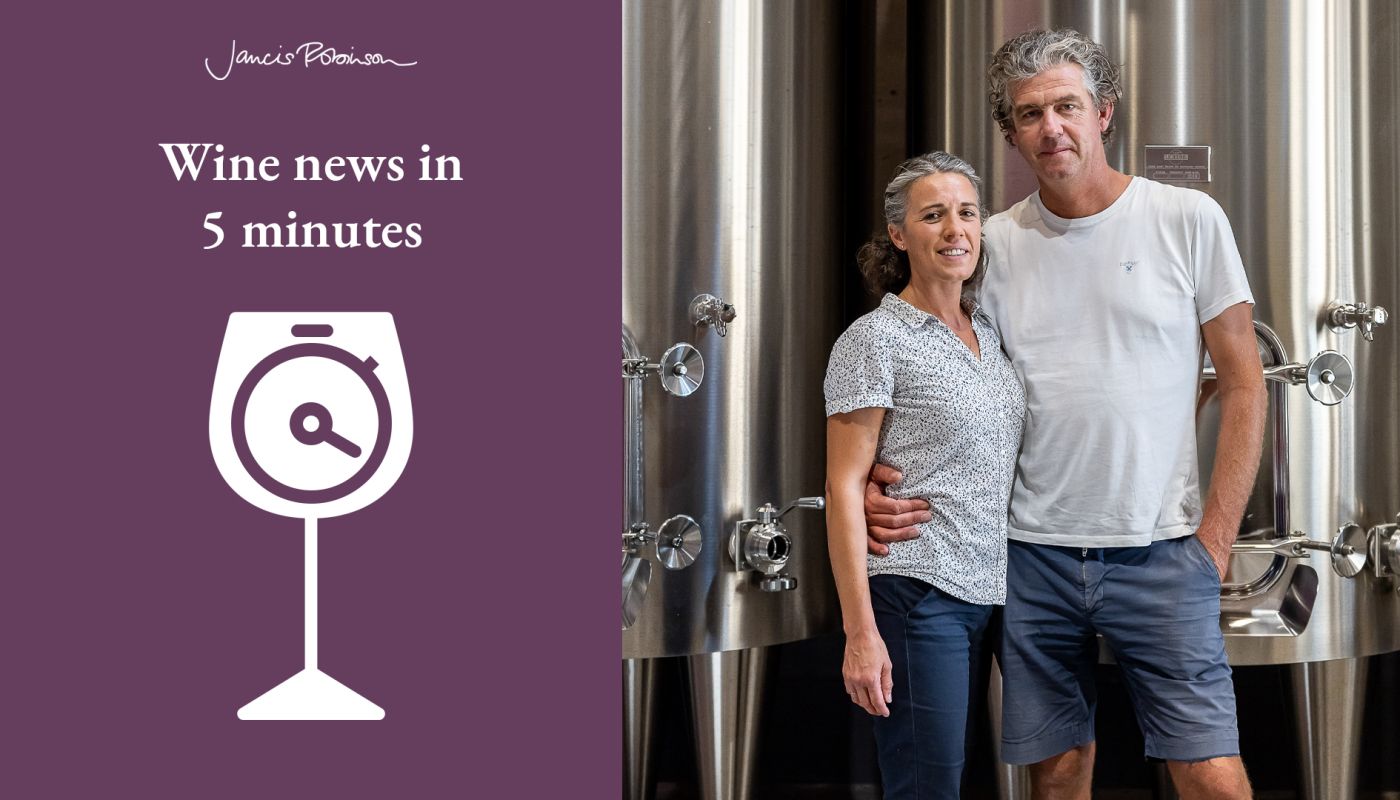
Photo at top of Julie and Baptiste Guinaudeau of Château Lafleur, courtesy of the château.