Tear up everything I have ever written. Ignore all that I have said. Perhaps after all the roles of restaurateur and chef are not confined to those in their twenties and thirties. Although on second thoughts Bruno Verjus may be the exception that proves my previously stated rule.
Verjus is 63 and has been the chef, restaurateur, inspiration and lynchpin behind his two-star Michelin restaurant Table in Paris for almost 10 years; it celebrates its tenth birthday in April 2023. He was 54 when he first opened Table. He has very forthright ideas about whether his career choice is a suitable one for anyone of a similar age.
Verjus has not always been in the restaurant business. Born in Roanne, he initially trained as a doctor, then was in business before the food bug really got him and he was for several years a successful food blogger. I first met him about 15 years ago at Hedone restaurant in Chiswick, which an equally food-obsessed Mikael Jönsson, another self-taught chef and one who also turned to cooking later in life, once ran with great aplomb.
In 2005, Verjus, who almost qualified as a doctor, sold the medical business he had built, and had a strong collaboration with the Omnivore Food Festival, before turning his intelligence to writing books and to radio. With his friend Alain Kruger he created a radio show for France Culture called On ne parle pas la bouche pleine (No talking with your mouth full).
Once bitten, Verjus decided to take the plunge and, looking around for a suitable location, he struck lucky. His initial offer on his current site was unsuccessful and he looked elsewhere. Then a phone call came through from the landlord who said the higher bidder had fallen through. ‘If I had been less naive, I would have lowered my offer', Verjus joked on my recent visit to Table, ‘but it is still very reasonable and the whole area, on the borders of the 11th and 12th arrondissements, has improved significantly over the past decade.’
The restaurant’s interior has changed little over the years. Only the customers’ chairs have been replaced with something far more comfortable. Table is heavy on polished metal. There is the open kitchen which runs down the right-hand side. The eating area forms an undulating run directly in front of the kitchen, with a gap wide enough for the rotund Verjus to slip through. It is also possible in fine weather to eat in the elegant garden.
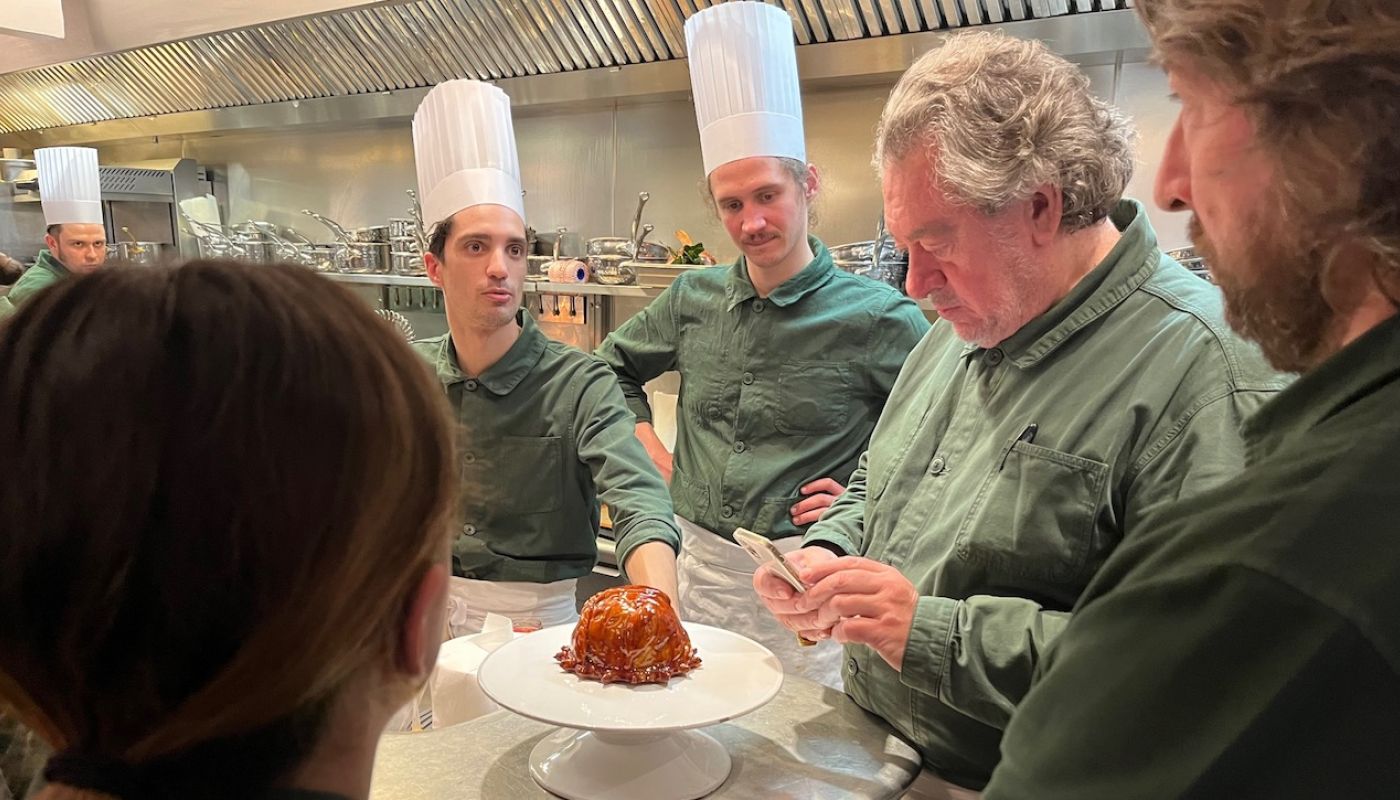
The kitchen is notably high tech, made to appear even more so by the spacecraft-like presence in front of it of eight able-bodied young men and one woman all wearing dark green shirts. Verjus was wearing the same (‘it’s important that we all look a team', he explained). This impression is strengthened by the fact that all the chefs wear white chefs’ hats, which they leave by the open grill between services, while Verjus distances himself by wearing a pair of purple tartan trousers and orange sneakers.
This team produces a menu of approximately 15 very differing courses plus cheese and desserts for a staggering 400 euros per person (this is more or less the price in many of Paris’s top restaurants today. Guy Savoy charges 630 euros for his 15-course tasting menu). Business is brisk, however, with 80% of his customers from overseas – including one man from Hong Kong who flew in, ate on his own with a bottle each of Selosse champagne and Domaine de la Romanée-Conti burgundy, and then flew out. They usually serve 14–16 customers every lunchtime and 24–26 every evening, Tuesday to Friday. ‘I like my team to have time off’, Verjus commented. ‘That way their personalities develop.’
The menu changes constantly depending on inspiration and what the kitchen is sent. To justify the price there is a run of expensive ingredients: foie gras, truffles, caviar, sea urchin, sea bass and expensive cuts of tuna. But reading through the menu that I was handed at the end of the meal, I was struck by the kitchen’s creativity with the less expensive ingredients.
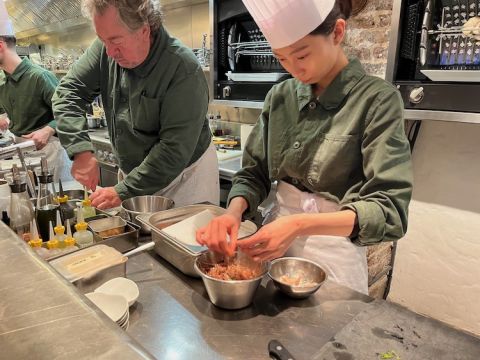
A Parisian friend and I began with a trio of small dishes, the highlight being a pastry case filled with diced raw shrimp which the young Taiwanese chef peeled with great dexterity under our noses. This was followed by a most unlikely combination of a dish of sea urchin and veal bone marrow in a langoustine consommé, the obvious richness of all three cut by the addition of citrus. This was an example of the high level of technique assisted by the almost complete absence of salt, which had the unquestionable effect of making all the major proteins taste far sweeter and therefore more succulent than usual.
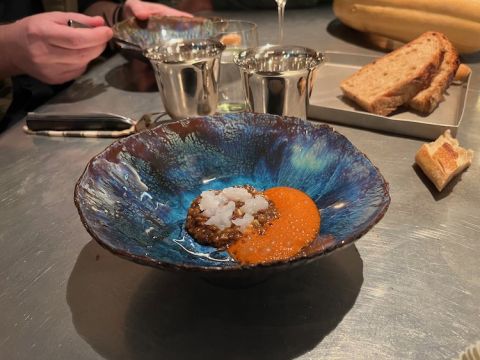
Dish number eight was called simply Donburi, the Japanese for bowl, and marked the beginning of a new level. The blue bowl contained white lentils from Champeix in the Auvergne, cooked to generate a lovely crunch, topped with diced raw squid alongside a seafood emulsion. This to me was possibly the highlight of the lunch: how anyone concocted such an intense, fragrant and flavourful combination is beyond me. This was served with a glass of elegant IWA sake, made by Richard Geoffroy, formerly chef de cave at Dom Pérignon and a good friend of Verjus, that was elegantly presented by their sommelier, Agnese Morandi.
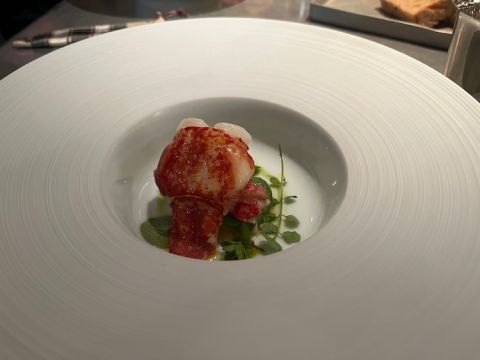
There then followed two pieces of the sweetest lobster poached in butter enlivened with capers; a red prawn from Palamós in Spain, which we could hear spitting on the grill, highlighted by a sauce of ginger and turmeric; sea bass with caviar and a cockle sauce; and a relatively small but thick piece of belly of tuna that was grilled and served with a sauce of three peppers – a play on steak au poivre.
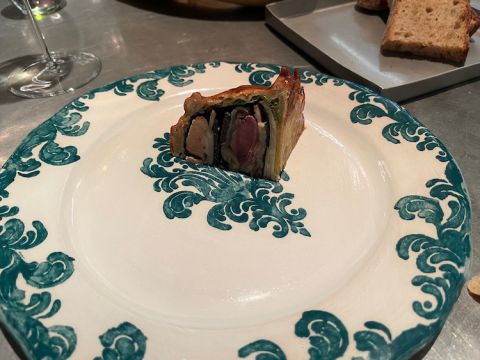
Finally, two meat courses which had only been decided upon that morning, so they contradict the two described on my menu, printed and dated 17 February, the day I ate there. The first was a pithiviers, obviously new to quite a few of the chefs as they gathered around it when it finally emerged, bronzed and glistening, from the oven (see main image above). The pithiviers, which I had seen in its original state, comprised layers of cabbage, celeriac, truffles, pigeon and foie gras and was delicious. As were the few slices of a veal kidney, cooked specifically for my host, that had been rotating on the open spit no more than a few meters from where we happily sat for the best part of three and a half hours.
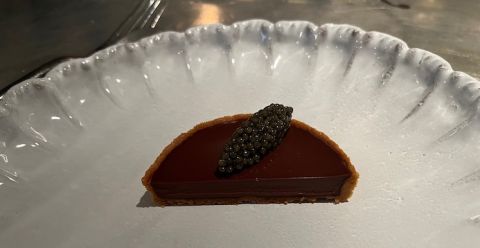
We skipped cheese. We enjoyed but could not finish two of the three desserts, a pink praline ice cream, homage to Mère Brazier, and a large madeleine that Verjus dreamt up on holiday in Greece. But I fell head over heels for the third: half a round of a chocolate tart, infused with capers to cut its richness, and topped with a spoonful of Oscietra caviar. The saltiness of the caviar matched that of the capers while the richness of the chocolate made a spectacular finale.
The menu at Table has evolved over the decade. ‘In 2013 I opened here as a neighbourhood restaurant with a 25-euro lunch menu and à la carte in the evening. It had to be simple as I was on my own. After three years I was able to hire a few staff and grow up a little so that by 2017 the menus were more confident and I was able to bring together more staff. In 2018 we were awarded our first star ...’
‘Then Covid struck and all my kitchen staff, with the exception of Giuseppe [one of his chefs], left but this presented me with an opportunity. I was able to hire really good staff and from September 2021 to really go for fine dining. We closed on Saturdays, Sundays and Mondays and I doubled my menu price and in 2022 we won our second star’, he finished with his trademark laugh.
I wondered whether Verjus’s achievements had come from his many years as a customer? ‘I do believe that by writing the menu every morning I am always designing a restaurant I would like to go and eat in. I am always on the customer’s side. It is my 30 years as a restaurant-goer that have led me to where I and Table are today.’
My final question to Verjus was perhaps the simplest: would he recommend other 50-year-olds following in his footsteps? ‘Definitely’, came his emphatic response, ‘as long as you have the passion. You do meet some amazing people.’
A coda
My editor, boss and wife has asked me to set out the reasons why I so much preferred my meal at Table to that of Alain Ducasse at The Dorchester a few weeks ago.
There are of course numerous similarities between the two. Top-class chefs have to underpin their expensive menus with similar, expensive ingredients: foie gras, caviar, expensive cuts of fish, shellfish and lashings of truffles.
And, rather like the Morecambe & Wise sketch where Ernie tells André Previn that he is playing the notes of Greig’s Piano Concerto correctly but not necessarily in the right order, the order that the ingredients are displayed is down to the chef.
At Table, I believe, the order was more exciting than at Ducasse. As was the setting, although I realise that I am comparing a small Paris restaurant with a much larger one in London. And for me there was the added two bonuses in Paris of being so close to an open kitchen and watching the shrimps being peeled, for example, and being able to thank the chefs personally as they left the kitchen for their hour’s break between shifts.
But the biggest difference lies in the approach of the two chefs, both now in their mid sixties. Ducasse started young and has conquered most of the world, very successfully. Verjus arrived as a chef much later in life and will, I hope, remain happily cooking, watching and politely interfering for many years. This was the biggest difference.
Table 3, rue de Prague, 75012 Paris, France; [email protected]