As the world takes its first, very tentative, steps to towards a return to normal, we at JancisRobinson.com would like to stay ahead of the rest of the pack.
In the first of a series of articles therefore, I will be going back to various cities in which I have eaten extremely well, to ‘meet again’ certain individuals who made my visit so exceptional the first time.
My first stop would be the most challenging. It is Tokyo, a city I have visited on three separate occasions. But Tokyo is a city that is extremely difficult to get to know, I imagine, after even three years of living there: its language, its way of life, the inherent values and the customs of all the more than 20 million who live there. I barely scratched the surface.
Yet the food there is sensational. I may be the recipient of more than my fair share of recommendations but I cannot recall a bad meal on any of my trips there. From sushi at the old Tsukiji fish market; to a far more elaborate meal at Le Sputnik with Yujiro Takahashi, where he cooked an innovative menu that showed off his time spent in France; to a bourride of hata, or grouper, with a delightful garlicky sauce cooked by Jérôme Waag and Shinichiro Harakawa at their unusually named Blind Donkey restaurant. There have been many others and my reviews of these are to be found on a well-known wine website here.
But in the above cases what was missing was a personal connection with the chef or restaurateur, unlike the two memorable establishments described below.
The first nostalgic stop would be Robata Honten, almost hidden in a passageway that leads from the Imperial Hotel to the Tokyo International Forum. It has been located for decades in an area crowded with restaurants but this robata (translated as ‘fireside cooking’) shows its distinction by not having a plastic menu outside nor numerous photos of the dishes on offer. Instead, there was a tray of fresh vegetables by the door and a bottle of red wine.
These made me stop and peer through the window. And I can still recollect what I saw 12 years ago. Against a background of dark wood was a man wearing full chef’s whites and slightly behind him a tall woman wearing a kimono. As I wrote at the time, no restaurant I have seen, before or since, has more closely resembled a film set.
This man is Takao Inoue, who inherited this restaurant from his grandfather and father before him and has filled it with everything that he likes, including the paintings on all three floors. All the bowls and all the serving dishes have been made by friends of his from around Japan.
The food, which Inoue described as ‘Japanese family-style but not too traditional’ is displayed on about 25 different dishes close to the robata that is obviously Inoue’s domain. I can recall vivid salads, a lot of fish, and a series of hot dishes that included pork belly with hard-boiled eggs and a thick, utterly delicious, stew of oysters and enoki mushrooms.
When I last looked, Robata Honten was temporarily closed due to the city’s stringent COVID-19 regulations. But I fervently hope that it will survive. Inoue had put his heart and soul into this restaurant and on the night we had the pleasure of eating there, I realised that I had come across a consummate host – even though neither of us spoke a word of each other’s language.
The language hurdle was easily overcome at Mikawa, thanks to the presence of a charming and efficient translator. But it was what I enjoyed with my eyes – sitting, as I was, no more than a yard away from Tetsuya Saotome – that left the longest impression on me.
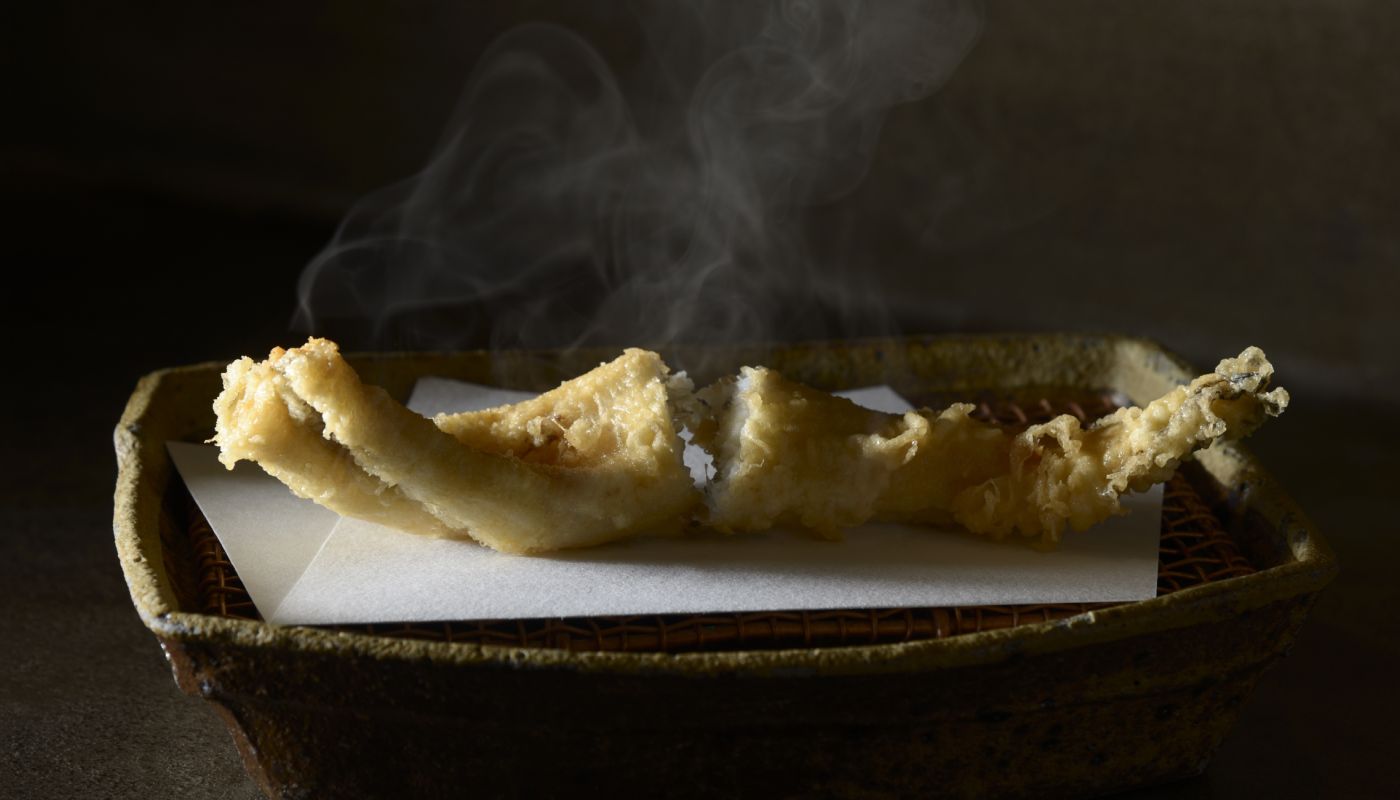
This restaurant is memorable because it has specialised in tempura cooking since Saotome opened it and during this time he has become a maestro with the nabe, or tempura pot, and a simple batterie de cuisine. While behind him a couple of young men cut the vegetables and fish into small portions, Saotome works his magic with no more than a whisk, a spatula and an innate sense of timing. Alongside are pairs of long-handled bamboo and metal chopsticks that, with a strainer, form his entire range of cooking equipment, while just below him are large tins of sesame and salad oils. As cooking techniques go, it could not be more minimalist.
This style of cooking is quintessentially Japanese and today can be found at its best at specialist tempura restaurants in Japan. Outside Japan, tempura invariably appears as a menu filler rather than the main ingredient. But it is a style of cooking that is unquestionably worth seeking out for anybody lucky enough to be travelling there. (Tempura Yamanoue is another highly recommended tempura restaurant in Tokyo.)
Food, like wine, does travel but food invariably suffers in the process. And the distinct pleasure of enjoying a style of cooking that had its origins in a particular country make it even more compelling. I have to say that I enjoy the freshness of tempura cooking, plus its versatility, as much as any other style – and how I wish I could enjoy the beauty of tempura cooking to the full without taking an overnight flight from London to Tokyo, when such a journey is once more allowed and free of form-filling.
‘I’m not frying’, I remember Saotome explaining, ‘but baking in oil and my role when the fish is in the pot is to calculate the right combination of air, water and batter. I think that I am able to see the scales on the fish that other people cannot see and then just coat each piece in the appropriate amount of batter. After that the trick is simply to count the seconds the fish should be cooked for.’ Like all artists, he made it all sound rather simple, hiding the many years of practice.
On his website (from which the image above is taken), Saotome looks as friendly, as wiry and as healthy as when I last saw him, and comments, ‘After 60 years I am finally getting better’.
Robata Honten 〒100-0006 Tokyo, Chiyoda City, Yurakucho, 1 Chome−6−3 8; tel: +81 (0)3-3591-1905
Mikawa 〒106-0032 Tokyo, Minato City, Roppongi, 6 Chome−12−2; tel: +81 (0)3-3423-8100. Currently open but with a shorter dinner service; reservations taken only by phone and in Japanese.