The chef sitting opposite me in his restaurant in downtown Portland, Oregon, looked the epitome of the young American chef.
He was bearded and wearing a baseball cap. He spoke enthusiastically of his passion for cycling. He spoke even more rapturously of the suppliers, farmers and food purveyors in this bountiful state in the Pacific Northwest. And his face really lit up when he talked about how, thanks to Franklin Jones, who created B-Line, two of these passions have been brought together in a sustainable delivery service that collects from over 200 producers and delivers their wares to chefs and retailers by non-polluting bicycle power.
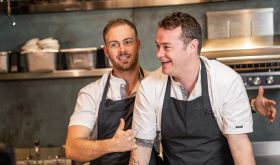
But the chef sitting across the table from me was no neophyte. He was in fact Greg Higgins, now a well-worn 56 year old, who for the past 21 years has been the chef-proprietor of Higgins Bar & Restaurant, and who during that period has been one of the principal actors behind the rise in this state’s reputation for great food and wine.
Oregon is a state I have long taken an active interest in. Back in 1981 I was the first, alongside Mark Savage MW of Windrush Wines, to recognise the quality of the wines then emerging from this state, and I shipped several wines directly, including Knudsen Erath, Eyrie and Adelsheim to feature on my restaurant L’Escargot’s first wine list way back then. They may not have been to everyone’s taste but they certainly provided the USP every restaurant needs when it opens.
Although we have passed through Portland in the intervening years, invariably en route to the annual International Pinot Noir Celebration now in its 28th year in McMinnville, our stay in the city has inevitably been brief.
This visit was to be no exception – in fact it was four hours only. While Jancis was at the tasting organised by Diana and Jason Lett of Eyrie to celebrate the 50th anniversary of the planting of the Willamette Valley’s first Pinot Noir, I was on a whirlwind tour that involved meeting several individuals, each as passionate as Higgins, each of whom offered fascinating insights into how and why Portland has become this magnet for food and wine lovers.
Our first stop was at the very relaxed Ned Ludd restaurant on Martin Luther King Jnr Boulevard in the north-east corner of the city currently undergoing a major renaissance. It has been home for the past three years to Jason French.
Short of funds as so many are, French took over a failed pizza restaurant with just a wood-burning oven but he has developed it with great taste. There is a particularly attractive outside seating area. And although the kitchen does not have gas, the menu has been cleverly extrapolated to incorporate a series of dishes that can be collated and then placed in the cooking utensils that are then finished in the oven. By choosing to name his restaurant after Ned Ludd, who led the Luddite anti-mechanical movement in early-19th-century Britain, he has nailed the restaurant’s flag to that of handmade craft. Ned Ludd is now, thanks to French’s vision, an American Craft Kitchen.
But it is what French has developed in the adjacent building that was to prove even more insightful. In this space French has created Elder Hall, a venue for classes, tastings, dinners and events that tips its hat in design terms to the 19th-century Shaker movement. Several of the walls are covered in colourful quilts and one wall is hung with several dozen wooden chairs whose backs are made up of those thin wooden spines that are invariably more pleasurable to look at than to sit in.
And it is here that French is able to put on various different culinary attractions that will far surpass the restaurant next door in profitability. This is particularly true, as French explained, thanks to the presence in the city of four major companies without whom business in Portland would simply not be of the same magnitude. These are Nike, Adidas, Intel and Wieden + Kennedy, the advertising agency that created the Just Do It slogan for Nike back in 1988. It is these companies’ bright young staff who have shown such enthusiasm for learning about and enjoying good food and wine.
While the inspiration for this business could not be more local, that behind my next stop in the Artisan Quarter got underway several thousand miles away when Ben Jacobsen spent some time in Scandinavia. During his time there he became fascinated by the local obsession for salt, an ingredient he had hitherto taken for granted.
Back in Oregon he spent three and a half years of trial and error trucking up to 1,000 gallons (3,785 litres) of sea water at a time back from over 20 different locations, each a 90-minute drive or more west of the city, until he found what he believed would be the best water for the salt he wanted to refine.
The treatment removes the magnesium and calcium, essentially the inherent bitterness, and after a week’s processing the salt water leaves the pure flake which Jacobsen supplies to over 300 professional chefs across the US, with English-born April Bloomfield of New York’s The Spotted Pig, perhaps his biggest fan.
Jacobsen is also now producing over 5,000 lb (2,268 kg) of salt a month in 12 different flavours combining his raw material with that of other local artisans. There is a coffee flavour with Stumptown roasters and his salt finds its way into Spielman Bagel Chips, Blackbird Granola and the pourable mustard from Mustard & Co in Seattle. But most addictive of all are the Salty caramels and Salty black licorice Jacobsen makes.
Standing extremely patiently next to Jacobsen in front of several pots of his luscious-looking honey was Damian Magista, whom I recognised immediately as a man after my own heart. For many years now our children have called me The Honey Monster but here was someone who had actually done something about his passion for this magical ingredient other than just consuming vast quantities of it like me.
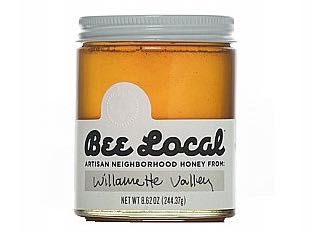
Magista founded Bee Local four years ago with one hive and since then Bee Local has gone from strength to strength as a consequence of the relatively unspoilt and varied terroir Portland and its environs can offer him. There are hives on top of four different hotels in the city that supply honey to their kitchens and their bartenders. There is a hive located within the Cameron winery in Dundee and a smoked cherrywood honey gently cold smoked by chef BJ Smith from the Smokehouse 21 restaurant. Magista used the expression ‘hyperlocal’ to describe his range of honeys, a word I could not better.
By this time, I was feeling very hungry. Our two-hour flight from San Francisco had offered little; there was only time for a quick mouthful at Ned Ludd; and in the former warehouse that is now home to Jacobsen and Magista my appetite had been piqued by pieces of baguette topped with salt and tastings of honey. But as I climbed back into the hugely comfortable, silent electric Tesla car kindly laid on by Travel Portland, driven unsurprisingly by someone with a beard and a black pork pie hat, I was optimistic that my appetite would be sated. I was en route to meet Brett Burmeister, the bewhiskered expert on food carts, Portland’s distinctive contribution to the gastronomic world.
Brett was able to explain with great enthusiasm how and why Portland’s food carts had evolved since the initial ones appeared 30 years ago in a parking lot near the renowned Powell’s book store. But my hunger was not assuaged, despite being surrounded by over a dozen food carts on rapidly developing SE Division Street that restaurateur Andy Ricker initially made a destination with his Pok Pok restaurant.
They began, quite simply, because the Portland city councillors adopted a highly progressive approach based on the simple principle that food brings people together in a way that nothing else can. Underpinning this was an equally liberal interpretation of the planning laws. As long as the wheels stay on the food carts, then their presence is interpreted as temporary – even though many have been on the same site for years – and, consequently, they trade to the benefit of all within the letter of the law. As I looked around this collection of about a dozen food carts, including a double decker bus now converted into a dress shop, I could see that they all had their wheels on – and sat comfortably on small piles of bricks.
Food carts have to conform to certain physical specifications. They are 8’ x 16’ (2.4 x 2.8 m) in dimension and capable of being coupled up to a nearby electricity supply, with a fresh water and a ‘grey water’ tank. The cooking is done on propane gas and all the preparation of the food is carried out within the cart. What they serve the food on should be compostable and biodegradable – this is Oregon, after all – and because customers place their orders and then wait for it to be cooked, anyone who works in a food cart has to combine the following physical and mental capabilities in my opinion: physical strength; good hand/eye coordination; not a trace of claustrophobia; a very strong voice with which to shout out the customer’s name when their orders are ready; and, of course, a permanent smile.
I sat opposite Brett in the fading spring sunlight on the communal tables in the centre of this pod, surrounded by carts selling pizza, Ingrid’s Scandinavian desserts as well as my first introduction to the cooking of Belize from a cart started by a couple who had taken their honeymoon there. Their biggest sellers were Belizian chicken with roasted red pepper tri-tip and stewed red beans in a coconut curry. But the clock was moving on and I, alas, had to too if we were not to miss our plane back to San Francisco.
Before taking off for the airport I only had time to call in to the hugely popular bar of Greg Higgins’s restaurant, to shake hands with one of the men who started this culinary advance, and to enjoy the merest suggestion of his food.
Higgins spoke modestly but with great pride of all that Oregon has achieved with now over 20 artisanal cheese producers, 500 wineries and one dedicated couple in Canby who now produce 300 different top-quality crops from their 10-acre site during the course of a growing year.
I was intrigued by the reference on Higgins’ menu to Hama Hama oysters. He described this family-run company on the east slopes of the Olympic peninsula as coming from their own ’merroir’, an aquatic counterpart to terroir.
We checked our watches and there was just time to order one portion of Hama Hama oyster chowder with leeks, fingerling potatoes, garlic croutons and chive butter. It was unquestionably the best oyster chowder I have ever tasted. Plump oysters, great acidity in the chowder, and a lovely crunch from the croutons all contributed to a terrific dish. But it was served so hot that I had no time to finish more than half of it before my departure.
I left hungry and, as a result, I look forward to our next visit to Portland, Oregon, with an even keener appetite.
Higgins Restaurant & Bar 1239 SW Broadway, Portland; tel 503 222 9070
Ned Ludd 3925 NE Martin Luther King Jr Boulevard, Portland; tel (503) 288 6900
FOOD TOURS IN PORTLAND
Cycle Portland Bike Tours – Foodie Fieldtrip
Pedal Portland – Food Carts Tour
Portland Walking Tours - Epicurean Excursion, Flavor Street and Chocolate Decadence