So goes the first line of the well-covered 1961 song by the doo-wop band The Drifters. And there, in a line, is our relationship with sweet wines. Sweet wine for sweet food. Particularly very sweet wine.
Occasionally someone will trundle out a sip of Sauternes to go with foie gras, normally accompanied by a great dollop of some sort of marmalade. And of course, we’re all well versed in the cheese-board sweet-white-wine pairing. But our imaginations and boundaries, when it comes to sweet white wines, don’t stretch much further than that.
Undaunted, Wines of Hungary UK, chef Jonny Lake and Master Sommelier Isa Bal (of Trivet restaurant in London, both ex Fat Duck) took on the challenge to test their own, and our, imaginations and boundaries with a sweet Tokaj lunch. Not only are we talking sweet wines throughout an entire six-course lunch, but we’re talking about some of the most concentrated sweet wines in the world. No Kabinetts and feinherbs here – these were mostly full-on Aszú 5 and 6 puttonyos wines: at least 150 g/l of residual sugar in each one.

Bal (his wild curly fanfare of hair in complete contrast to his quietly spoken persona) seems to have embraced the whole idea with relish. When it comes to eating, drinking and food-pairing, we are, he told me, limited only by our prejudices and misconceptions. ‘We think that we cannot eat something delicate after something spicy; we think we cannot drink dry wine after sweet wine; we think we cannot have very sweet wine with a main course. This is not true. The human palate is more flexible and powerful than most of us realise.’ He certainly gave us the chance to scrutinise his theory.
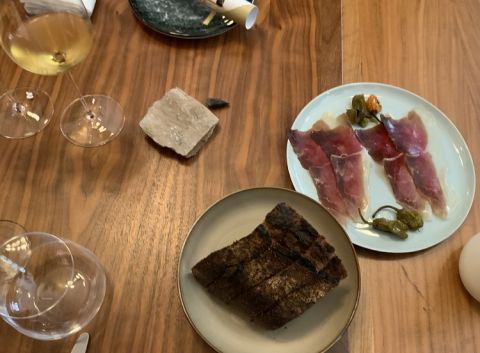
The meal started with thin slices of mangalitza ham. If you haven’t tasted this ham, you need to drop everything including this article right now, and find out how and where to get hold of it – not only is it knee-bucklingly delicious, but the fat (sweet, nutty, umami, so silky you want to wear it to bed) is actually good for you. This was served with heritage-wheat sourdough bread and delicately smoky pickled chillies. They were paired with Juliet Victor Szamorodni 2017 (188 g/l RS) and Patricius Aszú 6 Puttonyos 2017 (212 g/l RS). It’s no surprise that both wines went well with the charcuterie – intense, salty-sweet cured pig is always delicious with a drizzle of honey or a smear of apricot jam. The big surprise for me was the pickled chillies. They were mild, to be fair, and had clearly been pickled in a sweet pickling, but until I tasted it, I would never have argued for an Aszú with pickled chillies! Intrigued, I got home and tested out an Aszú 6 Puttonyos with some little cornichons and, sure enough, the combination worked!
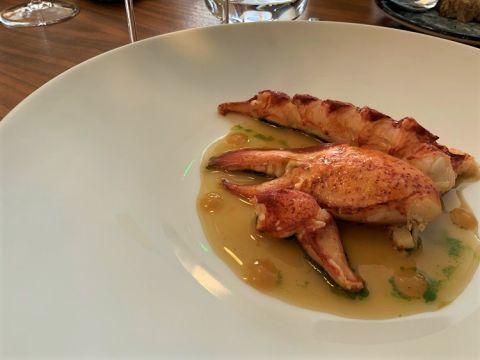
The next course was ‘lobster in a spicy nage’. Our table had to Google ‘nage’ – a broth used for poaching delicate foods, I’ve now learned. The lobster was delicate, the spicy nage was delicate. I don’t know what was in the nage but the dish pinged with lime and lemongrass citrus notes. With this, Bal paired Barta Öreg Király Dűlő Aszú 6 Puttonyos 2016 (245 g/l RS) and Royal Tokaji Gold Label Aszú 6 Puttonyos 2016 (188 g/l RS). The two wines were very different. Barta, despite having considerably more residual sugar, was piercingly fine, very racy, almost as delicate as the lobster. It made an exquisite pairing. Perhaps one of the best pairings of the whole meal. The Royal Tokaji was a Notting Hill Carnival of fruit – a tropical-fruit bomb. Mango, pineapple, passion fruit, so explosively ripe that it felt as if it was dripping down my chin. It overwhelmed the dish. Too big, too dense, too tropical. Looking at the tech info afterwards, it’s interesting to note that the total acidity on the Barta is 13.2 g/l vs Royal Tokaji at 10.9 g/l, and the Barta is just 9.36%, Royal Tokaji 11% alcohol. Perhaps those disparities made all the difference?
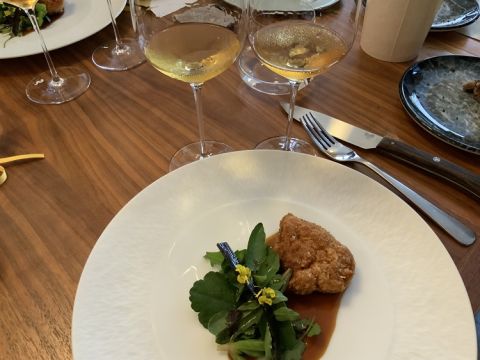
The third course was ‘crispy veal sweetbreads, wild herb and confit kombu salad’. It was served with an umami-rich, very sweet jus that tasted like balsamic vinegar, mirin, sake, soy and miso (although I don’t know what was in it!). By itself, the jus was almost too sweet, but tasted with the spicy, sorrel-sharp, peppery leaves, the balance of the dish was perfect. The wines for this were Tokaj-Hétszőlő Aszú 6 Puttonyos 2017 (RS 154 g/l) and Zsirai Aszú 6 Puttonyos 2013 (RS 182 g/l). The Hétszőlő is unusual, and interesting, in that it’s a 100% Hárslevelű Aszú; most Aszú has a high percentage of Furmint, which provides the acidity, drive and backbone of the wine. A rich, weighty, crêpe-de-Chine wine tasting of papaya, ripe cantaloupe and dulce de leche, it lifted the dense, sweet, umami power of the food and played ping-pong with the peppery leaves. The Zsirai, with very slightly higher acidity but tasting of orange marmalade on dark-toasted rye bread and pecans in cooked-orange syrup and even a little smoky, synchronised with the dish in a totally different way. Instead of lifting the dish, it echoed the flavour notes, like two tenors singing the same song together. The wine and the food seemed to melt into each other, lines blurred, boundaries lost.

Course four: pigeon and persimmon, the menu said. It wasn’t quite that simple! It came with little purple Savoy cabbage leaves, carrots, thin slices of roasted persimmon, and a kind of meat-herb-grain croquette, all dressed in a glossy, savoury-sweet reduction that I suspect may have had some Aszú wine in it. The pigeon was medium rare but buttery tender, the cabbage was only just cooked with a bit of chew, the persimmon had a nudge of tannin, the carrots were cooked to the perfect point between crunch and confit, the croquette was crisp on the outside and melting on the inside.
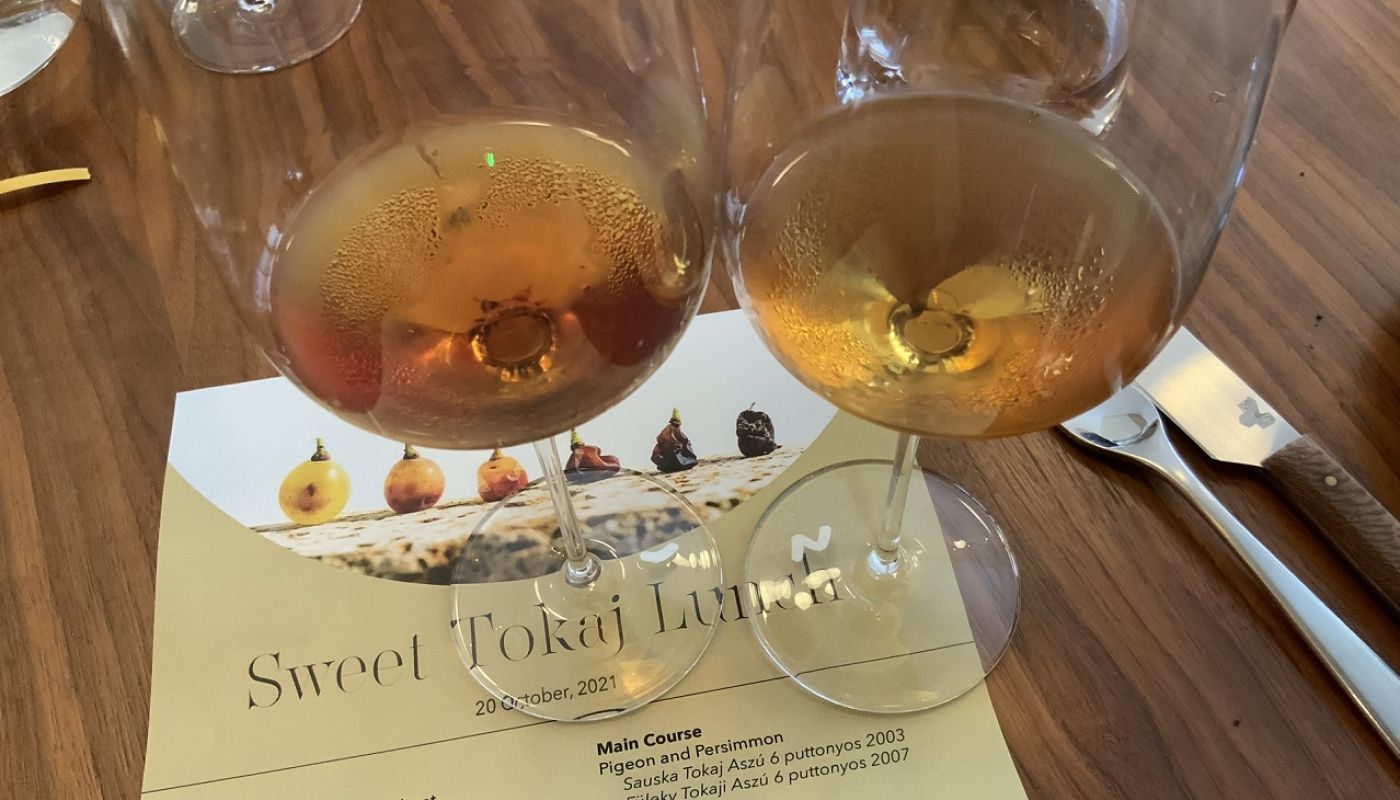
Bal’s choices here were Sauska Aszú 6 Puttonyos 2003 (RS 222 g/l) and Füleky Aszú 6 Puttonyos 2007 (RS 201 g/l). The Sauska, which apparently has some Muskat in it, smelt of roses pressed into quince paste, tasted of dried cherries in prune juice, of rose-water syrup, of dried apricots and even a tiny touch of chocolate and coffee. For an 18-year-old wine, it was staggeringly fresh and fragrant but it also had tremendous texture. When tasted with the food, the two seemed to take each other’s intensity to a new depth, almost as if daring each other to go higher, longer, deeper, bolder. The texture of the wine gave extra grip to the textures of the dish. The Füleky was all oranges and peaches, peaches, peaches, with acidity that seemed far higher than 7.3 g/l. It etched all the elements of that autumnal, gamey dish into sharp relief, adding a piquancy that seemed almost contradictory, if not impossible, for a wine with 200 grams of residual sugar.
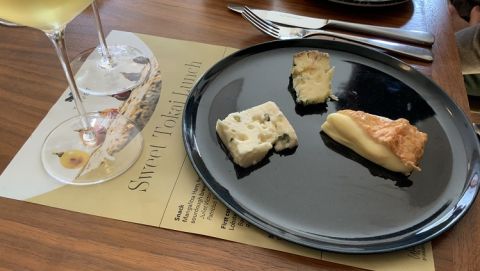
Cheeses came next, along with Isa Bal’s curveball. On the plate, Roquefort, Coston Basset Stilton and Époisses. In the glass on the left, Chateau Dereszla Aszú 5 Puttonyos 2017, RS 169 g/l. In the glass on the right, Pajzos Megyer Dry Szamorodni 2011, RS 2.2 g/l. NB, dry. Bal encouraged us to taste the wines from left to right. Sweet wine first: 169 grams of residual sugar followed by two grams.
Before I go any further, a word about Szamorodni. This is a traditional style of Tokaj made from late-harvest grapes that are a mix of very sweet, raisined and botrytised. It’s unlike Aszú in that the grapes are whole-bunch picked (Aszú is selected and picked berry by berry), whole-bunch soaked for 6–12 hours and then pressed and vinified. From here, winemakers can make two styles of Szamorodni: sweet (édes) or dry (száraz). The édes has 50–100 g residual sugar and is aged for at least one year in barrel and at least one year in bottle. The száraz is unique. It is fermented to dryness and then aged for a minimum of six months under a layer of flor, although most producers keep it there for two years, often many more. The flor means that the wine develops a salty, nutty character, the grape varieties and volcanic soils give the wine stunning freshness, minerality and acidity, and the late-harvest picking and botrytis bring an intensity of fruit and flavour. The wine has been compared to sherry and vin jaune, but it’s different from both. It is, as I said earlier, unique.
The Dereszla reminded me of honeyed nut butter with masses of clementine and long, lime-bright acidity. Tasting less sweet than some of the preceding 6 Puttonyos wines, it seemed to emphasise the saltiness of the Stilton to an almost uncomfortable degree, called attention to the molten texture of the Époisses (mirrored in the wine) and was simply heavenly with the Roquefort.
The Megyer Száraz Szamorodni was, at first, a shock. But, just as Bal predicted, my palate adjusted within seconds. Perhaps simply because I had been told it could. It was instantly clear why people compare it to Jura, but instantly clear that it was from Tokaj. Bone dry, salty, almondy, but stamped with the sharp silhouette of Tokaj’s apricots, marmalade, honey and lime. When I tasted it with the Stilton, I wrote down one word: Kerpow! The cheese seemed to uncover a sweetness and rich depth in the wine and together they were a stunning combination. The pairing with the Époisses accentuated florality in the cheese and the nuttiness in both the cheese and the wine. Given the choice I might have opted for the sweet wine rather than the dry, but the pairing worked. When it came to the Roquefort, however, the sweet wine triumphed, hands down.
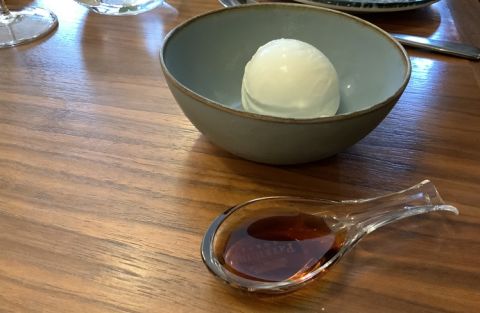
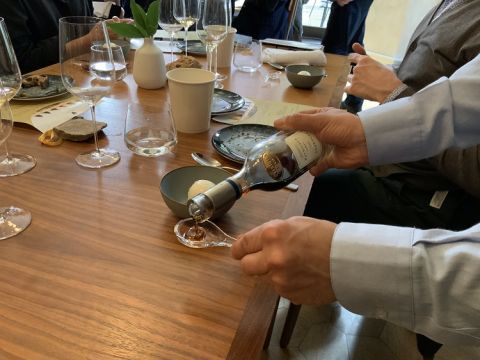
Dessert was a yogurt gelato, grainy, tangy and (perhaps because of the acidity) not particularly sweet. It was served with an elixir that was more an all-body experience than a wine: the Patricius Eszencia 2000. With 618 g/l of residual sugar, just 2% alcohol and 11.5 g/l of acidity, this thick, dark amber-brown wine was served in a glass spoon. Just dipping the tip of your tongue in it is almost enough. It’s almost impossible to sip. It was a genius combination. The cool gritty sourness of the gelato curved into the fierce silky syrup of the wine, white/dark, yin/yang, a canvas for the masterpiece.
The hubbub in the room spoke to the thought-provoking, defiant nature of the project. This wasn’t simply a food-pairing wine lunch. It put Tokaji Aszú in a different light. And while most of us agreed that we wouldn’t opt to drink very sweet wines with every course of a meal, that was not the point of the exercise. What it did prove was that Tokaji Aszú is not just for dessert.
All photos are taken by Tamlyn Currin.
For tasting notes on the wines discussed here, among many others, see The sweet spot of central Europe.