
There is really one word that accurately describes the three-day Barcelona Wine ‘Week’ which this year featured 1,300 wineries and attracted 27,000 wine professionals, and that is ‘stylish’. From the manner in which many of the participants dressed at the opening night reception (pictured below) to the temporary restaurant set up in one of the two exhibition halls which featured three different chefs, this trade fair was an impressive display of Catalan style and confidence.

It was also an occasion for us to catch up with old friends. We first met the chef Ferran Adrià almost 30 years ago on our initial lunchtime visit to his world-famous restaurant El Bulli on the Costa Brava. We stayed in touch. He once came to our house for dinner when I cooked roast grouse – he ate everything on his plate before I had finished serving everybody else and had sat down – and he once christened JR ‘the Pope of wine’ (inaccurate on sex and religious grounds). When Ferran Centelles mentioned that we would be in Barcelona he asked to join us for dinner. But whether it was our company or Ferran’s choice of restaurant that was the driving factor was something that I never found out.
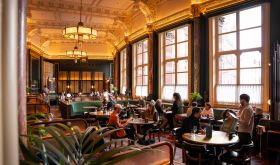
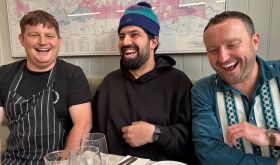
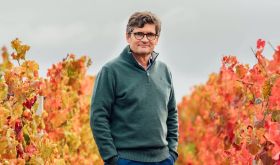
Al Kostat’s entrance is unusual to say the least. The restaurant is on the first floor and to gain access you must buzz to have an ornate, extremely discreet door at street level opened. Then it is up a handsome, elegantly lit staircase with no obvious sign of the gastronomic highlights to come and into the most unusual restaurant layout. The building is owned by Moritz, the Catalan beer company, and run by chef Jordi Vilà (below), who somehow manages to operate two restaurants in the same open space and from the same open kitchen.

Immediately in front of it to the right of the entrance are a handful of smartly laid-out tables with white tablecloths. These constitute the alkimia part of the restaurant, which offers a set menu (dinner €184, lunch €110) and has earned a Michelin star. To the left are the tables which constitute the al Kostat part of his restaurant. Here there are no tablecloths; the backdrop is a series of images projected onto the walls; and the cooking is traditional Catalan.
While I was trying to absorb all this, Adrià opened with a question, the first of a non-stop torrent of impassioned speech, mostly in Catalan which poor Ferran Centelles had to translate all through dinner. ‘What is the most common Spanish food preparation?’ he wanted us to guess, continuing ‘one that is used all over the world but the Spaniards rarely claim as their own?’ We were stumped and remained so until Adrià triumphantly told his answer: mayonnaise, the wonderfully creamy dressing that takes its name from Port Mahon in Minorca where the French won a rare naval battle against the British in 1756.
The menu for al Kostat (which translates as ‘next to’) was handed over by our attractively attired waitress and I just managed to smuggle mine into my bag as we abandoned all responsibility and left the ordering to Adrià. He seemed happy to do so while we asked Ferran to choose a bottle from the expansive wine list with wines from all over the world; soon, a bottle of fully mature white Rioja, Viña Gravonia 2011 from López de Heredia, arrived, delighting everyone.
The menu is typically Catalan. It is vast, about 40 choices with an added section headed ‘Now we’re cooking with truffles’ since Spain, predominantly around Teruel, is now the biggest producer of truffles in the world. Several of the dishes began with the vegetable first. There was humour. One dish is described as served with ‘whatever the sea offers us – which is plenty’. Credit is openly attributed with one dish described simply as ‘Pierre Koffmann’s pig’s trotter’.

We began with dishes that exhibited the kitchen’s ability and Adrià’s influence. Rings of the freshest squid were covered in the thinnest of batter, promptly fried and served with a bowl of mayonnaise. Green beans arrived with potato and perol sausage, a speciality of Girona. These are then followed by an even simpler and even more delightful dish. Tiny fresh peas (pictured above), hardly bigger that one of those annoying little white balls that Styrofoam crumbles into, had been sautéed and served with a thin slice of pork fat. They are sweet, delicious and silenced the four of us – quite an achievement – as we devoured them. Then came a ‘deconstructed’ cannelloni (pictured below) – silky flat pasta, just a little meat sauce and a cheesy bechamel almost invisible beneath a mass of grated black truffles that was so good it had all four of us almost licking the plate clean.

It was at this stage that Vilà came to our table. He is muscular, with a constant smile, and was acutely concerned that we were enjoying ourselves. He hurried back to his busy kitchen. Adrià is aware of his own influence but remains extremely modest. El Bulli’s fame brought the end to France’s dominance in cooking, while its closure in 2011 opened the position to chefs from all over the world. His own renown inspired a wave of young chefs from all over Spain and encouraged many, including Vilà, to look again at the cuisine of Catalunya, a region that has virtually everything on its doorstep: the mountains, the sea and plenty of vegetables for the kind of cooking that most appeals to the many guiri, local slang for the tourists who flock to Barcelona.
It was now 11 pm and it had been a long day for us that began early in London and fatigue was beginning to set in. But I would welcome reports on Vilà’s crema catalana (my favourite dessert) from anyone fortunate enough to eat at al Kostat.
The following afternoon, Ferran Centelles, who knows I like to eat local, presented me with the difficult decision of which restaurant to eat in that night. The two possibilities were very different. El Passidis del Pep has been renowned for the past 40 years for its seafood while the Basque restaurant Maitea (pictured below) has a slightly homier feel. But it was being told that Maitea also attracted many of the local wine producers that made my decision for me.

This reputation proved correct. We walked into what transpired to be a U-shaped restaurant with the initial run comprising a long bar counter and tables for two with the kitchen at the far end opening out into a more conventional restaurant space with numerous tables laid up for the larger parties expected that evening. I loitered, taking in the atmospheric artwork everywhere. Maitea takes its name from Maite, the mother of current maître d’ Nico Montaner, who was born in San Sebastián before moving to Barcelona. Montaner smiles continuously and wears his Detroit Cowboys T-shirt with pride.
When I had arrived at our table I looked around and the first person I saw was Jesús Barquín of Equipo Navazos, a professor of criminology and a fellow sherry lover. The meeting had the effect of choosing our aperitif for us.

Our table was soon covered in pieces of paper. There was the double-page menu with pintxos (Basque answers to tapas, glistening example above) on the left-hand side and numerous larger dishes on the right, Then there was the list of specials, the list of seasonal ingredients which included calçots, the much-prized local speciality that is a bit like refined leeks which were just in season. Then there was the impressive wine list from which we enjoyed an elegant Albamar Albariño 2023 and a delicious Els Escorpins Garnacha 2023 from L’Enclòs de Peralba, made by the current generation of the Gramona family.

The deftness of this kitchen’s cooking was highlighted by two dishes. The first, a pinxto, was described as ‘cod with mayonnaise’ (above). It required considerable skill when eating it. The freshness of the cod, the slipperiness of the mayonnaise, and the crispness of the bread combined to make the inevitable licking of the fingers as enjoyable as the first bite.
Then there was an omelette stuffed with calçots that constituted a creamy-but-firm egg envelope wrapped around crunchy pieces of calçots, the plate swept clean of this delightful combination with pieces of crisp baguette. We ended with a txuletón, the traditional Basque cut of steak (raw, below) with excellent fries and plenty of salt.

I left Barcelona impressed by these two restaurants, the confidence of their cooking matched by the relaxed nature of the service. And at 11 am the following morning at the airport I was equally struck by the long queues of Chinese tourists waiting to board planes back to Shenzhen and Beijing. The Chinese are famously keen on their food
Al Kostat Rda Sant Antoni 41, 08011 Barcelona, Spain; tel: +34 932 076 115
Maitea Carrer de Casanova 155, 08036 Barcelona, Spain; tel: +34 934 395 107
Photo at top and of chef Jordi Vilà courtesy al Kostat.
Come back next week for Jancis’s report on the Barcelona Wine Fair. If you need any Spanish wine to tide you over until then, check our tastings note database, where there are nearly 14,000 Spanish wine reviews.