Part 1 – Prosecco then and now
This piece is different. I usually try to be non-technical, because I love amateurs, not technicians. An amateur is someone who ‘passionately loves’ a thing, a technician is a ‘very skilled worker’. I hate working, I love passion: welcome to Italy. This time I have to make an exception because I have to convey, as a direct witness, the way Prosecco is changing, so I will be compelled to use some technical words and concepts which I wouldn’t use while relaxing outside the Bar Centrale with friends.
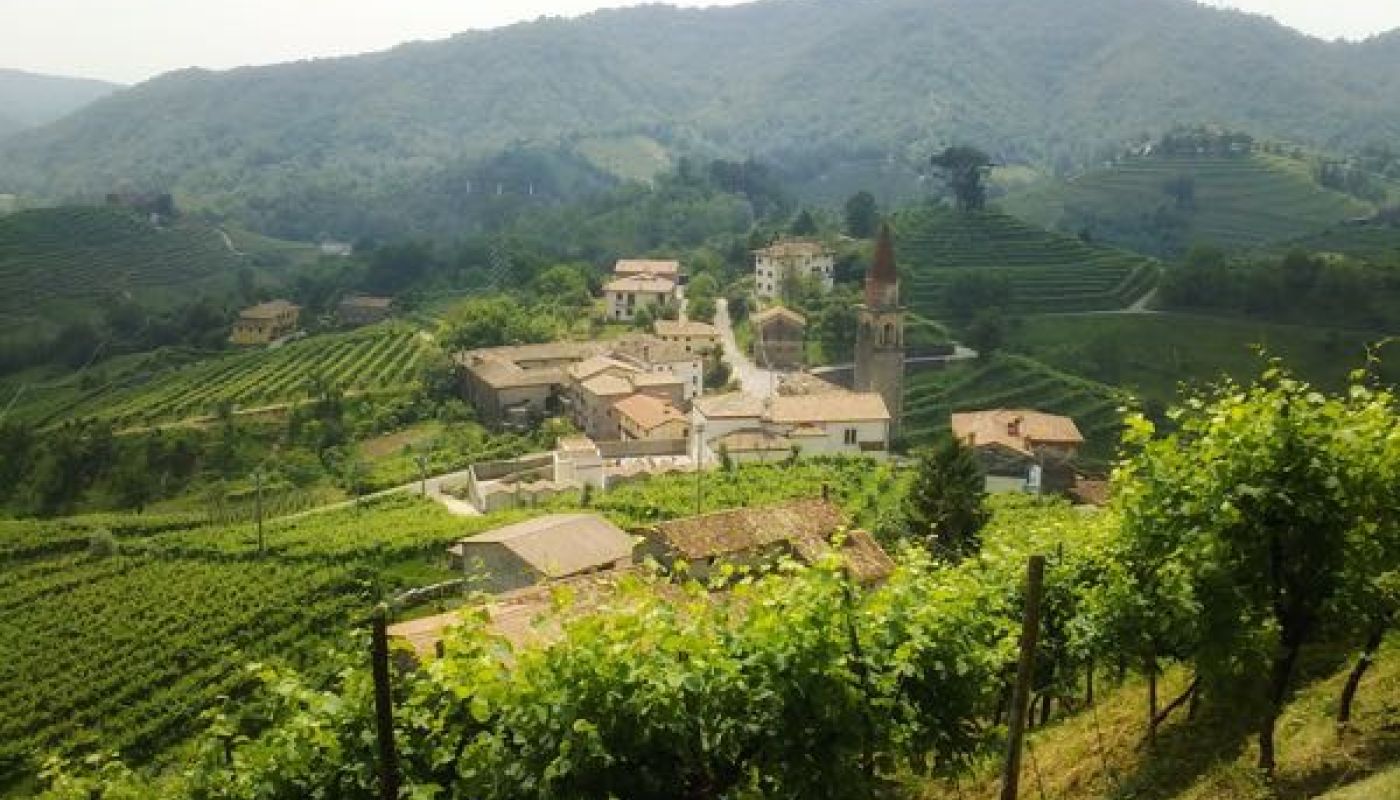
I live in the Asolo DOCG Prosecco Superiore zone. Our territory is, along with the most famous Conegliano Valdobbiadene DOCG Prosecco Superiore appellation, the premier cru territory inside the greater DOC Prosecco, which covers all of Friuli and almost all of the Veneto, say the whole north east of Italy, producing massive quantities of solid, cheap ‘entry-level’ Prosecco, which is going to invade the world. (Not buying? Close to 50 million bottles produced in 2006, close to 500 million bottles produced in 2016.) These two DOCG zones are very different from the DOC zone, in just about every repect. Here we are in the hill zone of northern Veneto, close to the Alps. Here the vines are exposed to extreme climate variations, the slopes bringing swings in temperature and humidity every day, with the ground always well drained. Exposure and soil composition vary from parcel to parcel but are always excellent for our grapes. (Above right are the slopes around the village of Rolle.) For these reasons, even a non-skilled taster will always easily be able to distinguish, in a blind tasting, one brother from the other.
So today Prosecco has two faces: inside the DOCG territory wines are more and more complex, refined, important, emotional and, inevitably, costly. In the DOC part, simplicity is the goal, yields are higher, and costs are low thanks to mechanisation (flat terrain, no steep hills). I am not saying that one is good and one is bad, they are both very good, for a very different use and expectation.
Things change. Twenty years ago Prosecco was an extremely undemanding wine: all the winemaker used the Charmat method, producing the very same wine with the very same technique. You could not distinguish one glass from 20 others made by different winemakers. Prosecco was Prosecco, full stop. The good side of this was that standardisation made the product recognisable, giving it a precise flavour, thus identity. Winemakers became quite rich because the product was good, cheap, recognisable and fulfilled a need. One might say ‘perfect’… However, taste, expectations and demand are constantly drifting: wine is nowadays less a commodity and more an emotion, and Prosecco, at least a part of it, has the potential to become quite fine indeed, rather like the process that is taking place in Champagne, in which a growing number of producers are shifting from ‘Champagne wines’ to ‘Wines of Champagne’ (the former can be found at the supermarket for less than €15). We have entered the ‘polarisation’ era, whether you like it or not.
Nowadays the sons (and daughters, more and more) of these ‘new-rich former peasants’ are clever, interested, passionate, energetic and, last but not least, eco-friendly. They all got a degree at some wine university, they traveled and saw different things. Consequently they know what they are searching for and, controlling wine techniques very well, they know how to get it. What’s more, they are not tied to centenarian traditions like their French cousins, so they began to study the old techniques as a starting point for finding some new ones. In the end, it is simply the ‘millennial generation’ who are creating their own ‘generation of wines’ for themselves to enjoy. It makes sense. This story is about the astonishing results of this search. But let’s start from the beginning, a very good place to start (as The Sound of Music tells us).
I searched a long time for the origins of Prosecco, which derives from the historical local grape varieties Glera Tonda (once called Prosecco), Glera Lunga, Verdiso, Bianchetta and Perera. It has been proved that Glera Tonda, Prosecco’s main grape, came from the Friuli-Venezia-Giulia region; a tiny village called Prosecco still exists very close to Trieste. Scholars are trying to trace the grape’s origin back to Roman times: a very dangerous exercise, something like creating the genealogy of a new king, which usually takes you back to King Arthur … something like the Roman origins of Pinot Noir in Burgundy, ha ha (Mr Hugh Johnson’s hit men are already searching for me). Anyway, let’s say that the wine we are talking about was really famous in this zone even before it was known by its current name since, say, the sixteenth century if not before.
Am I boring you? Time for colpo di scena [dramatic turn of events]: I came across real and unsinkable documentation about early Prosecco in the few sentences below, found when I was studying Casanova’s memoirs in the first edition translated from French to English under the title The Life and Memoirs of Casanova, published in London in 1849.
The setting is a brothel in Treviso, around 1746:
I told the landlady I wanted the best that could be procured in Treviso for supper, particularly in wines.
‘If you do not mind the expense, sir, trust to me, and I undertake to please you. I will give you some Gatta wine.’
…
We had a delicious supper. I had to teach Christine how to eat oysters and truffles, which she then saw for the first time. Gatta wine is like champagne, it causes merriment without intoxicating, but it cannot be kept for more than one year.
It was an emotional moment for me. In those years champagne was far different from today and not even known in Italy (Casanova lived in Paris for long time, so he knew), and Prosecco was already following close behind. This sparkling ‘Gatta’ wine had the same pros and cons of today’s Prosecco: fine, bubbly, but no ageing possibilities at all. That’s the same lack, the real limit of Mr Charmat’s method. The inventor didn’t succeed in improving the conservation of the product compared with the embryonic, classic methods. Something had to be done …
Part 2 – new-wave Prosecco and some examples
The Prosecco in Casanova’s times started with the ‘ancestral’ method, the same method used for the most traditional Blanquette de Limoux or Gaillac Mousseux: in autumn the cold halted fermentation; in spring the wine, not yet completely fermented, was bottled; the heat re-started the fermentative process inside the bottle, meaning pressure and bubbles. That’s all, including the strange habit of leaving the second fermentation lees inside the bottle. If you begin to drink them you may become addicted, like me. This method was used in our zone for more than 150 years, then in 1895 Mr Martinotti invented the re-fermentation method that involved adding to the base wine sugars and yeasts, using large closed vats – as if they were the largest bottle ever invented. Mr Charmat refined and patented the invention, so in the wine books he is the guy. The system was (and is) good for aromatic and semi-aromatic grape varieties, because it boosted aromas, delicacy and freshness more than structure. Glera and Moscato were the perfect candidates in whites, Lambrusco and Brachetto in reds. Thanks to Mr Martinotti and Mr Charmat, Proseccoland enjoyed another 100 years of plenty. But nothing is forever, and people’s attitude to wine (and food) roll in and out like the tide. Nowadays people no longer swallow one litre per meal (unless they are me). They drink for pleasure, not for thirst, so they begin to ask for more complexity, refinement and quality. Realising that the time was ripe, some years ago a powerful renewal movement kick-started, with the aim of giving Prosecco identity, character, structure and, above all, the necessary longevity to allow it to evolve. The results are, as I said, astounding.
Firstly they began to conduct the second fermentation in the bottle, as they do in champagne. But Glera is neither Pinot nor Chardonnay, and although the result was very interesting at times, the average consumer, who inevitably compared it with its ‘big brother’ (champagne) and found it not as good, did not want to buy it. Another way had to be found. In fact these producers found many ways and here are some examples (there are many others), with names in alphabetical order, to help you to navigate this exciting new wave. Try their top wines and behold, a new world will open up before you.
- Andreola: expanding, as many others, the ‘cru’ concept, parcels vinified separately.
- Bele-Casel: organic artisans. Boschera, a local grape, reappears to fight today’s lack of acidity. In a few years I foresee it crucially coming back. Sulphites, what sulphites?
- Bellenda: they produce ancestral, sur lie, traditional method, short traditional (Cava) method, extended Charmat. The first to dare to use wooden fermenters.
- Bisol: traditional method at best, and one of the best ‘Cartizze’ as well (Cartizze being the only Prosecco grand cru zone, 107 hectares). The company is partially owned by Ferrari of Trento.
- Bortolomiol: organic, working towards zero carbon footprint.
- Cirotto: a wonderful, but not for beginners, zero dosage traditional method.
- Col Vetoraz: the DOCG Superiore benchmark. Don’t go there on a sunny day. You may fall in love with the unique Cartizze grand cru landscape. And it will be forever.
- Dal Bello: their ‘Celeber’ is an emotional zero dosage Charmat.
- Silvano Follador: the pioneer. After years of research, he produces a partially fermented grape must starting from botrytised grapes. Ten years of wood ageing.
- Fratelli Bortolin: they make a single fermentation from the must to the bubbles, something like Asti method, sulphite-free.
- Loredan Gasparini: single fermentation lasting nine months with indigenous yeasts, character, finesse.
- Marchiori. The forerunner. All the five aforementioned historical varieties vinified separately, then balanced in different cuvées before the second fermentation. But also macerations, partial fermentations on grapes already fermented as per reds (part way to ripasso), indigenous yeasts. Above all: the study of vintages and ways of improving structure.
- Miotto: the ‘sur lie’ (somewhat ancestral method but with yeasts and sugar added before bottling, lees left inside) and ‘frizzante’ (pétillant) specialist.
- Merotto: he cuts off half of the yield 20 days before harvest, leaving the cut grapes on the vine, then harvesting all the grapes together, giving concentration, structure.
- Pat del Colmel: back from the past, using Rabiosa, Perera and Bianchetta, but also Recantina, a forgotten local red grape. Soon enough Prosecco rosé? Maybe.
- Ruggeri, alias Rotkäppchen-Mumm: their ‘Giustino B’ is an extra-dry world-class Charmat.
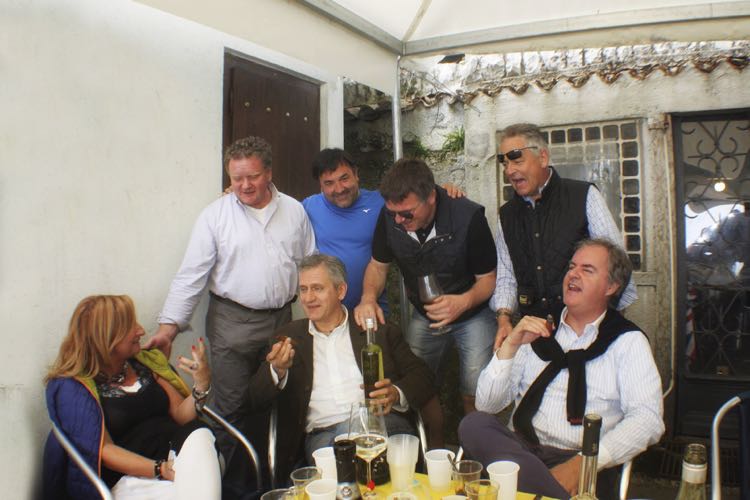
As you can imagine, me and my rat pack (below) tasted everything in liquid form, taking no prisoners: vat, bulk, barrique, demijohn, tank, bottle, jug, cup or glass, the results: 1% ‘whatthef’; 20% ‘mmph’; 50% ‘wow’; 20% ‘by gosh’; 10% ‘omg’; 1% ‘hallelujah’ (sorry, at Bar Centrale we forget the Parker scale). Anyway the situation is constantly evolving, so we are sadly compelled to repeat all the tastings, 24/7, all year long. That’s Veneto (Veneto means ‘blessed’…).
One of the most important goals is that Prosecco Superiore is, for the first time in history, grown up enough to put the vintage on the label and offer vertical tastings of several vintages – unthinkable only a decade ago. (You don’t believe me? Go to Merotto and ask for a five-vintage vertical. I did.) Another important thing is that some of these bottles actually surpass many champagnes in terms of complexity, finesse, emotion, and sometimes also price. If this is not a shift, what is?
In the future Prosecco will polarise even further. We’ll have the ‘historical’ Charmat Prosecco in the big DOC zone and, in the Superiore hilly DOCG land, the winner in the competition between the new methods I cited (and probably some brand new ones). No problem at all – there is space for both, the world is quite large. The advice I give you is to stay tuned and open minded, but probably you already are, if you got to the end of this article.
Thanks for your time.
















