The phrase ‘wine dinner’ must strike anyone reading a wine website as rather strange. After all, I hear you say, what is a dinner without wine? I am delighted to say I have little experience of wine-free dinners.
But wine dinners have been a singular aspect of life in the restaurant business for the past 50 years at least. They are the occasions when a restaurant will put on a dinner to highlight a particular wine or wine style or wine region or, increasingly, inviting someone from outside such as a wine producer, wine writer or perhaps even a wine author on a book tour to host the evening. In the northern hemisphere these events are called wine dinners while outside Europe they are usually referred to as winemaker dinners.
This is because in Calfornia, Australia, New Zealand, South Africa and South America wineries tend to produce the full range of wines, from still white wines to reds to sweet wines, so that each of the (invariably) four courses has a different accompanying wine from the same producer. In Britain wine writers are often asked to host wine dinners.
I recall our series of wine dinners in the 1980s at my restaurant L’Escargot in London’s Soho. In particular, one for 50 diners hosted by the late Edmund Penning-Rowsell at which we managed to serve Château Montrose 1961 as the highlight of the evening. We certainly didn’t charge more than £50 a ticket and managed to make a small profit (today a bottle of the same wine would cost around £645). In New York the Union Square Cafe has just held a wine dinner entitled Bordeaux’s Glory Days whose tickets cost $1,494. Hosted by podcaster Levi Dalton of ‘I’ll Drink To That!’, it featured four 2000 first growths plus six examples of the likes of Château Cheval Blanc and Vieux Château Certan back to 1982. Their next wine dinner in March will feature Napa Valley winemaker Cathy Corison.
Apart from being enjoyable, with any luck, wine dinners serve many a purpose. They fill a room, usually the private dining room of a restaurant, on an otherwise quiet evening. They may even yield a small profit. They test the chef and the brigade to cook a range of dishes to complement the wines. And, perhaps most significantly of all, they add to everyone’s wine knowledge, not just the guests but the restaurant staff.
But to ensure a smooth service wine dinners present a major challenge for the kitchen. Unless there is a separate kitchen to handle a dining room seating a usual minimum of 40, cooking for a wine dinner requires a complete change of approach for the normal restaurant kitchen. Most are designed to serve tables of a maximum of eight or at the very most 10. They comprise different sections: cold larder, meat and fish, which cook the dishes and then transfer them to the head chef who, standing by the pass, sends the food to the customers. The size of the pass is the usual limiting factor.
A wine dinner is much more demanding, requiring the same number of first courses, main courses, cheese and desserts. It not only requires a different approach, but also a great deal of space, a commodity invariably lacking in any professional kitchen. Forty first-course plates; 40 main courses, invariably all from the meat section; 40 plates of cheese (stacked, I seem to remember, in the walk-in cold store); and then 40 plates of dessert. I recall the scene in my restaurant kitchen where there were plates of food under covers everywhere I looked on the evening of a wine dinner.
To judge from my and Jancis’s inboxes, wine dinners are becoming more and more common – perhaps as the wine trade seeks increasingly to depend on hospitality (see Restaurants – the wine world needs them now). So I decided to ask chefs, winemakers and restaurateurs about them. I began with chef Chris Galvin, who recently put on a wine dinner featuring Garzon wines from Uruguay at Galvin Bistro that was £95 for a four-course dinner with wines, all served – he stressed – at communal tables.
I began by asking him, why have wine dinners been a feature at his four restaurants for the past 20 years? ‘Many reasons’, he answered.’Our passion for wine, to generate interest and a challenge for the chefs, sommeliers and the front-of-house team. For seasonal menus that link to the wines such as game, black and white truffles, caviar, and to highlight wine regions such as Beaujolais. Also, interestingly, we often choose the wine or grower first and the challenge is to create the food to complement them.
‘These evenings generate lots of fun, we often have the same guests returning (some for 20 years!). We have a grower or supplier to lead the presentation. They will sometimes move on from the private dining room where the dinner is being held to wander round the rest of the room sharing the wine with regular guests. It creates a real buzz with the team.’
‘And do wine dinners make money?’, I asked, to which came this careful reply.
‘We try not to lose money, but they create little profit. It is more about providing interest and a service to our guests, a point of interest for the sommelier team and chef who is challenged to think carefully about the food and wine combination. It helps Jeff [Chris’s brother, a fellow chef and his business partner] and me since the kitchen and the restaurant have to communicate and they actually enjoy it!’
When I asked who is the biggest winner from a wine dinner – the winery, the restaurateur or the customer – Galvin replied: ‘I would honestly say we are all winners. The winery because they can reach a wider audience with their produce and have their wines shown in the best light supported by a well-balanced menu and a knowledgeable person who hosts the event. The restaurant because it creates energy, interest and shows evolution. The customer because it is a great way to discover new wines or enjoy favourite wines served with carefully considered dishes, and access to expert knowledge. Often our guests will be invited to vineyards on the night and we have had many guests going on to visit these vineyards.’
Australian wine producer Michael Hill Smith MW explained, from Wine Paris which he described as ‘overwhelming’, ‘wine dinners are a popular way of a restaurant filling the room early in the week or during the cooler months. As far back as the 1970s Len Evans introduced Winter Wine Dinners at Bulletin Place, his Sydney restaurant, with this in mind. Often these dinners are subsidised to a degree by the wineries so the price generally offers good value to diners.
‘Stokehouse at St Kilda in Melbourne does a number of wine dinners during the year. We did a Tolpuddle Vineyard mini-vertical dinner with them about 18 months ago for around 120 people which sold out in a matter of hours, with a waiting list. They fill the entire upstairs of the restaurant and the dinners are quite liquid but with plenty of energy. Not all wine dinners are as big or as successful but they remain popular often with wine retailers as a way of selling wine to customers on the night in convivial surroundings. In Sydney, The International had a strong season of wine dinners throughout 2025 which I understand they plan to continue in 2026.’
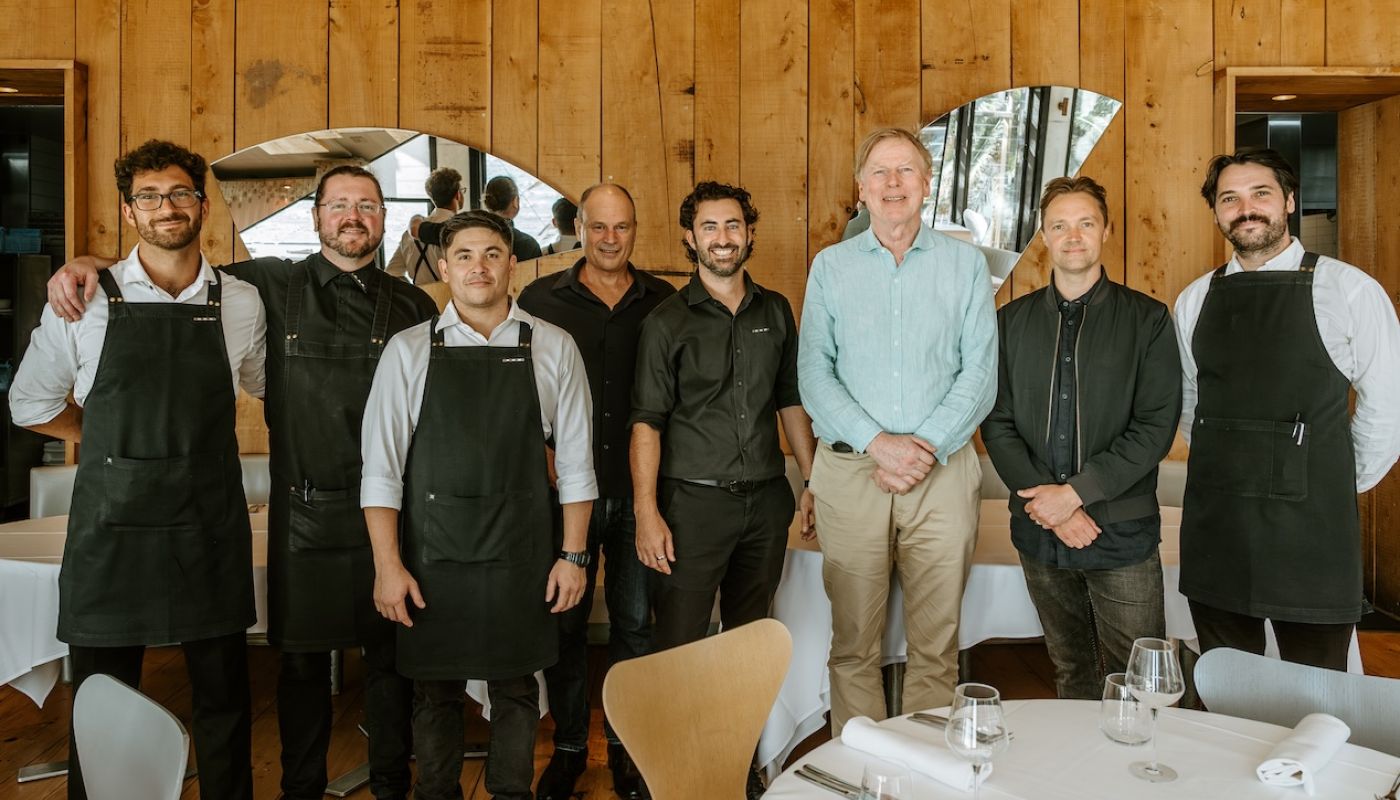
Hill Smith’s reference to Stokehouse, and the continuous rain in the UK, prompted me to email this restaurant in heatwave Melbourne. Madeleine O’Shea, their marketing manager, responded, ‘We host 3–4 large-scale wine dinners each year, alongside smaller, more intimate collaborations. Over the years, we’ve had the pleasure of welcoming producers such as Tolpuddle and Shaw + Smith, hosted by Michael Hill Smith, as well as icons including Vasse Felix with Virginia Willcock. We’ve also collaborated with wine writers like Jasper Morris (pictured above at a Stokehouse burgundy dinner with seven members of the restaurant team), and marked significant milestones through anniversary dinners – including 175 years of Yalumba and Pol Roger, where we were joined by Laurent d’Harcourt of Pol Roger.
‘In terms of who benefits most, we see these dinners as genuinely mutually rewarding. For us as a restaurant, they allow a deeper connection between winery and guest, using our dining room as the setting to bring the story, the wines and the people behind them together. The wines are offered to guests without the usual restaurant mark-up, allowing us to focus on creating a generous, considered food experience that complements the line-up. For wineries, particularly those visiting from interstate or overseas, the exposure and direct engagement with a highly engaged audience is invaluable. And for guests, it’s a chance to experience wines in a way that goes far beyond a cellar-door tasting, through thoughtfully matched food, rare access to winemakers, and a level of context and education that elevates the entire experience.’
I asked Morris about his experience of hosting wine dinners. He replied, ‘I love doing these dinners, on many levels. It is great publicity for my books and my website, and also remunerative. It also gives me a chance to talk about a favourite subject to people who want to listen and learn. The atmosphere is almost always really positive from the outset. The skill isn’t about preparing lots of information, but of making sure you are in kilter with the particular group you are speaking to. I find it very stimulating and they certainly raise adrenalin levels!’
Daniel Johnnes, the wine director of Daniel Boulud’s restaurant empire and the founder of La Paulée and La Fête du Champagne wine extravaganzas, reported thus while travelling between Mexico City, where he is planning a wine dinner, and his home in New York. ‘My first wine dinners were at Montrachet restaurant in New York in 1985. From then on these dinners featured Jacques Seysses, Aubert de Villaine, Dominique Lafon, Roumier and many more who, believe it or not, were not that well known in New York at that time. From 1988 to 2000 I hosted hundreds and then I founded La Paulée.
‘No one gave me the idea. I was passionate about wine and we were garnering a pretty good wine clientele. I wanted to create an experience for them, to give them reasons to come back.’
My last question was this: what advice would you give a restaurateur or sommelier planning to organise their initial wine dinner? ‘Make sure’, Johnnes continued, ‘it’s based around a wine that you are passionate about as your enthusiasm will have a great influence on the outcome of the dinner. Make sure that you serve food of the same quality. And watch your costs closely. Rising costs – the private dining room, the cost of the food and the wines – are making it difficult to arrange these dinners. But it is possible and the market is there, eager for wine knowledge.’
Long may this continue.